How to Future-Proof Your Test Automation Pipeline
Build a test pipeline that stays fast, reliable, and useful as your system changes, with practical guidance on test levels, flaky failures, data, and CI gates.
A future-proof test automation pipeline is one that continues to give fast, trustworthy feedback as your architecture and risks change. Put quick, isolated checks early; use contract and integration tests to verify boundaries; reserve end-to-end tests for critical user journeys; and run broader regression and non-functional checks at a cadence that fits their cost and purpose. Measure feedback time and reliability, make failures diagnosable, and regularly remove or repair tests that no longer earn their maintenance cost.
There is no universal test-pyramid ratio or vendor that can guarantee this outcome. Treat the pipeline as maintained software: review it when the system, production risks, or team needs change. The UK Home Office describes the test pyramid as adaptable to complexity, safety needs, time, and resources, while recommending early testing, integration checks, practical automation, selective end-to-end coverage, and metrics. Home Office test-pyramid guidance
1. Define what the pipeline must protect
Start with risks and decisions, not a target test count. For each important user journey or system boundary, ask what could fail, how costly that failure would be, which check can detect it, and how quickly the team needs the answer.
- List critical outcomes. Include business-critical flows, data integrity, authorization, integrations, and deployment behavior.
- Map existing checks to those risks. Identify gaps, duplicate assertions, tests that cover implementation details, and checks with unclear ownership.
- Choose the cheapest check that gives adequate confidence. Test local logic close to the code; test a boundary with a contract or integration check; use an end-to-end journey when behavior depends on the real combination.
- State the pipeline decision. For each stage, say what runs, what blocks progression, who investigates failures, and what evidence is retained.
Coverage percentages and test counts can reveal trends, but they do not show whether a high-risk flow is protected or whether a failure is trustworthy. Connect checks to behavior and risk, then use coverage data as one diagnostic signal.
2. Balance test levels by cost and confidence
| Test level | Best fit | Trade-off | Typical placement |
|---|---|---|---|
| Unit | Local rules, transformations, and edge cases | Fast and focused, but cannot prove that real dependencies work together | Every change |
| Component | A service or module with controlled dependencies | More realistic than unit checks; setup and state need care | Every change or pull request |
| Contract | Expected request and response behavior across a service boundary | Checks compatibility, not every runtime behavior of the full system | Pull request or integration stage |
| Integration | Important interactions with databases, queues, or external services | Can be slower and more environment-sensitive | Pull request or pre-deployment |
| End-to-end | Critical user journeys and high-risk combinations | Costly, slower, and often harder to diagnose and maintain | Small critical set on changes; broader set later |
| Non-functional | Performance, load, stress, security, resilience, or accessibility risks | Different checks need different environments and cadence | Risk-based gates, pre-release, or scheduled runs |
Use the pyramid as a design prompt, not a quota. Architecture, safety requirements, system complexity, and available resources can justify different distributions. Reduce duplicated coverage: a slow browser test need not repeat every edge case already checked at a lower level. Keep enough end-to-end tests to exercise the complete critical path.
Mocks are useful for slow, costly, unavailable, or nondeterministic dependencies, but a mock can drift from the real service. Where a mock represents an API, pair it with contract checks or integration coverage that verifies compatibility. Do not mock the component whose behavior the test is meant to verify.
3. Put checks in stages that preserve useful feedback
Run fast, relevant checks first, then progress toward checks with higher environment and execution cost. A failure should stop progression when it means the next stage would provide misleading results or expose an unsafe change. Avoid making every possible check a prerequisite for every small edit if that delays feedback enough that people bypass or ignore it.
| Stage | Example checks | Gate purpose |
|---|---|---|
| Commit or pull request | Formatting and static checks, unit tests, focused component and contract checks | Catch local defects quickly and protect interfaces |
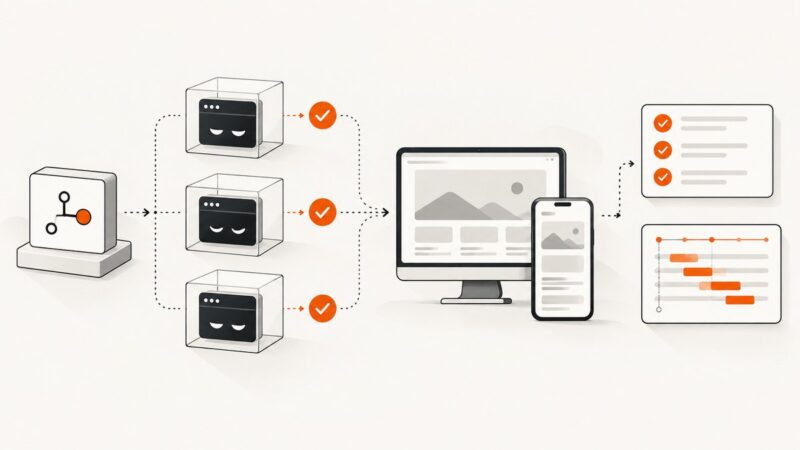
| Integration or pre-deployment | Selected integration tests, migration checks, critical end-to-end journeys | Verify key dependencies and deployment readiness |
| Scheduled or pre-release | Broader regression, full end-to-end suite, load or stress checks, accessibility and security scans as appropriate | Find risks whose cost or runtime makes them unsuitable for every change |
| Deployment and production | Smoke checks, health signals, selected safe production checks, rollback conditions | Confirm the deployed outcome and limit impact if it fails |
This is a starting pattern, not a mandatory schedule. Set cadence based on risk, execution cost, and how quickly the team needs feedback. Microsoft recommends explicit stages and quality gates, result analysis, and broader scheduled regression in suitable environments. AWS guidance also describes integrating automated testing and rollback around deployments using predefined conditions. Microsoft testing guidance · AWS testing and rollback guidance
4. Make failures diagnosable and flaky tests accountable
A red build is useful only if the team can tell what failed, reproduce it, and decide what to do. Record the test name, failure details, duration, relevant revision, environment and configuration, and safe test-data identifiers. Keep logs structured enough to compare failures over time. Do not put credentials, tokens, or sensitive production data in test output.
A flaky test passes and fails without a relevant product change. Repeatedly rerunning it until green hides uncertainty; it can teach people to dismiss genuine regressions. Microsoft recommends independent tests and deterministic data, and HMRC warns that unreliable tests erode confidence.
- Reproduce the failure and determine whether timing, shared state, order dependence, external services, resource contention, or unstable data caused it.
- Remove shared mutable state where possible. Make each test establish its own preconditions and clean up its own data.
- Replace arbitrary sleeps with condition-based waits where the test framework supports them. Set a bounded timeout and report what condition was still missing.
- Use controlled test doubles for unstable external dependencies, while retaining contract or integration checks for the real boundary.
- Assign an owner and an investigation deadline. If a test must be quarantined, make its status visible, track the risk it leaves uncovered, and set a review date.
- Fix, redesign, or delete obsolete checks. Do not let a quarantine become a permanent hidden bypass.
HMRC Engineering guidance says tests provide the most value when they run often enough to detect new defects and potential regressions. Regular execution matters only when results remain credible. HMRC test-automation guidance
5. Treat test data and environments as part of the system
Environment drift and shared data can create failures that look like product defects. Keep test configuration close to production where practical, and make differences explicit. Automate environment setup and teardown for repeatable checks; check configuration against its source of truth before testing when drift is a risk.
- Prefer synthetic data that represents relevant shapes and edge cases.
- If a scenario genuinely requires production-derived data, anonymize it and control access.
- Give tests isolated records or namespaces so parallel runs do not overwrite one another.
- Version persistent fixtures and schemas; update them when behavior changes.
- Keep secrets in a secure runtime store, not in source code, fixtures, screenshots, or logs.
- Use realistic failure responses and latency in dependency simulations where those behaviors matter.
For UI checks, stabilize the capture conditions as well as the application state: use deterministic data, wait for a meaningful readiness condition, and control viewport, locale, timezone, and animation behavior where relevant. A screenshot comparison can help detect visual changes, but it does not by itself prove that a flow is functionally correct or accessible.
6. Cover production risks beyond functional behavior
Build non-functional checks around decisions they support. Performance and load checks should run in environments where their measurements are meaningful; security checks should be placed according to severity and remediation workflow; resilience checks should exercise relevant failure modes; and accessibility checks should include automated and, where needed, human review. Not every check needs to block every commit.
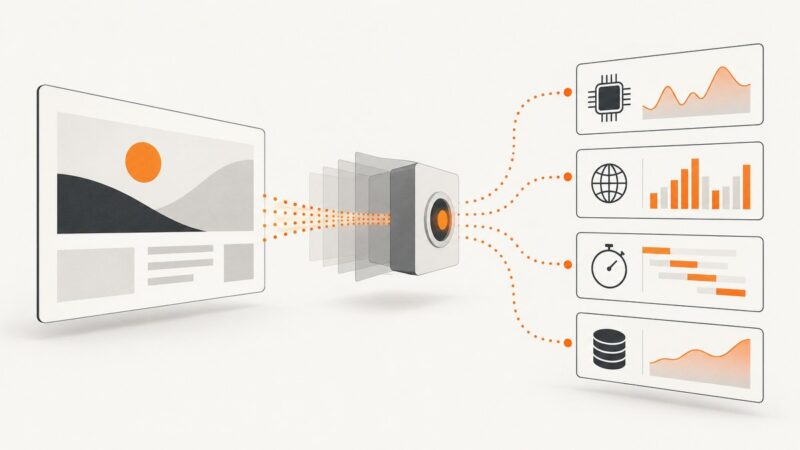
For visual regression or UI diagnostics, preserve the relevant page state and compare like with like. A browser-based capture may be affected by cookie banners, newsletter popups, chat widgets, bot checks, and loading behavior, so account for those conditions rather than interpreting every pixel difference as an application regression. ScreenshotNeo is a website screenshot API and MCP server from Yorker Media; it can capture screenshots or PDFs and offers options such as waiting for a selector, hiding elements, custom CSS and JavaScript, and viewport/device selection. See ScreenshotNeo and its API documentation.
7. Measure speed, stability, and coverage of risk
Choose a small set of measures that prompt an action. Review them by suite and pipeline stage, and examine trends rather than treating one run as a verdict.
| Measure | What it can reveal | Follow-up question |
|---|---|---|
| Execution time by stage and suite | Slowdown, resource contention, or misplaced checks | Can work be parallelized, made more focused, or moved to a suitable cadence? |
| Failure rate and failure category | Product regressions, infrastructure problems, or test defects | Can the team distinguish these causes quickly? |
| Unreliable or quarantined test share | Loss of trust and unaddressed maintenance debt | Who owns each test and when will its status be reviewed? |
| Defects found after release and coverage gaps | Risks the current suite misses | What regression check would have detected the defect? |
| Duration and diagnosis time for failures | Whether feedback is not only fast but actionable | What evidence is missing from the result? |
The Home Office lists execution time, unreliable-test percentage, defect density, and defect leakage across test levels among useful metrics. These are categories to track, not promised outcomes or universal targets. Avoid optimizing one number in isolation: reducing runtime by removing useful coverage can increase risk, while adding checks without improving diagnosis can slow delivery without increasing confidence.
8. Example: a maintainable CI pipeline shape
This GitHub Actions example illustrates stage ordering, explicit gates, and retained diagnostics. Replace the placeholder commands with your project’s actual scripts and adapt the runner, service dependencies, and artifact policy. It is a shape for organizing checks, not a complete pipeline for every stack.
name: checks

on:
  pull_request:
  push:
    branches: [main]

jobs:
  fast:
    runs-on: ubuntu-latest
    steps:
      - uses: actions/checkout@v4
      - uses: actions/setup-node@v4
        with:
          node-version: 22
          cache: npm
      - run: npm ci
      - run: npm run lint
      - run: npm test -- --run

  integration:
    needs: fast
    runs-on: ubuntu-latest
    steps:
      - uses: actions/checkout@v4
      - uses: actions/setup-node@v4
        with:
          node-version: 22
          cache: npm
      - run: npm ci
      - run: npm run test:contract
      - run: npm run test:integration

  critical_journeys:
    needs: integration
    runs-on: ubuntu-latest
    steps:
      - uses: actions/checkout@v4
      - uses: actions/setup-node@v4
        with:
          node-version: 22
          cache: npm
      - run: npm ci
      - run: npm run test:e2e:critical
      - name: Upload diagnostics
        if: always()
        uses: actions/upload-artifact@v4
        with:
          name: browser-diagnostics
          path: test-results/
          if-no-files-found: ignore
          retention-days: 7
Keep workflow permissions narrow, pin or regularly update third-party actions according to your security policy, and avoid uploading secrets or sensitive test data as artifacts. Configure required checks in your repository so a failed required job actually blocks the intended merge or deployment. Add a scheduled workflow for broader suites only when their results have a clear owner and response path.
9. Troubleshooting common pipeline failures
| Symptom | Likely cause | Practical fix |
|---|---|---|
| A test passes locally but fails in CI | Different runtime, configuration, timezone, locale, dependencies, or resource limits | Record environment details, align runtime and configuration, and reproduce using the CI environment or container. |
| Failures appear only under parallel execution | Shared records, files, ports, accounts, or mutable global state | Isolate test data and resources; make setup and cleanup per test; use unique identifiers. |
| Browser tests fail intermittently on page readiness | Arbitrary sleep, unstable network, slow assets, or waiting for the wrong signal | Wait for a specific element or application-ready state with a bounded timeout; capture logs and a screenshot on failure. |
| Mocks pass while production integration breaks | Mock behavior no longer matches the real interface | Add contract validation and targeted integration checks; update mocks with interface changes. |
| The pull-request pipeline keeps getting slower | Suite growth, duplicate end-to-end coverage, serial work, or expensive setup | Measure by stage, remove redundant checks, parallelize independent work, and move broad checks to a cadence that still meets risk needs. |
| Failures are frequently rerun without investigation | No ownership or policy for flaky tests | Assign an owner, label the failure type, set a review deadline for quarantine, and track the unresolved coverage risk. |
| Test results cannot identify the failing dependency | Insufficient logs, missing environment context, or opaque assertions | Record safe inputs, expected and actual outcomes, dependency status, and durations; improve assertion messages. |
| Visual diffs change on every run | Dynamic content, animations, fonts, consent overlays, viewport differences, or incomplete loading | Control data and capture conditions, wait for stable content, and deliberately handle overlays and volatile regions. |
| A deployment check fails after the change is live | Pre-production did not represent production configuration or traffic conditions | Compare configuration, improve representative checks, define health thresholds, and ensure rollback criteria and ownership are explicit. |
10. Improve the pipeline continuously
- Establish a baseline. Record stage durations, failure categories, unreliable tests, and known risk gaps.
- Choose one friction point. For example, an unowned flaky suite or a slow duplicate browser check.
- Change the suite or workflow with a stated reason. Preserve the risk the check was meant to cover.
- Review the result. Did feedback become faster or clearer? Did confidence or uncovered risk change?
- Repeat after meaningful system changes. New services, user flows, dependencies, and production defects can change the right test mix.
After a production defect, add a regression check at the lowest level that faithfully reproduces the failure, then add a higher-level check only when it protects an important interaction that lower-level tests cannot establish. Remove obsolete checks when behavior or architecture changes, and keep automation scripts aligned with test intent.
Or skip the browser setup
If your test pipeline needs page screenshots for visual review or diagnostics, ScreenshotNeo can capture a URL in one request. The API accepts a URL and returns an image or PDF; see the ScreenshotNeo API documentation for parameters and response details.
curl -G "https://api.screenshotneo.com/v1/shot" -d access_key=YOUR_API_KEY --data-urlencode url=https://stripe.com -o shot.webpimport requests
r = requests.get(
"https://api.screenshotneo.com/v1/shot",
params={"access_key": "YOUR_API_KEY", "url": "https://stripe.com"},
timeout=90,
)
open("shot.webp", "wb").write(r.content)const q = new URLSearchParams({ access_key: 'YOUR_API_KEY', url: 'https://stripe.com' });
const res = await fetch(`https://api.screenshotneo.com/v1/shot?${q}`);ScreenshotNeo accepts cookie and consent banners before capture and removes more than 60 known consent platforms, newsletter popups, and chat widgets; each step can be turned off. Bot checks, blank pages, timeouts, failed loads, and cache hits cost nothing, and response headers report the page verdict and billing status. Its MCP server gives AI agents tools for screenshots, page information, and PDF capture. The free plan includes 1,000 screenshots a month with no card; paid plans start at $5 for 3,000 screenshots. Sign up for 1,000 free screenshots a month, with no card required.
FAQ
Does future-proofing mean keeping every old test?
No. Keep checks that protect current behavior or risk. Repair, replace, or remove tests whose intent is obsolete, duplicated, or too unreliable to provide useful evidence.
Should every test failure block a release?
Define gates according to the risk and the decision a check supports. A known infrastructure failure and a reproducible product regression may need different handling, but both should be visible and owned.
How often should the test strategy be reviewed?
Review it after material architecture or risk changes, production defects, major shifts in suite health, and on a regular team cadence. The right interval depends on how quickly the system and its risks change.
Is a screenshot comparison an accessibility test?
No. It can reveal visual changes, but it does not establish keyboard access, semantic structure, screen-reader behavior, or complete accessibility conformance.