How Generative AI Is Changing Enterprise Automation
Generative AI is moving from drafting and Q&A into repeatable workflows and tool-using agents. Learn where it fits, how to measure results, and how to keep actions under control.
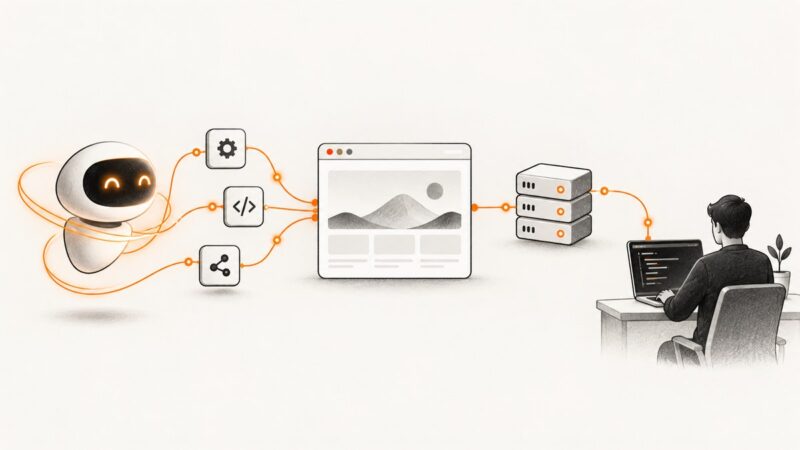
Generative AI is changing enterprise automation by extending it from predictable, rules-based steps into language-heavy work: interpreting requests, summarizing documents, drafting responses, extracting information, and routing cases. When connected to business tools, an AI agent can also take bounded actions. The useful pattern is usually a model handling ambiguous inputs, deterministic software enforcing business rules, and people reviewing consequential decisions.
That shift is real, but the evidence does not support treating every reported time saving as an enterprise-wide productivity gain. Worker surveys, adoption surveys, and vendor-published customer cases measure different things. Start with a specific workflow, measure it, and expand only when quality, safety, and economics hold up.
How is generative AI changing enterprise automation?
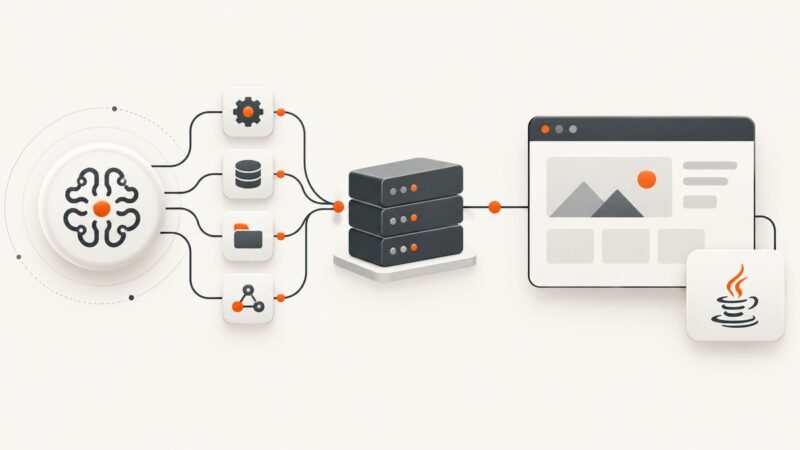
Traditional automation works best when inputs and steps are structured and stable: validate a field, apply a rule, update a record, or route a request. Generative AI adds a way to handle less structured material such as emails, support questions, policy documents, and free-form requests. An agent can combine that interpretation with tools such as APIs, search, and workflow systems.
This does not mean that an entire business process or job is automatically autonomous. A system may summarize a case for a person, draft a response for approval, or complete one low-risk step while a conventional workflow handles the rest. Distinguish among AI use, worker assistance, automation of a step, and end-to-end autonomous execution.
| Automation pattern | Good fit | Example |
|---|---|---|
| Rule-based automation | Stable inputs and explicit business rules | Route an approved request based on account tier |
| AI-assisted work | Language or documents need interpretation, but a person decides | Summarize a support case and suggest a reply |
| Bounded agent workflow | AI interprets a request and can use limited tools under controls | Look up an employee policy and create a draft service ticket |
| Autonomous process | Only appropriate when actions are well tested, bounded, observable, and recoverable | Complete a low-impact update subject to deterministic validation |
What tasks can AI agents automate at work?
Common areas include customer support and query handling, IT issue resolution, software development, document analysis, audit preparation, and employee services. A task is a stronger candidate when it is repetitive, language-heavy, bounded, and has a reliable way to check its result.
- Support: classify and summarize requests, retrieve relevant guidance, draft answers, and route exceptions.
- IT and employee services: interpret chat requests, find authorized information, open or update tickets, and hand sensitive cases to staff.
- Document and audit work: extract evidence, compare documents against a checklist, prepare a workpaper, and flag gaps for reviewer attention.
- Software and data work: assist with code, analyze data, extract fields, and summarize results. These use cases augment parts of work; they do not establish that whole roles have been automated.
Examples should be read in context. OpenAI’s 2025 enterprise report identifies customer support, coding and developer tools, data analysis, extraction, and summarization among use cases in its customer base. Google Cloud’s Wells Fargo case describes reusable APIs and generative AI experimentation and reports roughly 20% lower workflow time for branch-banker query resolution. That is a vendor-published case result, not a prediction for other banks. Google Cloud’s AES case reports that AI agents helped process audit documentation, with some work completed in about an hour and a reported 10–20% increase in audit accuracy; a human remained in the review process. Those are AES and vendor-reported outcomes, not independently established general results.
Are companies actually seeing productivity gains from generative AI?
Some workers and organizations report benefits, but the measures differ and should not be combined into a single expected uplift.
- OpenAI’s 2025 report draws on a survey of workers at nearly 100 enterprises and aggregated, de-identified product usage data. Surveyed workers attributed 40–60 minutes saved per active day to ChatGPT Enterprise use, and 75% reported improved speed or quality. The report also gives department-level self-reports, including faster issue resolution among IT workers and faster code delivery among engineers. These are OpenAI customer and survey findings, not independent experimental measurements.
- McKinsey’s 2025 Global Survey reports that 64% of respondents said AI was enabling innovation, while 39% reported enterprise-level EBIT impact. These are survey responses, not audited causal estimates, and the population and measures differ from OpenAI’s report.
Task-level time saved can coexist with limited enterprise-level financial impact. Integration, review, exception handling, licensing, infrastructure, security, and process redesign all affect whether local improvements change company-wide results. Establish a baseline and measure both quality and total operating cost before claiming ROI.
Where should an enterprise start?
- Choose a bounded workflow. Pick a recurring task with a clear owner, known inputs, manageable consequences, and a human fallback. Avoid starting with an irreversible high-impact decision.
- Measure the current process. Record cycle time, staff time, quality, error and rework rates, throughput, and current operating costs.
- Define what the model may do. Separate interpretation or drafting from deterministic policy checks and system writes. State which decisions require approval.
- Test representative cases. Include ordinary examples, missing information, ambiguous requests, unusual exceptions, and malicious or misleading instructions.
- Connect only necessary data and tools. Use authorized, current information and give the agent the minimum permissions needed for the task.
- Keep consequential actions reviewable. Require a human approval for sensitive, high-impact, or hard-to-reverse actions. Provide a way to pause or stop execution.
- Log and monitor. Record relevant inputs, retrieved context, tool calls, approvals, outputs, and outcomes while following data-retention and privacy requirements.
- Compare results with the baseline. Measure errors, escalations, review time, and total cost as well as speed. Fix failure modes before widening access or autonomy.
This sequence is a practical synthesis of risk-management guidance, not a prescribed universal standard. NIST’s Generative AI Profile is a voluntary resource for governing, mapping, measuring, and managing risks across the AI lifecycle; it is not a certification or guarantee of effectiveness.
How do enterprises keep AI agents under control?
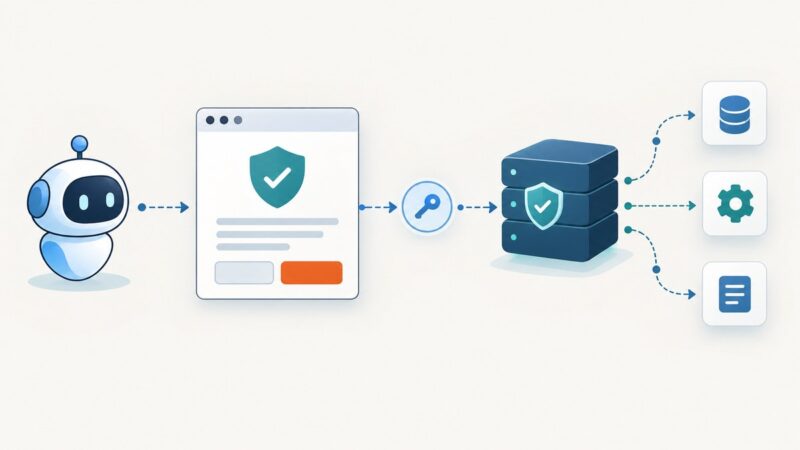
When a system can call tools or change business records, governance becomes part of day-to-day operations. Microsoft’s agent-risk guidance describes risks such as task deviation, inadequate human oversight, poor intelligibility, malicious instruction handling, sensitive-data leakage, and excessive permissions. Its guidance recommends limiting tools and data, making plans and actions visible, requiring approval for high-impact or irreversible actions, and providing a safe pause or stop mechanism.
| Control | Operational question |
|---|---|
| Identity and permissions | Can the agent access only the records and actions needed for this workflow? |
| Approval gates | Which writes, external messages, financial changes, or irreversible actions need human approval? |
| Deterministic checks | Which business rules can be enforced in ordinary code before an action is accepted? |
| Observability | Can an operator see the request, context, proposed action, tool call, and result? |
| Recovery | Can staff pause the workflow, correct a result, undo a change, and handle exceptions? |
| Evaluation | Are quality and safety checked on representative cases after model, prompt, or integration changes? |
For document and web workflows, evidence capture can support review trails. ScreenshotNeo is a website screenshot API and MCP server for developers; its [website](https://screenshotneo.com) describes clean captures, and its API or MCP tools can be used to capture pages as part of a workflow. Treat a screenshot as supporting evidence, not proof that an agent’s interpretation or action was correct.
How should a team evaluate an automation opportunity?
| Axis | Questions |
|---|---|
| Workflow fit | Is the work repetitive and language-heavy? Which steps must remain deterministic? |
| Data and integration | Can the system access current, authorized information and safely call required systems? |
| Reliability | How will outputs and actions be evaluated on normal, exceptional, and adversarial cases? |
| Autonomy and impact | Can the agent draft or recommend, or can it write, approve, or trigger an irreversible action? |
| Governance | Are access controls, approvals, logs, ownership, monitoring, and incident response defined? |
| Economics | Do cycle time, quality, throughput, and total operating costs justify implementation and maintenance? |
Or skip the browser setup
If your workflow needs a screenshot of a web page as evidence or input, you can automate a browser yourself, or make one API request with ScreenshotNeo. This runnable cURL example saves a WebP capture:
curl -G "https://api.screenshotneo.com/v1/shot" -d access_key=YOUR_API_KEY --data-urlencode url=https://stripe.com -o shot.webpPython:
import requests

r = requests.get(
    "https://api.screenshotneo.com/v1/shot",
    params={"access_key": "YOUR_API_KEY", "url": "https://stripe.com"},
    timeout=90,
)
r.raise_for_status()
open("shot.webp", "wb").write(r.content)
Node.js (18 or newer, which includes fetch):
const q = new URLSearchParams({ access_key: 'YOUR_API_KEY', url: 'https://stripe.com' });
const res = await fetch(`https://api.screenshotneo.com/v1/shot?${q}`);
if (!res.ok) throw new Error(`Screenshot request failed: ${res.status} ${await res.text()}`);
await import('node:fs/promises').then(fs => fs.writeFile('shot.webp', Buffer.from(await res.arrayBuffer())));
Replace YOUR_API_KEY with your key and change the target URL. Keep the key in a server-side secret store; do not expose it in browser JavaScript or a public repository. The endpoint supports PNG, JPEG, WebP, and PDF captures. See the API documentation for request options.
- Cookie and consent banners are accepted like a visitor and removed, along with supported newsletter popups and chat widgets; each step can be turned off.
- Bot checks, CAPTCHAs, blank pages, timeouts, failed loads, and cache hits cost nothing. Response headers identify the page verdict and billing status.
- An MCP server provides
take_screenshot,get_page_info, andcapture_pdftools for Claude, Cursor, and other MCP clients. - The free plan includes 1,000 screenshots per month with no card. Paid plans start at $5 for 3,000 shots; every feature is on every plan.
Sign up for ScreenshotNeo’s free plan and get 1,000 screenshots a month with no card.
Screenshot options for workflow evidence
ScreenshotNeo accepts a URL in one GET request and can return an image or PDF. Options relevant to automated workflows include full-page capture with lazy images loaded, a CSS-selected element, dark mode, 12 device presets or a custom viewport, retina scale, PDF paper size and margins, landscape and page ranges, custom CSS or JavaScript, clicking an element, hiding selectors, waits for a selector, delay, or network idle, blocking ads, trackers, requests or resource types, custom headers, cookies, user agent and Authorization, timezone and geolocation, transparent background, image resizing, configurable cache TTL, signed links for public image tags, asynchronous jobs with signed webhooks, and bulk capture for up to 100 URLs per call. There is also a usage API and OpenAPI specification.
For reliable workflow integration, choose waits that reflect the page’s actual loading behavior; network idle may be inappropriate for pages with continuous requests. Use element capture when only one region matters, and full-page mode when the whole document is relevant. Treat page content as untrusted input, keep credentials scoped, and avoid logging secrets in URLs or captured output. The parameter names used by other screenshot APIs also work, which can simplify migration.
Performance, reliability, and cost
- Performance: capture time depends on page load behavior, waits, full-page length, and rendering options. Avoid unnecessary fixed delays; a selector wait can target the content needed. Batch independent URLs with bulk capture when appropriate.
- Reliability: distinguish a successful HTTP request from a useful page capture. Check the response’s page-verdict and billing headers, and handle blank, blocked, timed-out, or failed pages explicitly. For asynchronous jobs, use signed webhooks and verify them before accepting results.
- Cost: ScreenshotNeo bills only clean shots; bot checks/CAPTCHAs, blank pages, timeouts, failed loads, and cache hits cost nothing. Plans are Free: 1,000 per month; Starter: $5 for 3,000; Growth: $15 for 15,000; Pro: $39 for 60,000; Scale: $99 for 250,000; Business: $249 for 1,000,000. Yearly billing gives two months free.
- Workflow economics: include model use, integration, human review, retries, storage, and maintenance in the cost of automation. Compare total cost and quality against the measured baseline, not only the API line item.
Troubleshooting common automation failures
| Symptom | Likely cause | What to do |
|---|---|---|
| The model gives a plausible but wrong answer | Ambiguous input, stale or missing context, or no output validation | Retrieve authoritative current data, constrain the task, validate required fields and rules in code, and route uncertainty to a person. |
| The agent performs an unintended action | Broad tool permissions, unclear boundaries, or untrusted instructions in data | Reduce permissions, separate read and write tools, require approval for consequential actions, and test instruction-injection cases. |
| The workflow works in a demo but fails on real cases | Testing covered only ordinary examples | Evaluate representative volumes, exceptions, missing data, and adversarial cases; monitor failures after release. |
| Automation is faster but costs more overall | Review, integration, retries, or maintenance were omitted from the estimate | Measure end-to-end staff time and all operating costs against the baseline. |
| A screenshot response is blocked or blank | The target page returned a bot check, CAPTCHA, blank page, timeout, or load failure | Inspect the response headers for the page verdict and billing status; retry only when appropriate, and do not treat a blocked page as evidence of page content. |
| Screenshot output misses content | Capture started before the relevant element appeared, or the page loads continuously | Wait for a specific selector or appropriate delay; avoid network-idle waits on pages with ongoing traffic. Check selector and viewport choices. |
| API request is rejected | Missing or invalid access key, malformed URL, or unsupported parameter value | Check the key and URL encoding, then compare parameter names and accepted values with the API documentation. |
Frequently asked questions
Does generative AI replace traditional automation?
No. Deterministic automation remains a good fit for stable rules. Generative AI can handle interpretation and language tasks around those rules, with controls between model output and system actions.
Does an agent need permission to write to business systems?
Only if the workflow requires it. Start with read-only access or draft actions where possible, and add narrowly scoped writes with approval gates after testing.
Do reported productivity figures predict my company’s results?
No. The cited figures describe particular survey respondents or customer cases. Measure your own workflow, quality, and full operating costs.
Can an AI agent use screenshots as evidence?
It can receive a captured page as workflow input, but a screenshot does not establish that the page is accurate, current, or authoritative. Preserve source and review context.