BlogScreenshots on your device
The History of Website Screenshots
Trace website screenshots from CERN and Mosaic to web archives and modern full-page capture, with practical ways to preserve any page today.
Website screenshots started as incidental records of what early browsers rendered. They became a deliberate way to document design changes, compare browsers, preserve disappearing pages, and share a page as a fixed image. The story runs from Tim Berners-Lee’s first browser and website at CERN, through Mosaic’s inline graphics and mass adoption, to the Wayback Machine and today’s browser-aware full-page capture tools.
What counts as a website screenshot?
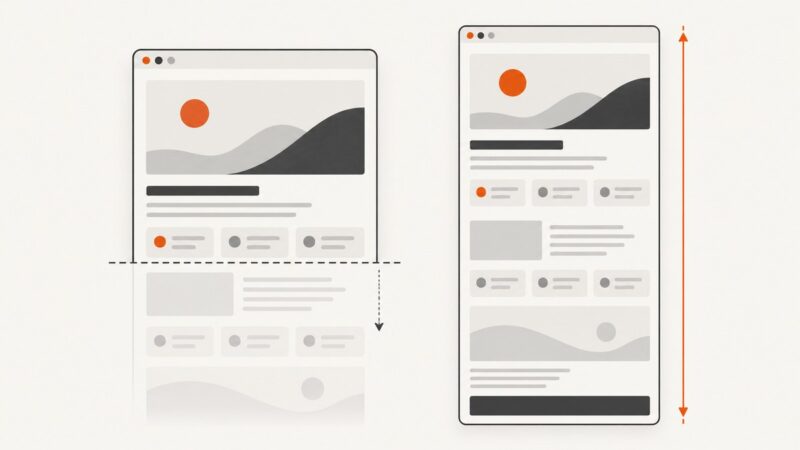
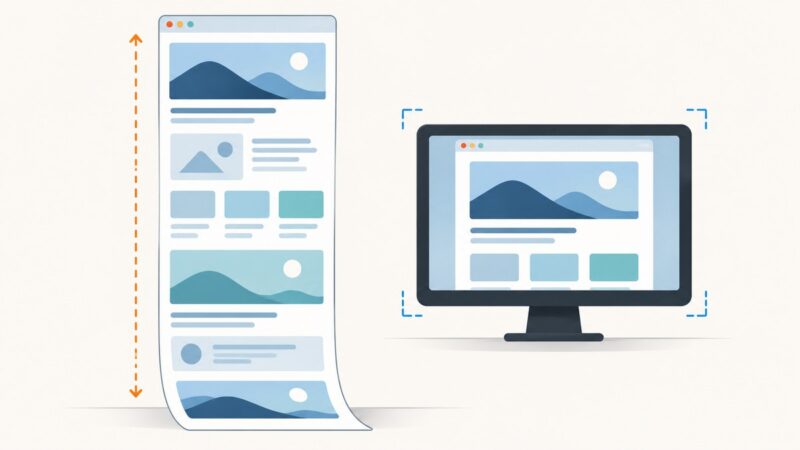
A screenshot is a static visual capture of a page as rendered by a browser or browser-like engine. It may show only the current viewport, the entire scrollable page, or one selected element. It can include browser chrome, such as tabs and the address bar, or contain only the page itself.
That definition separates screenshots from related records:
| Record | What it preserves | Best use |
|---|---|---|
| Viewport screenshot | What fits in the window at one moment | Sharing, bug reports, visual references |
| Full-page screenshot | The complete rendered document, including content below the fold | Design review, documentation, regression evidence |
| Web archive capture | A dated response and its archived assets, sometimes replayable | Historical research and preservation |
| Browser-window photograph or OS grab | Screen pixels, including browser chrome and desktop context | Evidence of the viewing environment |
1989–1993: The web’s first visual environments
Tim Berners-Lee invented the World Wide Web at CERN in 1989. CERN records that the first website was dedicated to the Web project and hosted on Berners-Lee’s NeXT computer. The WorldWideWeb browser was written in 1990, the line-mode browser launched in 1992, and CERN put the Web software into the public domain on 30 April 1993. See CERN’s history of the Web.
There was no standard screenshot command in those first environments. Early visual records were usually an operating-system screen grab, a photograph, or a saved rendering made for documentation. The Ancient Browsers Archive preserves software and emulation for WorldWideWeb/Nexus, Line Mode, MacWWW/SAMBA, ViolaWWW, Erwise, tkWWW, Midas, Lynx, and Cello. Each browser could render the same markup differently, so a screenshot also recorded the browser’s capabilities and limitations.
Line-mode browsing produced text-oriented views. Graphical browsers introduced images, fonts, layout differences, and a stronger reason to preserve exactly what a visitor saw. This is why asking “When was the first website screenshot taken?” has no single documented answer: screenshots existed as informal records before screenshot tooling had a common name or format.
1993–1995: Mosaic makes browser views culturally important
NCSA Mosaic was developed in 1993. The National Science Foundation describes it as the first freely available browser to combine graphics and text inline. In less than 18 months, Mosaic became the “Web browser of choice” for more than a million users. Inline images made a browser window visually compelling and gave screenshots something recognizable to preserve.
NCSA’s institutional history explains the design motivation. Developer Mike Folk recalled: “Hey, these [other browsers] don’t do pictures. We’re all about pictures … We can do better than this.” Mosaic’s Macintosh and Windows installers appeared in December 1993; Opera’s first version followed in 1994, Netscape Navigator 1.0 in December 1994, and Internet Explorer 1.0 in August 1995. Those releases created visual eras that screenshots could compare.
To study an early page, ask four questions: which browser rendered it, which operating system supplied the fonts and window chrome, whether external images still existed, and whether the capture is a live reconstruction or a dated record. A modern recreation may look plausible while differing from the original in typography, scripting, and missing assets.
1996 onward: Screenshots become historical evidence
The Internet Archive says the original idea for the Wayback Machine began in 1996. Its archive lets a user enter a URL, choose a date range, and browse captured versions. Captures come from many crawls and collections, so an archived page is evidence of a particular crawl rather than a guarantee that every asset or interaction survived. Start at web.archive.org.
The W3C’s design history provides a concrete example: the earliest capture of its initial website design in the Wayback Machine is dated 27 December 1996. That page documents successive redesigns through the fifth design as of 20 June 2023. Government archives use the same dated-capture model; the UK Government Web Archive presents a URL timeline and lets researchers refine results by date, redirects, and full-text search.
How to view an old version of a website
- Open the Wayback Machine and enter the complete URL, including the path.
- Choose a year and a highlighted capture date.
- Check the address bar and capture timestamp before citing the page.
- Follow important links inside the replay; a page may load while an embedded stylesheet or image is missing.
- Save a screenshot of the replay and record the archive URL, date, and any missing resources.
An archive replay and a screenshot answer different questions. The replay may preserve links and text that can be searched; the screenshot freezes the visual state for a report or comparison.
Modern browser capture
Screenshot tooling moved from operating-system grabs toward browser-aware capture. Firefox DevTools can capture the full page or a selected element and save the file to Downloads. Microsoft Edge’s Screenshot feature supports full-page and selected-area capture, annotation, and moving-content capture; its documented shortcut is Ctrl+Shift+S, although availability varies by device, market, and browser version.
Capture a full page in Firefox
- Open the page in Firefox.
- Open Developer Tools and choose the screenshot command.
- Select full-page capture or capture the selected element.
- Review lazy-loaded sections and sticky headers before sharing the image.
Capture a full page in Edge
- Open the page in Edge and invoke Screenshot (Ctrl+Shift+S where supported).
- Choose the full-page or selected-area mode.
- Use annotation tools if the image is for a review.
- Save the result and retain the source URL and capture time.
How to capture a reliable webpage today
For repeatable evidence, define the capture conditions instead of relying on whatever a desktop window happens to show.
- Choose the target. Decide whether you need the viewport, the complete page, or one CSS-selected element.
- Set the environment. Record viewport width and height, device pixel ratio, browser version, timezone, locale, and color scheme.
- Wait for content. Allow fonts, images, client-side rendering, and lazy sections to finish. A selector wait or network-idle wait is more reliable than an arbitrary short delay.
- Control noise. Dismiss consent banners, close chat widgets, and hide transient overlays before capture.
- Capture and verify. Check the top, middle, and bottom of a long page; confirm that images and fonts loaded.
- Store provenance. Keep the URL, timestamp, options, viewport, and resulting file together.
DIY browser automation with Playwright (Node.js)
import { chromium } from 'playwright';

const browser = await chromium.launch();
const page = await browser.newPage({ viewport: { width: 1440, height: 900 }, deviceScaleFactor: 1 });
await page.goto('https://example.com', { waitUntil: 'networkidle' });
await page.screenshot({ path: 'example-full.png', fullPage: true });
await browser.close();
For production, add a selector wait for the page’s main content, a bounded timeout, retries for transient navigation failures, and a fixed browser version. Full-page images can be very tall; use a PDF or element capture when a single bitmap is impractical.
Or skip the browser setup
ScreenshotNeo is a website screenshot API and MCP server. One GET request returns a PNG, JPEG, WebP, or PDF. Before capture it accepts cookie or consent banners and removes more than 60 known consent platforms, newsletter popups, and chat widgets; each step can be turned off. Bot checks, CAPTCHAs, blank pages, timeouts, failed loads, and cache hits are not billed, and response headers identify the page verdict and billing result. Its MCP server provides take_screenshot, get_page_info, and capture_pdf tools for Claude, Cursor, and other MCP clients.
See the ScreenshotNeo documentation for all options.
cURL
curl -G "https://api.screenshotneo.com/v1/shot" -d access_key=YOUR_API_KEY --data-urlencode url=https://stripe.com -o shot.webpPython
import requests
r = requests.get("https://api.screenshotneo.com/v1/shot", params={"access_key": "YOUR_API_KEY", "url": "https://stripe.com"}, timeout=90)
open("shot.webp", "wb").write(r.content)
Node.js
const q = new URLSearchParams({ access_key: 'YOUR_API_KEY', url: 'https://stripe.com' });
const res = await fetch(`https://api.screenshotneo.com/v1/shot?${q}`);
Useful options include full-page capture with lazy images loaded, CSS-element capture, dark mode, 12 device presets or any viewport, retina scale, PDF paper size and margins, custom CSS and JavaScript, click-before-capture, hide selectors, selector or network-idle waits, blocked ads and trackers, custom headers, cookies, user agents and Authorization, timezone and geolocation, transparent backgrounds, resizing, user-selected cache TTLs, signed links, asynchronous jobs with signed webhooks, bulk capture of up to 100 URLs per call, a usage API, and an OpenAPI specification. Parameter names used by other screenshot APIs also work, which simplifies migration.
Performance and cost: Reuse a cache TTL for unchanged pages, use element capture when a full page is unnecessary, and use bulk capture for batches. Async jobs and signed webhooks keep long captures out of request timeouts. The Free plan includes 1,000 shots per month with no card. Starter is $5 for 3,000, Growth $15 for 15,000, Pro $39 for 60,000, Scale $99 for 250,000, and Business $249 for 1,000,000; yearly billing gives two months free, and every feature is available on every plan.
Start with 1,000 free screenshots a month with no card.
Troubleshooting checklist
| Symptom | Likely cause | Fix |
|---|---|---|
| Top of page only | Viewport capture was selected | Enable full-page capture or use the API’s full-page option. |
| Blank or partial image | Navigation or client rendering had not finished | Wait for a selector or network idle; increase the bounded timeout and retry. |
| Cookie banner covers content | Consent dialog appeared after navigation | Accept or remove it before capture, or enable ScreenshotNeo’s consent handling. |
| Images are missing | Lazy loading, blocked requests, or an expired asset URL | Scroll or enable lazy-image loading, inspect blocked resources, and retry. |
| Fonts change between runs | Different browser, locale, or font availability | Pin the browser environment and wait for document.fonts.ready. |
| Request times out | Slow page, bot check, or long script | Use async capture, a selector wait, and a retry policy; inspect verdict headers. |
| Unexpected bill | A successful page was captured and billed | Read X-Page-Verdict and X-Billed; cache stable pages with a chosen TTL. |
What screenshots can and cannot prove
A screenshot proves what a particular renderer displayed under particular conditions. It does not prove that every visitor saw the same page, that an interaction worked, or that an archived page was complete. For historical work, cite the capture date and archive URL. For testing, store the viewport, browser, locale, and capture options. For legal or compliance records, preserve the original response and metadata alongside the image.
FAQ
When was the first website screenshot taken?
No single first screenshot is documented. Early browser windows could be saved or photographed before standardized screenshot tools existed.
How did people save webpages in the 1990s?
They saved source files and assets, printed pages, made operating-system screen grabs, or relied on institutional and later web archives. These methods preserve different parts of a page.
What did early websites look like?
The earliest environments were text-oriented. Mosaic’s inline graphics made mixed text-and-image pages common, followed by recognizable Netscape and Internet Explorer eras.
Is the Wayback Machine a screenshot service?
It is primarily a dated web archive with replayable captures. You can screenshot a replay, but the archive itself may also preserve HTML, images, and links.
Should I use a full-page image or PDF?
Use a full-page image for visual comparison and a PDF when pagination, paper size, margins, or selectable text matter.