How Testing Helps You Build Better Software Faster
Testing speeds development when it gives fast, trustworthy feedback on each change. Learn what to automate, how to keep tests useful, and where human judgment still matters.
Testing helps you build better software faster when it gives you quick, trustworthy feedback about a change. A useful check can reveal a regression while the code is still fresh in your mind, so you can diagnose and fix it before more work depends on it.
That benefit does not come from maximizing test count. Slow, flaky, or hard-to-maintain tests can become a bottleneck. The goal is a balanced set of checks that catches meaningful problems quickly, with human exploration for questions automated tests cannot answer.
How does testing help build better software?
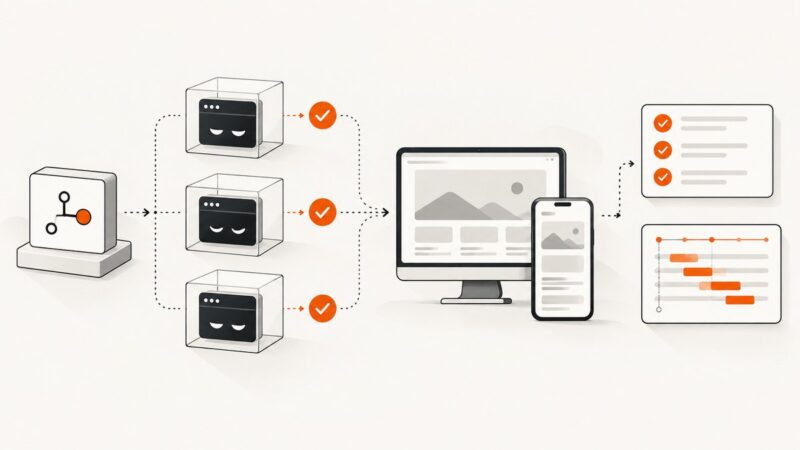
Tests shorten the distance between a code change and information about its effects. When a commit triggers a build and relevant checks, the result becomes part of the development loop. If a check fails for a real reason, the author can investigate promptly rather than reconstructing the change after several more features have landed.
This feedback loop supports smaller corrections and more confident changes. It is evidence about a change, not proof that the whole system is correct, secure, or free of defects.
DORA describes fast feedback on the effects of changes across the software delivery lifecycle as a key practice. In its 2021 report, organizations classified as elite performers that met reliability targets were 3.7 times more likely to leverage continuous testing. That is an association reported in that study; it does not establish that continuous testing alone caused the difference. See the 2021 Accelerate State of DevOps Report.
Does testing slow down software development?
It can, if feedback takes too long or failures are difficult to trust. Test execution consumes time, and teams also pay for writing checks, maintaining test data and environments, and diagnosing failures. Those costs can outweigh the value of a check that is redundant, brittle, or rarely catches a meaningful issue.
Testing is more likely to help delivery when the signal is fast and reproducible. DORA’s test automation guidance recommends that developers be able to get feedback from automated tests in less than ten minutes both on local workstations and from CI. Treat that as a target for useful automated feedback, not a guarantee that every complete test suite will fit within ten minutes. See DORA’s test automation guidance.
Measure the suite as part of the development system: time to feedback, frequency of flaky failures, time spent diagnosing failures, and whether checks catch defects that matter. A test pass is one source of evidence. It cannot compensate for unclear requirements, poor integration practices, weak operational reliability, or missing user feedback.
How can automated testing speed up development?
Automation is useful when a check is repeatable, has a clear expected result, and needs to run often. For example, a team can make a relevant set of checks run when code is integrated so that failures surface near the change that caused them. Continuous testing means testing throughout delivery rather than waiting until development is declared complete. DORA also describes continuous integration as integrating work frequently and verifying it with automated builds and tests; see its continuous integration guidance.
- Choose a short feedback set. Run the checks that matter for the change during development and integration, and keep the feedback loop useful and quick.
- Make failures actionable. A failure should be reproducible and point to behavior someone can investigate. Diagnose flaky checks instead of teaching the team to ignore failures.
- Correct defects while context is fresh. Investigate meaningful failures promptly, before later work makes the source harder to isolate.
- Add focused regression coverage when it is dependable. After a defect, add a check if it can reliably catch that failure again.
- Keep human testing in the workflow. Use exploratory, usability, and acceptance testing to investigate behavior and user needs that scripted checks may not capture.
- Review the suite regularly. Improve, remove, or replace redundant, brittle, slow, or expensive checks based on the signal they provide.
What tests should a development team automate?
Automate a check when its result can be judged consistently, it is valuable to repeat, and its maintenance cost is reasonable. Keep human judgment where a person needs to explore behavior, interpret a user’s needs, or decide whether an experience is acceptable.
| Testing activity | Good fit for automation | Why human work still matters |
|---|---|---|
| Repeatable regression checks | Often a good fit when the expected behavior is clear and the check is stable. | People still need to investigate failures and decide whether expected behavior matches the requirement. |
| Build and integration checks | Useful to run routinely as changes are integrated. | A passing build does not establish that a feature meets every user need. |
| Exploratory testing | Automation can cover known, repeatable cases discovered during exploration. | A tester can follow unexpected behavior and investigate questions not encoded in advance. |
| Usability and acceptance work | Some specific acceptance conditions can be scripted if they are observable and stable. | Judging usability and whether a solution fits user needs requires human input. |
There is no universally correct test mix. Compare checks by the feedback they provide, how frequently they need to run, the reliability of their signal, authoring and upkeep cost, and the need for human judgment. For tools, consider fit with the team’s language and build pipeline, speed, reproducibility, integration effort, and maintenance burden.
Keep the feedback loop reliable
- Prefer meaningful failures. Investigate flaky results and improve reproducibility; noise erodes trust and delays response.
- Control suite growth. More checks add execution and upkeep costs. Keep checks that provide useful evidence and revisit those that do not.
- Make environments and test data part of the design. Unavailable or inconsistent dependencies can make failures hard to reproduce.
- Collaborate across roles. Developers and testers should work together during delivery, and builds should be available for exploratory work.
- Keep expectations explicit. A test can only check what has been defined and observed. Gaps or ambiguity in requirements remain risks.
Visual checks for web changes
Some web regressions are easier to spot in a rendered page than in an isolated assertion: a missing image, an unexpected layout shift, or a consent overlay covering content. A screenshot can provide a visual artifact for review, but it does not replace functional tests, accessibility review, or a person’s judgment of the experience.
For a manual check, open the page in the browser configuration relevant to the change, wait for its important content to appear, capture the viewport or full page, and compare the result with the expected behavior. For repeatable review, record the page URL, viewport, device scale, wait condition, and relevant state such as theme or authentication. Keep the baseline current when a deliberate design change is approved.
Or skip the browser setup
ScreenshotNeo is a website screenshot API and MCP server. A single request can capture a URL as an image or PDF; the API supports options including viewport and device presets, full-page capture, element capture, dark mode, waits, custom headers, cookies, and custom JavaScript. See the ScreenshotNeo API documentation.
curl -G "https://api.screenshotneo.com/v1/shot" -d access_key=YOUR_API_KEY --data-urlencode url=https://stripe.com -o shot.webpimport requests
r = requests.get(
"https://api.screenshotneo.com/v1/shot",
params={"access_key": "YOUR_API_KEY", "url": "https://stripe.com"},
timeout=90,
)
open("shot.webp", "wb").write(r.content)const q = new URLSearchParams({ access_key: 'YOUR_API_KEY', url: 'https://stripe.com' });
const res = await fetch(`https://api.screenshotneo.com/v1/shot?${q}`);
if (!res.ok) throw new Error(`Screenshot request failed: ${res.status}`);
await Bun.write('shot.webp', res);ScreenshotNeo accepts cookie and consent banners like a visitor, then removes more than 60 known consent platforms, newsletter popups, and chat widgets before capture; each of those steps can be turned off. Bot checks and CAPTCHAs, blank pages, timeouts, failed loads, and cache hits are not billed, and response headers report the page verdict and billing status. Its MCP server offers take_screenshot, get_page_info, and capture_pdf for Claude, Cursor, and other MCP clients. The Free plan includes 1,000 shots per month with no card; paid plans start at $5 for 3,000 shots.
Sign up for 1,000 free screenshots a month, with no card required.
Troubleshooting automated feedback
| Symptom | Likely cause | Useful response |
|---|---|---|
| A check fails intermittently without a code change | The check, test data, or environment is not reproducible. | Reproduce the failure, identify the varying dependency or state, and make the check deterministic or replace it. |
| Developers wait too long for results | The feedback set is too broad, serial, or expensive for routine use. | Review what needs to run at integration time, reduce avoidable work, and retain a separate path for slower checks where appropriate. |
| A defect escapes despite a passing suite | The behavior was not covered, the requirement was unclear, or the relevant behavior was not observable to the check. | Clarify expected behavior, add a focused check if reliable, and use exploratory or acceptance work for uncovered questions. |
| A new regression test is brittle | It may assert incidental details instead of stable behavior, or depend on fragile setup. | Revisit the observable behavior and simplify its setup; keep the test only if its signal justifies the upkeep. |
| Many checks pass but confidence remains low | Test count is being treated as a proxy for quality, while coverage or signal quality may be weak. | Review what failures the checks catch, where human review is needed, and how the system behaves in delivery and operation. |
Frequently asked questions
Can testing guarantee defect-free software?
No. Tests sample defined behaviors and can miss defects, misunderstood requirements, and conditions that were not anticipated. Combine automated evidence with human review and operational feedback.
Should every test run on every commit?
Not necessarily. Choose a fast, relevant feedback set for frequent integration, and decide separately how to run slower checks so they do not make routine feedback unreasonably slow.
Does continuous testing mean automating every kind of testing?
No. It means testing throughout delivery. DORA recommends a combination of automated and manual testing, including exploratory, usability, and acceptance work.
Further reading
- DORA: Test automation
- DORA: Continuous integration
- DORA Research: 2022
- Agile Testing: A Practical Guide for Testers and Agile Teams by Lisa Crispin and Janet Gregory