How to Scale Automated Testing
Scale automated testing with risk-based coverage, faster CI feedback, and reliable results. Learn how to choose test levels, parallelize safely, and control flakiness.
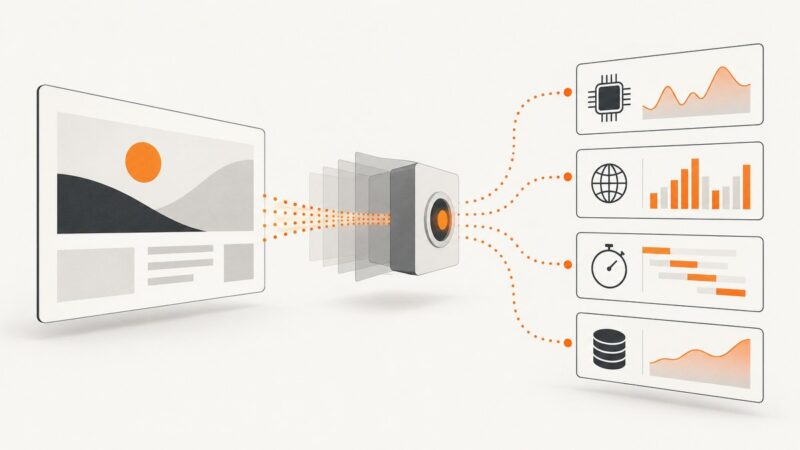
Scale automated testing by increasing coverage of the risks that matter while keeping feedback fast and results trustworthy. Start with critical user journeys and failure impact, put each check at the least costly level that gives adequate confidence, make tests independent before parallelizing, and track suite speed alongside reliability and defects.
There is no universal test count, end-to-end percentage, acceptable flake rate, or maximum suite runtime. Those depend on your architecture, risks, delivery path, environments, and the cost of each test. The test pyramid is a useful starting model, not a required shape.
1. Define risk and feedback needs
Before adding tests or workers, agree on what evidence the team needs before a change can merge or a release can ship. Include engineering and product owners in that decision, then revisit it as the system and workload change.
- Critical journeys: Which user or business flows must keep working?
- Failure impact: What happens if a check misses a defect in payment, access control, data integrity, or another important boundary?
- Integration boundaries: Which databases, services, queues, browsers, or third-party systems can fail independently?
- Feedback timing: What should a developer learn before merge, and what can wait for a broader release check?
- Environment limits: Which tests require scarce accounts, shared services, licensed environments, or costly infrastructure?
Write down the risks, the checks intended to address them, and where those checks run. This makes duplicate coverage and untested boundaries easier to spot. Microsoft’s testing guidance likewise recommends a strategy based on workload risks and requirements rather than a fixed recipe.
2. Put checks at the least costly useful level
Choose the lowest level that gives adequate confidence for each behavior. Lower-level tests are often quicker to run and easier to diagnose, while higher-level tests can validate interactions that isolated checks cannot. A layered portfolio limits the cost of asking every question through a browser.
| Test level | Useful for | Trade-offs to consider |
|---|---|---|
| Unit | Isolated logic, calculations, validation, and branching behavior. | Fast and focused, but cannot prove that external components are wired together correctly. |
| Contract or component boundary | Checking assumptions between a service and its callers, or validating a component’s defined interface. | Can cover an important boundary without exercising the whole deployed system; its value depends on a maintained contract. |
| Integration | Interactions among application components, databases, queues, and service adapters. | Provides broader evidence, but setup and shared dependencies can increase runtime and failure diagnosis effort. |
| API or service-level | Business behavior across a service boundary without browser rendering. | Often covers broad behavior efficiently; it may not catch browser-only behavior or prove a full user journey. |
| End-to-end | A small set of critical journeys that need validation across the running system. | Exercises real boundaries, but usually needs more setup and can be more sensitive to timing and environment conditions. |
For example, validate input edge cases in unit tests, check persistence and service interaction in integration tests, and reserve browser-level checks for a few high-impact journeys where the complete path matters. Avoid asserting the same detail at every level when a cheaper check already gives adequate confidence.
Home Office engineering guidance recommends many unit checks, fewer integration checks, and a limited set of end-to-end checks focused on critical flows and high-risk areas, while allowing teams to adapt to context. The shape is guidance, not a quota. Complex integrations, safety-critical systems, prototypes, resource constraints, and other architecture choices can call for a different mix. High-level tests can also be appropriate when they are fast, reliable, and inexpensive to change.
For scale, keep each test’s purpose visible: what risk does it cover, what boundary does it exercise, and what unique evidence does it provide? Remove redundant checks when another test provides the same evidence at lower cost, but do not remove a test just because its level is unpopular.
3. Make automated checks part of the delivery path
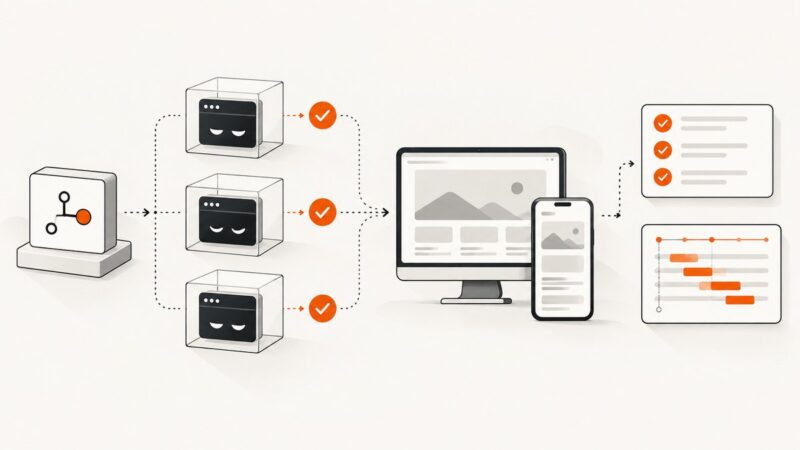
Run relevant checks regularly, preferably on each change where practical, so a failure can be connected to recent work. Stage the pipeline to provide useful feedback early and reserve broader, more expensive checks for later stages or higher-risk changes.
- Fast local and change checks: Run formatting, static checks, focused unit tests, and other low-dependency checks early.
- Boundary checks: Run contract, integration, or service-level tests once the required components and test data are available.
- Broader confidence checks: Run critical end-to-end journeys and wider suites before release, or in parallel with merge checks if the project requires it.
- Scheduled coverage: Run checks that are too expensive for every change on a regular schedule, and make their results visible to the people who own the affected risks.
Choose stages according to how quickly each check gives actionable evidence. A long test that finds an important release-blocking defect may belong in the pipeline; the question is where it can run without delaying every developer unnecessarily.
CI products document capabilities such as pipelines, test result reporting, distribution across agents, and selection of impacted tests. These are product features, not guarantees that a particular configuration will be faster or complete for your repository.
4. Measure bottlenecks before adding parallel workers
Record where time goes before increasing concurrency. Look at total wall-clock duration and per-test or per-stage duration, including environment provisioning, setup and teardown, test data creation, resource contention, and uneven work distribution. A suite may spend more time waiting for a shared service than executing assertions.
Parallel execution can reduce elapsed time when tests are independent and the infrastructure has capacity. It can also expose hidden coupling, increase contention, or cost more in compute and environment usage. Establish isolation and cleanup first.
- Identify the slowest tests and pipeline stages from recent runs.
- Separate test execution time from environment and data setup time.
- Check whether tests share mutable databases, accounts, files, ports, global state, or external rate limits.
- Make each test create and clean up its own data, or give workers isolated namespaces or environments.
- Try a modest amount of concurrency and compare wall-clock time, failure patterns, resource use, and worker balance.
- Increase workers only while the measured feedback improvement justifies the added capacity and complexity.
pytest’s documentation describes uncontrolled state, order dependencies, uncleaned data, and global state as causes of flaky behavior, including under parallel execution. Parallelism can reveal these problems; it does not fix them. CircleCI documents dynamic splitting that pulls tests from a shared queue to balance work, and Azure DevOps documents distributing execution across agents. Evaluate the behavior against your own runner, test duration data, and infrastructure.
5. Keep failures meaningful and investigate flaky tests
A flaky test gives different outcomes without a relevant code change. Treat it as a defect in the test system until its cause is understood: repeated unreliable failures teach people to distrust the suite and can obscure real regressions.
For a failure that passes on rerun, preserve the original result and investigate before treating the rerun as success. Check:
- Shared state: Does another test or worker modify the same row, account, file, or service state?
- Order dependence: Does the test assume setup performed by a previous test?
- Cleanup: Are temporary records, processes, browser sessions, or resources left behind?
- Timing assumptions: Does the test rely on a fixed sleep instead of waiting for a specific condition?
- Concurrency safety: Does parallel execution cause collisions, resource exhaustion, or rate limiting?
- Environment variation: Are network, clock, browser, service, or test-data differences affecting the result?
Assign an owner and track the investigation alongside the affected test. Retries can help classify intermittent failures, but they are mitigation, not a repair. Permanently allowing failures through an expected-failure mechanism is also risky because it can normalize a broken check. The cited guidance does not set one flake threshold for every team; define an operational policy based on your release risk and ability to respond.
6. Use test selection and analytics with safeguards
Running only tests believed to be affected by a change can shorten feedback, but it depends on accurate dependency or coverage information. Keep a reliable broader run as a backstop appropriate to your risk, and watch for gaps in selection data.
Azure DevOps documents Test Impact Analysis, and CircleCI documents impact analysis based on coverage data. Their documentation describes product capabilities, not proof that every relevant test will be selected in every repository. Verify support for your languages, runners, build structure, and service plan. If the selection mechanism is new, compare its choices with full-suite runs before relying on it as a merge gate.
Use results to identify recurring failure patterns and tests that cost time without adding clear evidence. Pair code coverage with assertions and risk review: coverage can show that code ran, but not whether the test would detect a meaningful defect.
7. Review outcomes instead of test counts
Track a small set of measures that connects feedback speed to trust and defect detection. Useful measures documented in the cited guidance include:
- Suite and stage execution time.
- Percentage of unreliable or flaky tests.
- Defect density and defect leakage across test levels.
- Automation coverage.
- Pass and fail trends, recurring failure patterns, and code coverage.
Interpret these together. A shorter run is not an improvement if it drops critical risk coverage. More code coverage is not sufficient if the tests lack useful assertions. More tests can make the suite slower and harder to maintain without increasing confidence. Review the measures periodically and move checks when you can improve feedback without losing required evidence.
GitLab publishes an estimated distribution dated 2025-02-03: 75.66% unit, 19.79% integration, 4.31% white-box system or feature, and 0.24% black-box end-to-end or QA tests across its Community and Enterprise editions. Treat this only as GitLab’s reported example, not an industry average or a target for your own portfolio.
8. Capture UI behavior selectively
When visual output is part of the risk—for example, a critical rendered page or a browser journey—screenshots can make failures easier to inspect. They are evidence for specific UI behavior, not a substitute for assertions about business logic, APIs, or data integrity. Capture only what helps a person diagnose or verify a risk, and avoid adding screenshot work to every check by default.
For a browser-based capture in your own test harness, use a browser automation tool supported by your stack and wait for a meaningful page condition before saving the screenshot. For example, this runnable Playwright script for Node.js takes a full-page screenshot after a page heading appears:
import { chromium } from 'playwright';

const browser = await chromium.launch({ headless: true });
try {
  const page = await browser.newPage({ viewport: { width: 1440, height: 900 } });
  await page.goto('https://example.com', { waitUntil: 'domcontentloaded' });
  await page.locator('h1').waitFor({ state: 'visible', timeout: 10000 });
  await page.screenshot({ path: 'page.png', fullPage: true });
} finally {
  await browser.close();
}
Install the browser automation dependency and browser binaries as part of your project setup. Replace the example URL and selector with a page and condition relevant to your application. For a selector-specific capture, use await page.locator('[data-testid="summary"]').screenshot({ path: 'summary.png' }). Keep the browser version and viewport consistent when you need comparable images, and avoid asserting exact pixels where dynamic content or fonts make the result unstable.
Or skip the browser setup
ScreenshotNeo is a website screenshot API and MCP server. One GET request returns a PNG, JPEG, WebP, or PDF; see the API documentation for its options and parameters.
curl -G "https://api.screenshotneo.com/v1/shot" \
  -d access_key=YOUR_API_KEY \
  --data-urlencode url=https://example.com \
  -o shot.webp
Cookie and consent banners, newsletter popups, and chat widgets are removed before capture. Bot checks, blank pages, failed loads, timeouts, and cache hits are never billed, and response headers identify the page verdict and billing status. An MCP server lets Claude, Cursor, and other MCP clients take screenshots. The free plan includes 1,000 screenshots each month with no card; paid plans start at $5 for 3,000. Sign up for 1,000 free screenshots a month, with no card.
Performance, reliability, and cost checklist
- Performance: Measure actual stage and test duration, then address setup overhead and worker imbalance before buying more concurrency.
- Reliability: Make tests independent, clean up state, wait on conditions, and investigate intermittent failures instead of hiding them with retries.
- Cost: Account for CI minutes, parallel workers, environment provisioning, test data, external service usage, and maintenance time. The sources do not establish a universal cost benchmark.
- Coverage: Preserve checks that address critical risks; remove duplication only when another check provides the needed evidence.
- Selection: Validate impacted-test analysis against full runs and keep broader checks suited to the system’s risk.
- Trust: Review unreliable test share and failure patterns alongside runtime and defect outcomes.
Troubleshooting
| Symptom | Likely cause | Fix |
|---|---|---|
| Suite gets slower as tests are added | Duplicate checks, expensive setup, or slow tests run too early. | Profile by stage and test, remove redundant assertions, and move broad expensive checks to a suitable later stage. |
| Parallel runs fail but serial runs pass | Shared mutable state, order dependence, incomplete cleanup, or resource contention. | Isolate test data and worker resources, make setup explicit, and ensure cleanup runs even after failures. |
| Tests fail intermittently on CI | Timing assumptions, environmental variation, external dependencies, or concurrency races. | Capture failure context, wait on explicit conditions, stabilize dependencies where practical, and assign an investigation owner. |
| More workers do not shorten the pipeline | A serial setup bottleneck, shared environment limit, or uneven test durations. | Measure provisioning and setup separately, inspect worker utilization, and rebalance work before increasing concurrency again. |
| Impacted-test runs miss a regression | Incomplete dependency or coverage data, unsupported build paths, or stale selection metadata. | Compare selections with broader runs, verify repository and language support, and keep risk-appropriate full-suite coverage. |
| Screenshot output differs between runs | Dynamic content, inconsistent viewport or browser version, or capture before the page is ready. | Use a stable viewport and browser version, wait for a meaningful selector, and avoid exact pixel comparisons on dynamic regions. |
Frequently asked questions
How many end-to-end tests should we have?
There is no universal number. Keep enough to validate critical journeys and risks that need whole-system evidence, then use cheaper levels for checks that do not require the complete path.
Is the test pyramid mandatory?
No. It is a planning aid. Architecture, safety needs, integration complexity, and the real cost and reliability of tests can justify a different distribution.
Should every flaky test be retried?
A retry can help reveal intermittency, but it does not explain or repair it. Preserve and investigate the original failure, and avoid letting retries make unreliable checks appear trustworthy.
Can test selection replace the full suite?
Only if the selection data and failure cost justify that choice. Validate selection against broader runs and account for gaps in dependencies or coverage data.
Sources
- Home Office Engineering Guidance: Test pyramid
- HMRC Engineering Guidance: Test automation
- pytest documentation: Flaky tests
- Microsoft Learn: Automated testing with Azure Test Plans
- CircleCI Docs: Automated testing
- GitLab Docs: Testing levels
- Martin Fowler: Test Pyramid
- Microsoft Learn: Effective testing practices for Azure workloads