How to Integrate Visual Testing into DevOps
Add visual regression checks to CI/CD with repeatable Playwright captures, deliberate baseline reviews, and merge gates that fit your team.
Integrate visual testing into DevOps by capturing important UI states in a controlled browser environment, comparing each capture with an approved baseline, and reviewing differences before deciding whether a change can merge. Visual checks complement functional tests: they reveal rendered changes, but do not prove that an interface is usable or functionally correct. A practical first step is to add a small set of Playwright screenshot assertions to the CI job you already run, then make the baseline review and merge policy explicit.
How visual testing fits into a CI/CD pipeline
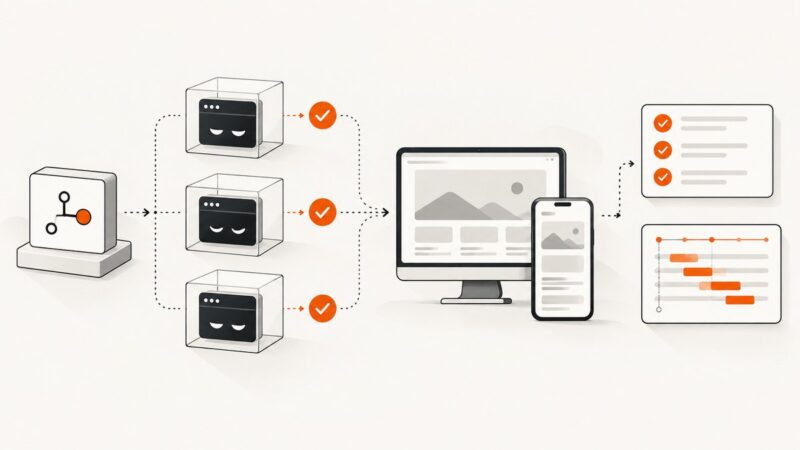
A visual regression test compares a rendered UI snapshot with a baseline so a team can see unintended changes. A typical flow is:
- Select important pages, components, and states.
- Render each state with a consistent browser, viewport, and test data.
- Capture a screenshot and compare it with the approved baseline.
- Review diffs in context and decide whether each change is expected.
- Update the baseline only after the change has been approved.
- Report the result or enforce a merge gate according to team policy.
The screenshot is evidence for review, not a verdict by itself. A diff may be a defect, an intentional design change, or rendering noise. Keep functional assertions for behavior such as navigation, validation, and checkout logic. See Chromatic’s visual testing documentation for its description of visual snapshots and Storybook stories as test cases.
Choose the UI states worth checking
Start with states where a visual regression could affect an important user journey or component. A small, high-value set is easier to keep deterministic and review than a capture of every route.
- Key landing, product, and account pages.
- Checkout or other high-value journey steps.
- Navigation open and closed, dialogs, validation errors, and empty states.
- Important responsive layouts, such as a desktop and a narrow mobile viewport.
- Shared components with meaningful variations, such as buttons, forms, and alerts.
For component-led work, Storybook stories can represent component states; Chromatic documents this approach in its visual testing guide. For end-to-end journeys, capture from a browser test after the test has reached the intended state. Avoid multiplying nearly identical captures without a clear risk they cover.
Run visual checks with Playwright in CI
Playwright’s built-in toHaveScreenshot() assertion is a direct route when your project already uses Playwright. The example below defines a deterministic page state, saves an approved screenshot baseline on the first baseline-creation run, and compares subsequent runs against it.
Install and configure
npm install --save-dev @playwright/test
npx playwright install --with-deps chromium
Create playwright.config.ts:
import { defineConfig } from '@playwright/test';

export default defineConfig({
  testDir: './tests',
  // Start with one worker in CI for stability and reproducibility.
  workers: process.env.CI ? 1 : undefined,
  use: {
    baseURL: process.env.BASE_URL ?? 'http://127.0.0.1:3000',
    browserName: 'chromium',
    viewport: { width: 1280, height: 800 },
    locale: 'en-US',
    timezoneId: 'UTC',
    colorScheme: 'light',
    // Keep diffs and failure evidence available in CI.
    trace: 'retain-on-failure',
    screenshot: 'only-on-failure',
  },
  reporter: [['list'], ['html', { open: 'never' }]],
});
Create tests/home.visual.spec.ts:
import { test, expect } from '@playwright/test';

test('home page visual state', async ({ page }) => {
  await page.goto('/');
  await expect(page.getByRole('heading', { name: 'Welcome' })).toBeVisible();

  // Wait for a meaningful ready condition instead of an arbitrary long delay.
  await expect(page.getByTestId('home-content')).toBeVisible();
  await expect(page).toHaveScreenshot('home.png', {
    fullPage: true,
    animations: 'disabled',
  });
});
The first run creates a baseline, so generate that baseline in a known environment and review it before treating it as approved. Commit the resulting snapshot files with the test, or use your chosen visual service’s baseline workflow. Keep baseline changes in the same review process as code changes.
Example GitHub Actions workflow
name: Playwright visual tests

on:
  pull_request:
  push:
    branches: [main]

jobs:
  visual:
    runs-on: ubuntu-latest
    steps:
      - uses: actions/checkout@v4
      - uses: actions/setup-node@v4
        with:
          node-version: 22
          cache: npm
      - run: npm ci
      - run: npx playwright install --with-deps chromium
      - run: npm run build
      - run: npm run start -- --port 3000 &
      - run: npx wait-on http://127.0.0.1:3000
      - run: npx playwright test
      - name: Upload Playwright report
        if: always()
        uses: actions/upload-artifact@v4
        with:
          name: playwright-report
          path: playwright-report/
          if-no-files-found: ignore
This workflow assumes the project has a start script and installs wait-on as a development dependency. Adapt the server startup and readiness check to your app. Playwright recommends setting workers to one in CI to prioritize stability and reproducibility; for larger suites, its CI guide describes sharding tests across jobs. Containers can help keep browser and operating-system dependencies consistent. See the Playwright CI documentation.
Make captures repeatable
Most noisy screenshot failures come from a changing capture environment or a page that was captured before reaching a stable state. Keep these inputs consistent:
- Browser and operating system: Pin the Playwright version and install its matching browser. Use a consistent runner or container when rendering differences matter.
- Viewport and device scale: Fix viewport dimensions and device scale factor. A different scale can change line wrapping and pixel output.
- Fonts and assets: Ensure fonts and images have loaded before capture. A fallback font can alter layout substantially.
- Data and time: Use fixtures or seeded data. Freeze timestamps or hide truly volatile regions where the tool supports it.
- Page readiness: Wait for a visible state or app-specific ready signal. A generic network-idle condition can be unreliable on pages with polling or analytics.
- Animation: Disable or complete animation before capture. Playwright screenshot assertions can disable animations as shown above.
- External content: Mock unstable APIs or block irrelevant third-party requests where appropriate. Do not hide a region if its content is what the test is meant to protect.
Playwright provides browser installation and container guidance for CI environments; its documentation calls containers useful for consistent screenshot and visual-regression environments. Percy also documents capture readiness and configuration in its Playwright client. Follow the capture and configuration behavior for the exact tool version in use.
Choose how visual differences affect merges
A detected difference should have an explicit path through code review. Common policies include:
| Policy | Pipeline behavior | Useful when |
|---|---|---|
| Report only | Publish results and artifacts; do not fail solely because pixels changed. | The team is first measuring review volume or refining coverage. |
| Human review required | Show diffs on the pull request and require approval before accepting a new baseline. | Design changes need a deliberate review. |
| Fail on unapproved changes | Return a failing check when a difference has not been accepted under the tool’s workflow. | The team has stable captures and a clear baseline approval process. |
An intentional design change still needs baseline approval; an unexpected diff needs investigation. Do not let CI silently bless every new image, since that can turn a regression into the new expected result. Conversely, a changed screenshot is not proof of a product defect: inspect the diff and the page state first.
Integration routes: native checks and hosted review
Choose based on the tests and review workflow you already have. Product behavior, current limits, and gate settings should be checked in the vendor documentation before adopting them.
| Route | Good fit | Check before adoption |
|---|---|---|
| Playwright native assertions | The team already runs Playwright and wants assertions close to its test suite. | Baseline storage and updates, browser consistency, cross-browser coverage, artifacts, and failure handling. |
| Chromatic | The team uses Storybook, Vitest, Playwright, or Cypress and wants hosted snapshot review and pull request checks. | Framework integration, CI token handling, diff behavior, and current plans and limits. See Chromatic CI documentation. |
| Percy | The team wants to upload visual snapshots from an existing CI suite and uses a supported integration. | Capture and review workflow, gate behavior, browser requirements, and current plans and limits. See Percy’s integrations and Playwright client. |
For Chromatic, the documented CI setup uses a CHROMATIC_PROJECT_TOKEN secret and a command such as chromatic --playwright --exit-zero-on-changes where that behavior matches the desired policy. Its UI Test and UI Review settings can affect whether detected changes produce a non-zero exit code, so decide how the team wants pull requests gated. Percy documents routing Playwright screenshot assertions through its client and an optional reporter gate; its review verdict is handled in the Percy workflow, and errors can fall back to native Playwright behavior. Verify current behavior in the linked docs before wiring a required status check.
Troubleshooting common visual test failures
| Symptom | Likely cause | Fix |
|---|---|---|
| Diffs appear on every build | Browser, operating system, fonts, viewport, locale, or device scale varies. | Pin versions and capture settings; use a consistent runner or container and install the matching browser dependencies. |
| Text or layout shifts intermittently | Fonts, images, or app data are not ready at capture time. | Wait for a specific app-ready condition and verify required assets loaded before asserting the screenshot. |
| Only animated regions differ | Transitions, carousels, blinking cursors, or video are at different frames. | Disable animations, set a stable frame, or mask a genuinely irrelevant dynamic area using the chosen tool’s supported mechanism. |
| Screenshot assertion times out | The page never reaches the expected state, a selector is wrong, or a request is stuck. | Inspect the trace and test report, assert the relevant locator before capture, and fix or mock the dependency causing the wait. |
| Baseline is missing on CI | Baseline files were not committed, generated for a different project/platform, or are stored in an unavailable location. | Review and commit the baseline or configure the selected service’s baseline workflow; make the CI environment match its generation environment. |
| CI fails after a deliberate redesign | The rendered result changed but the approved baseline did not. | Review the diff with the design change, then update and commit or approve the new baseline through the team’s normal review. |
| Hosted service check stays pending or fails | Missing or invalid CI token, a job did not upload snapshots, or the service’s status-check policy differs from expectations. | Check secret names and job logs, confirm the upload command ran, and verify the tool’s current pull-request gate settings. |
Performance, reliability, and cost
Visual testing adds browser work, snapshot comparison, artifact storage, and human review. No universal suite size or speedup follows from the tools’ documentation; measure job duration and review load in your own application.
- Start narrow: Cover the routes and states with the highest user or business impact, then expand based on failures and review capacity.
- Control concurrency: Begin with one Playwright worker in CI for reproducibility. If the suite becomes slow, shard it across jobs and compare the added runner cost and maintenance.
- Reduce wasted captures: Reuse existing journey setup where practical and capture only after the relevant state is ready.
- Plan for failure evidence: Retain reports, traces, and screenshot diffs so a failure can be diagnosed without rerunning blindly.
- Budget hosted review separately: Compare current plan limits, snapshot or build counting rules, retention, and CI usage with expected workload. The research sources do not establish current pricing, so check vendors’ pricing pages before estimating cost.
Reliability depends on stable rendering and a baseline process people follow. A fast pipeline with noisy failures can lose trust; a small, stable gate is often more useful than broad coverage no one reviews.
Or skip the browser setup
ScreenshotNeo is a website screenshot API and MCP server. One GET request captures a URL as PNG, JPEG, WebP, or PDF. For CI jobs that need a rendered page image without installing and managing a browser in that job, call the API as part of the capture step. Read the ScreenshotNeo API documentation for request options and response details.
curl -G "https://api.screenshotneo.com/v1/shot" -d access_key=YOUR_API_KEY --data-urlencode url=https://stripe.com -o shot.webpimport requests
r = requests.get(
"https://api.screenshotneo.com/v1/shot",
params={"access_key": "YOUR_API_KEY", "url": "https://stripe.com"},
timeout=90,
)
r.raise_for_status()
open("shot.webp", "wb").write(r.content)const q = new URLSearchParams({ access_key: 'YOUR_API_KEY', url: 'https://stripe.com' });
const res = await fetch(`https://api.screenshotneo.com/v1/shot?${q}`);
if (!res.ok) throw new Error(`Screenshot request failed: ${res.status}`);
await Bun.write('shot.webp', new Uint8Array(await res.arrayBuffer()));Replace the example URL with your target. The Node.js example uses Bun’s file writer; in Node.js, write the response bytes with node:fs/promises:
import { writeFile } from 'node:fs/promises';

const q = new URLSearchParams({ access_key: 'YOUR_API_KEY', url: 'https://stripe.com' });
const res = await fetch(`https://api.screenshotneo.com/v1/shot?${q}`);
if (!res.ok) throw new Error(`Screenshot request failed: ${res.status}`);
await writeFile('shot.webp', Buffer.from(await res.arrayBuffer()));- Cookie banners are accepted and removed before capture, along with known consent platforms, newsletter popups, and chat widgets; each cleanup step can be turned off.
- Bot checks, blank pages, timeouts, failed loads, and cache hits are not billed; response headers report page verdict and billing status.
- An MCP server provides
take_screenshot,get_page_info, andcapture_pdftools for AI agents and MCP clients. - The free plan includes 1,000 screenshots per month with no card; paid plans start at $5 for 3,000. Every feature is on every plan.
For visual regression specifically, you still need to define which states to capture, keep inputs stable, compare against an approved baseline, and decide how diffs affect merges. ScreenshotNeo supports options including full-page capture, CSS-selector element capture, viewport and device presets, retina scale, waits, custom CSS and JavaScript, hiding selectors, request blocking, caching, and bulk capture. See the docs for supported parameters.
Create a free ScreenshotNeo account for 1,000 screenshots a month with no card.
FAQ
Do visual tests replace end-to-end tests?
No. Visual snapshots show rendered appearance; functional assertions are still needed to check behavior and outcomes.
Should every screenshot difference fail a pull request?
That depends on the team’s review workflow. Make the behavior explicit, and require approval before accepting intentional baseline changes.
Can visual tests run only on pull requests?
Yes. A team can run them on pull requests, pushes to selected branches, or both; choose triggers that give reviewers timely results and fit the cost of the suite.
How many pages should a team capture first?
There is no universal number. Begin with a small set of important states, then expand based on observed regressions, runtime, and review capacity.