BlogScreenshots on your device
Why Java Robot Screen Captures Are Slow on Some Machines
Robot.createScreenCapture reads desktop pixels through native code, so OS, HiDPI scaling, permissions and display setup can change its speed.
java.awt.Robot.createScreenCapture(Rectangle) can be slow because it reads pixels from the desktop through a platform-native capture path. It is not copying an already rendered Swing buffer. The operating system, display server, desktop session, capture permissions, monitor layout, display scaling and JDK build all affect how long the native read takes.
There is no universal threshold that defines a “slow” Robot capture. Compare identical rectangles, monitors, scaling, permissions and JDK versions before concluding that Java itself is the cause.
What the call actually does
Robot asks the platform to return pixels for a screen rectangle. Oracle documents that screen capture may be a lengthy operation and recommends avoiding it on the AWT Event Dispatch Thread, especially when permission acquisition requires user interaction. See the Robot API documentation.
The returned BufferedImage is only the capture result. Image conversion, PNG or JPEG encoding, disk writes, synchronization and later processing are separate costs and should be timed separately.
Why two machines behave differently
Operating system and display server
OpenJDK routes Robot through platform-specific native implementations. Windows, macOS and Linux desktop sessions can use different APIs, compositors and permission models. On Linux, the X11 or Wayland session, compositor and desktop configuration can change the path further.
HiDPI and display scaling
Oracle’s graphics configuration documentation describes scaling transforms and multiple resolution variants. A logical rectangle can map to more physical pixels when a display is scaled, increasing the amount of data that must be read and processed.
Linux scaling defects have also affected Robot directly. OpenJDK issue JDK-8280861 records capture and pixel-color failures when scaling exceeded 100%; the issue was fixed in JDK 19 build 11 and affected development, JDK 11 and JDK 17 lines. Test the exact JDK build you deploy.
Permissions and first-call behavior
Some systems ask for screen-recording or accessibility permission. The first capture can therefore be slower, blocked, or paused while a user responds. A later call may be faster after permission is granted.
Rectangle, monitor and session choice
A full multi-monitor desktop transfers more pixels than a small fixed rectangle. Monitor selection also matters: a scaled external display and the primary display may have different transforms. Record the selected GraphicsDevice, monitor count and rectangle dimensions when comparing machines.
Measure the capture rather than guessing
Use a monotonic clock and time only createScreenCapture. Run the capture on a worker thread so the Event Dispatch Thread stays responsive.
import java.awt.AWTException;
import java.awt.GraphicsDevice;
import java.awt.GraphicsEnvironment;
import java.awt.Rectangle;
import java.awt.Robot;
import java.awt.image.BufferedImage;

public class RobotCaptureTiming {
    public static void main(String[] args) throws Exception {
        GraphicsEnvironment ge = GraphicsEnvironment.getLocalGraphicsEnvironment();
        GraphicsDevice device = ge.getDefaultScreenDevice();
        Rectangle bounds = device.getDefaultConfiguration().getBounds();
        Robot robot = new Robot(device);

        // Warm-up helps reveal first-call permission or initialization cost.
        robot.createScreenCapture(new Rectangle(bounds.x, bounds.y,
                Math.min(320, bounds.width), Math.min(240, bounds.height)));

        for (int i = 1; i <= 5; i++) {
            long start = System.nanoTime();
            BufferedImage image = robot.createScreenCapture(bounds);
            long elapsedNanos = System.nanoTime() - start;
            System.out.printf("run=%d size=%dx%d capture_ms=%.3f%n",
                    i, image.getWidth(), image.getHeight(), elapsedNanos / 1_000_000.0);
        }
    }
}
Compile and run it with the same JDK on each machine:
javac RobotCaptureTiming.java
java RobotCaptureTiming
For a useful comparison, record:
- OS, desktop session and display server
- JDK vendor, major version and exact build
- display scaling percentage and whether HiDPI is enabled
- monitor count, selected
GraphicsDeviceand rectangle width and height - whether permission was already granted
- first-run time versus warmed-up times
A controlled diagnostic sequence
- Capture a small fixed rectangle, such as 320×240, five times.
- Capture the selected display’s full bounds five times.
- Repeat with the same monitor selected explicitly through
GraphicsDevice. - On Linux, compare 100% scaling where practical, then repeat in the same desktop session. Treat any improvement as an environment finding, not a Java-language rule.
- Compare the exact JDK builds. Upgrade or patch lines affected by known scaling defects.
- Time encoding and file output independently if the application still feels slow after the native call is fast.
HiDPI and multi-resolution captures
If the application needs native-resolution variants on a scaled display, investigate Robot.createMultiResolutionScreenCapture and the image variants it returns. If you only need one ordinary image, avoid unnecessary multi-resolution processing and allocations. Keep the coordinate system consistent with the selected screen’s graphics configuration.
Keep Robot off the EDT
Never put repeated captures in an ActionListener or another Event Dispatch Thread task. A slow native call blocks repainting, input handling and layout.
import java.awt.Rectangle;
import java.awt.Robot;
import java.awt.image.BufferedImage;
import java.util.concurrent.ExecutorService;
import java.util.concurrent.Executors;

ExecutorService captureExecutor = Executors.newSingleThreadExecutor();
Robot robot = new Robot();
Rectangle area = new Rectangle(0, 0, 800, 600);

captureExecutor.submit(() -> {
    BufferedImage image = robot.createScreenCapture(area);
    // Encode or publish the image here, then notify the EDT with SwingUtilities.invokeLater.
});
Use a bounded queue or a single worker when captures are periodic. Otherwise, requests can pile up faster than the native capture path completes.
Troubleshooting
| Symptom | Likely cause | Fix |
|---|---|---|
| UI freezes during capture | Capture runs on the EDT | Move it to a worker thread and publish results back to the EDT. |
| Only the first call is slow | Permission prompt or native initialization | Grant screen-capture permission, warm up once off the EDT, and measure steady-state calls separately. |
| Linux is slow while Windows is fast | Different native path, desktop session, compositor or scaling | Record X11/Wayland and desktop details; compare at 100% scaling and with the same rectangle. |
| Capture fails or colors are wrong above 100% scaling | JDK scaling defect or coordinate mismatch | Check the JDK build against JDK-8280861, test a fixed JDK, and verify graphics-coordinate transforms. |
| Full-screen capture is much slower than a small area | More physical pixels and memory movement | Capture only the required region or split work into controlled jobs. |
| Robot timing is low but the app is slow | Encoding, allocation, locking or disk I/O | Profile each stage independently; do not attribute post-processing to Robot. |
| Wrong monitor or negative coordinates | Multi-monitor layout and device bounds | Use the target GraphicsDevice bounds and preserve its x/y origin. |
Performance and reliability practices
- Reuse a worker and avoid creating threads for every frame.
- Keep rectangles as small as the requirement allows.
- Separate capture, image conversion, encoding and upload timers.
- Apply backpressure to periodic capture; drop stale frames instead of building an unbounded queue.
- Log OS, JDK build, scaling, monitor and rectangle metadata with latency so regressions are comparable.
- Handle
AWTException, permission denial and headless environments explicitly. - Do not assume a desktop compositor or permission state is identical between local, CI and remote sessions.
When a desktop Robot is the wrong boundary
Robot captures whatever the logged-in desktop renders, so it requires a graphics session and its permissions. For server-side website images, a browser screenshot API avoids maintaining a desktop, display server and browser automation stack.
Or skip the browser setup
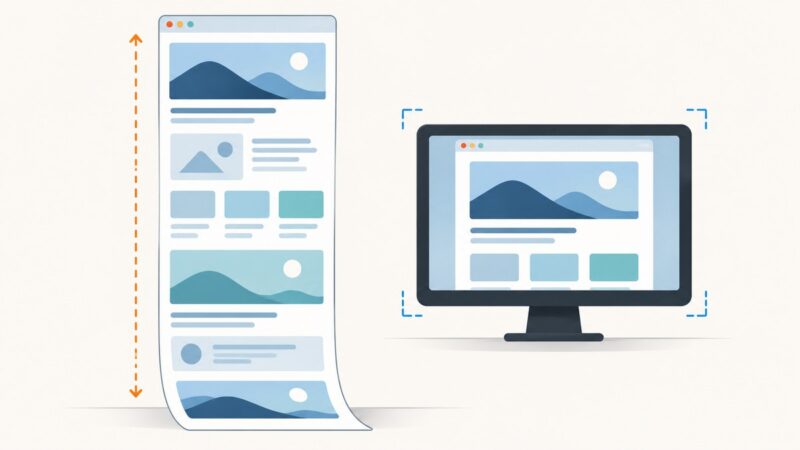
ScreenshotNeo is a website screenshot API and MCP server. One request returns PNG, JPEG, WebP or PDF, with options for full-page capture, elements, devices, custom CSS and JavaScript, waiting, blocking, authentication and more. Its consent step accepts cookie banners and removes more than 60 known consent platforms, newsletter popups and chat widgets before capture.
Only clean shots are billed: bot checks or CAPTCHAs, blank pages, timeouts, failed loads and cache hits cost nothing, and response headers report the page verdict and billing result.
curl -G "https://api.screenshotneo.com/v1/shot" \
  -d access_key=YOUR_API_KEY \
  --data-urlencode url=https://stripe.com \
  -o shot.webp
import requests
r = requests.get(
"https://api.screenshotneo.com/v1/shot",
params={"access_key": "YOUR_API_KEY", "url": "https://stripe.com"},
timeout=90,
)
r.raise_for_status()
open("shot.webp", "wb").write(r.content)const q = new URLSearchParams({ access_key: 'YOUR_API_KEY', url: 'https://stripe.com' });
const res = await fetch(`https://api.screenshotneo.com/v1/shot?${q}`);
if (!res.ok) throw new Error(`${res.status} ${await res.text()}`);
const fs = require('node:fs');
fs.writeFileSync('shot.webp', Buffer.from(await res.arrayBuffer()));See the ScreenshotNeo API documentation for all options. Its MCP server provides take_screenshot, get_page_info and capture_pdf for Claude, Cursor and other MCP clients. The free plan includes 1,000 screenshots per month with no card; paid plans start at $5 for 3,000 shots. Create a free ScreenshotNeo account.
FAQ
Is Robot always slower on Linux?
No. Linux can differ because its native capture path, desktop session, compositor, permissions and scaling differ. Measure the same setup on each machine.
Does HiDPI always make capture slower?
It can increase physical pixel work and has exposed documented Linux defects, but the effect depends on the JDK, display configuration and rectangle.
Can I make Robot asynchronous?
Robot’s method is synchronous, but you can call it from a worker thread and keep the EDT responsive.
What is a normal capture time?
No current authoritative cross-platform benchmark establishes one. Use controlled measurements from your deployment environment.
Should I switch to a screenshot API?
Use a service when you need website captures without a desktop session, browser setup and permission management. For local desktop pixels, Robot remains the appropriate API.