How to Build an MCP Screenshot Capture Workflow
Build a reliable MCP screenshot workflow with Playwright: inspect pages, capture viewport, element, and full-page images, then run it locally or over HTTP.
Direct answer: Install the Playwright MCP server, connect it to an MCP client, navigate to a page, call browser_snapshot to obtain stable accessibility references, interact with those references, and then call browser_take_screenshot when the page is ready. Use no scope options for the viewport, target for one element, or fullPage:true for the complete scrollable page.
What the workflow does
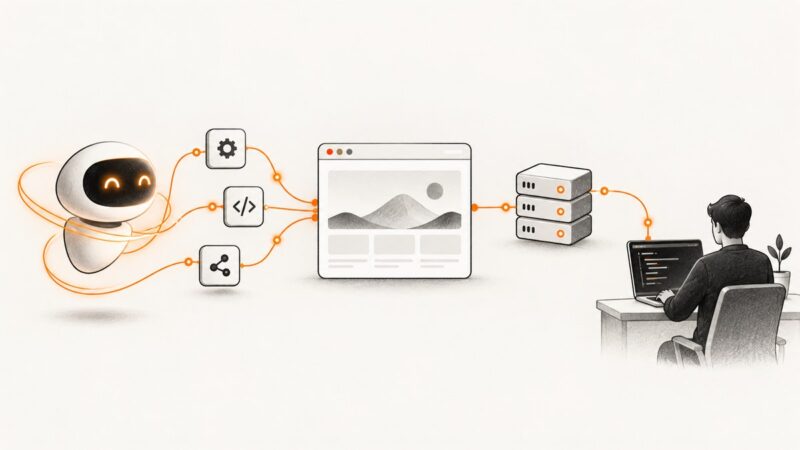
An MCP screenshot workflow separates interaction from visual evidence:
- The MCP client starts Playwright MCP.
- The browser navigates to the target URL.
browser_snapshotreturns the current accessibility tree and stable refs.- The agent uses those refs to click, fill, or otherwise change the page.
- A new snapshot confirms the resulting state.
browser_take_screenshotwrites a PNG, JPEG, or WebP artifact.
Playwright’s guidance is concise: “Screenshots are for looking at, not for acting on — use browser_snapshot to get refs to interact with.” See the screenshots reference and MCP getting-started guide.
Prerequisites
- Node.js 20 or newer.
- An MCP client such as VS Code, Cursor, Windsurf, Claude Code, Claude Desktop, or another compatible client.
- A URL that the browser process can reach.
- A writable location for screenshot files when your client does not manage artifacts automatically.
Install and register Playwright MCP
The simplest setup lets npx download and run the current server:
{
  "mcpServers": {
    "playwright": {
      "command": "npx",
      "args": ["@playwright/mcp@latest"]
    }
  }
}
Save this in the configuration format required by your MCP client, restart or reload the client, and verify that the Playwright tools appear. Pin a package version in production if you need repeatable builds; using @latest follows the current release.
Capture a viewport screenshot
- Ask the client to navigate to the page.
- Call
browser_snapshotand inspect the returned tree. - Perform any required interaction by using the snapshot refs.
- Call
browser_snapshotagain after navigation or a state change. - Call
browser_take_screenshotwithouttargetorfullPage.
A deterministic request can specify an output type, scale, and filename:
{
  "type": "png",
  "scale": "css",
  "filename": "artifacts/home-viewport.png"
}
scale:"css" keeps CSS-pixel dimensions. Use scale:"device" when you need device-pixel resolution.
Capture one element
Use a snapshot ref or a unique selector as target. A ref is preferable after inspecting the current page because it identifies the element in the accessibility tree.
{
  "target": "e42",
  "type": "webp",
  "scale": "device",
  "filename": "artifacts/pricing-card.webp"
}
You can also target a selector when your client and page make that selector stable:
{
  "target": "main article.pricing",
  "type": "jpeg",
  "filename": "artifacts/pricing.jpg"
}
Take a fresh snapshot after navigation, opening a dialog, switching tabs, or any DOM update. Old refs can stop identifying the intended element when the page changes.
Capture the full scrollable page
Set fullPage:true and omit target:
{
  "fullPage": true,
  "type": "png",
  "scale": "css",
  "filename": "artifacts/home-full.png"
}
Do not combine fullPage with an element target. For a long page, allow lazy images and deferred sections to finish loading before capture. If content appears only after scrolling, use the page’s own interaction or wait steps first, then take the screenshot.
Choose image type and resolution
| Option | Use it when |
|---|---|
type:"png" |
Text, diagrams, transparency, or lossless output matters. |
type:"jpeg" |
A smaller photographic image is acceptable. |
type:"webp" |
You want modern compression and broad pipeline support. |
scale:"css" |
You need predictable CSS-pixel dimensions for visual diffs. |
scale:"device" |
You need a high-resolution, device-pixel artifact. |
Use snapshots for deterministic interaction
Do not ask an agent to click coordinates from a screenshot. The reliable sequence is:
navigate to https://example.com
browser_snapshot
click the ref for “Open menu”
browser_snapshot
click the ref for “Documentation”
browser_snapshot
browser_take_screenshot { "target": "main", "type": "png", "filename": "docs.png" }
The second snapshot matters because refs are tied to the current page state. This also makes a workflow easier to review: each action has a structured input and each screenshot is a checkpoint.
Run Playwright MCP as a standalone HTTP service
A separate CI worker or automation process can host the server over HTTP:
npx @playwright/mcp@latest --port 8931Point the MCP client at:
http://localhost:8931/mcpThe HTTP mode uses a five-second heartbeat timeout by default. If a proxy, tunnel, or slow client needs more time, set PLAYWRIGHT_MCP_PING_TIMEOUT_MS in the server environment. Set it to 0 to disable the heartbeat.
PLAYWRIGHT_MCP_PING_TIMEOUT_MS=15000 npx @playwright/mcp@latest --port 8931Keep the service reachable only by the clients that need it, and put lifecycle management, logs, and artifact storage around the process in your CI or worker platform.
Add capabilities only when needed
Core navigation and snapshot tools are available by default. Optional capability groups add specialized behavior:
| Capability | When to enable it |
|---|---|
vision |
Canvas or visual interaction cannot be represented well by accessibility refs. |
pdf |
The workflow must produce PDF output. |
devtools |
You need tracing and browser diagnostics. |
network |
The workflow must inspect or control network behavior. |
storage |
You need to work with browser storage. |
testing |
The capture is part of a testing workflow. |
Enable only the groups required by the job. A smaller capability footprint reduces configuration and makes permissions easier to reason about.
Use tracing to debug a capture
When a screenshot is wrong, a single image rarely explains why. With tracing enabled through the development-tools capability, the execution trace can contain DOM snapshots, screenshots, network activity, and console logs at each step. Review the trace to locate the first failed navigation, missing request, console error, or state transition before the screenshot call.
Make the workflow reliable
- Re-snapshot after every meaningful state change. Navigation, modal dialogs, client-side routing, and form submissions can invalidate refs.
- Wait for the actual condition. Capture after the required selector exists, a known delay has elapsed, or the page reaches network idle according to your client workflow.
- Use deterministic filenames. Include a page name, viewport or scope, and an identifier from your build so downstream steps do not overwrite unrelated artifacts.
- Keep viewport and scale fixed for visual diffs. A changed device scale can look like a layout regression.
- Capture evidence after interaction. A screenshot before a cookie dialog is dismissed proves a different state from one after dismissal.
- Record failures with the URL and step. Store the last successful snapshot, the screenshot request, and trace information when available.
Performance and cost considerations
Full-page images and device-scale output require more browser work and produce larger artifacts than viewport captures at CSS scale. Element captures are usually the smallest scope. Reuse a running standalone server for a batch rather than starting a new process per URL, and avoid enabling capabilities that the job does not use. Cache or deduplicate artifacts in your own pipeline when the same page and state are captured repeatedly. Playwright MCP itself does not publish a universal speed or cost benchmark; measure your URLs, browser environment, and concurrency before setting service limits.
Troubleshooting
| Symptom | Likely cause | Fix |
|---|---|---|
| The MCP server does not appear | Invalid client configuration, missing Node.js, or npx cannot resolve the package. |
Check Node.js is version 20 or newer, validate the JSON, restart the client, and run npx @playwright/mcp@latest from a terminal. |
| A ref no longer works | The page changed after the snapshot. | Call browser_snapshot again and use the new ref. |
| The screenshot shows the wrong state | Capture occurred before navigation, animation, or a client-side update finished. | Wait for the relevant selector, state, or network condition, then snapshot and capture. |
| Only the visible area is captured | fullPage:true was omitted. |
Set fullPage:true and remove target. |
| An element capture fails | The target selector is not unique, hidden, or stale. | Use a fresh snapshot ref or a unique visible selector. |
| HTTP clients disconnect | The heartbeat expires through a slow proxy or client. | Increase PLAYWRIGHT_MCP_PING_TIMEOUT_MS, or set it to 0 when heartbeats cannot pass through the transport. |
| Lazy content is missing | Images or sections load only after scrolling or interaction. | Scroll or trigger the required interaction, wait for the content, snapshot, then capture. |
| The output is too large | Full-page scope, device scale, or PNG output creates a large artifact. | Capture an element or viewport, use CSS scale, or choose JPEG/WebP where lossless output is not required. |
Or skip the browser setup
ScreenshotNeo provides a hosted screenshot API and MCP server. It accepts one GET request and returns a PNG, JPEG, WebP, or PDF. Cookie and consent banners, newsletter popups, and chat widgets are removed before the shot. Bot checks, blank pages, failed loads, timeouts, and cache hits are not billed, and the response identifies the result with X-Page-Verdict and X-Billed headers. Its MCP tools include take_screenshot, get_page_info, and capture_pdf, so AI agents can request captures without managing a browser process.
See the ScreenshotNeo API documentation for all options.
curl -G "https://api.screenshotneo.com/v1/shot" -d access_key=YOUR_API_KEY --data-urlencode url=https://stripe.com -o shot.webpimport requests
r = requests.get("https://api.screenshotneo.com/v1/shot", params={"access_key": "YOUR_API_KEY", "url": "https://stripe.com"}, timeout=90)
open("shot.webp", "wb").write(r.content)const q = new URLSearchParams({ access_key: 'YOUR_API_KEY', url: 'https://stripe.com' });
const res = await fetch(`https://api.screenshotneo.com/v1/shot?${q}`);There are 1,000 screenshots a month free with no card. Paid plans start at $5 for 3,000 screenshots, and every feature is included on every plan. Create a free ScreenshotNeo account.
FAQ
Should I use a browser snapshot or a screenshot to interact?
Use browser_snapshot for interaction and refs. Use browser_take_screenshot for visual evidence after the desired state is reached.
Can I capture an element and the full page in one request?
No. Use an element target for one component or fullPage:true for the scrollable page, then make separate captures if you need both.
Which scale should visual regression tests use?
Use scale:"css" with a fixed viewport for stable CSS-pixel artifacts. Choose device scale when the test specifically covers device-pixel rendering.
When is standalone HTTP useful?
Use it when a CI worker, remote process, or multiple clients need to connect to one long-running MCP server instead of launching a local process for each session.
Do I need the vision capability for ordinary web pages?
No. Accessibility snapshots and standard screenshot tools cover ordinary DOM-based pages. Add vision for canvas or other visual interactions that structured refs cannot express.