What Is the Mobile Testing Pyramid?
The mobile testing pyramid helps teams balance fast, focused checks with realistic device and UI tests. Learn how to choose layers, coverage, and CI cadence.
The mobile testing pyramid is a way to organize tests by scope and feedback cost: many fast checks for isolated logic, fewer tests for components and interactions, and a small set of broad UI or end-to-end tests for important user journeys. It is a guide for choosing useful feedback, not a required test count or ratio. Android describes the traditional model as a baseline rather than a rule, and Apple recommends a large set of fast isolated unit tests, a smaller integration layer, and UI tests for common use cases. Android testing strategy · Apple Xcode testing
1. The layers in a mobile testing pyramid
Teams use “unit,” “integration,” and “end-to-end” differently, so write down what each layer means in your app. Android’s example expands the classic three layers into five, making boundaries easier to discuss:
| Layer | Scope | Example | Typical feedback |
|---|---|---|---|
| Unit | One small unit of logic, generally without Android framework dependencies | Check a price formatter or sign-in input validator | Fast and focused; failures are usually easier to localize |
| Component | One independently tested module or UI component | Verify a custom button’s behavior and appearance | Checks a component boundary without launching a full user journey |
| Feature | Two or more components or modules working together | Verify screen state management and interaction with an authentication manager | Finds integration problems within a feature |
| Application | The deployable app binary and its features or services | Exercise a sign-in dialog in a debuggable app build | Higher fidelity, with more setup and runtime |
| Release candidate | An optimized build in an environment close to production | Complete a critical sign-in journey against staging | Broad confidence for release-critical behavior |
These are scope labels, not test techniques. A behavior assertion, screenshot comparison, or performance check can appear at different layers. Choose the boundary that gives your team an actionable result.
2. How to choose the right layer
Start with the lowest layer that can answer the question you have. In a sign-in feature, for example:
- Test input validation as a unit: valid and invalid inputs should produce clear outcomes.
- Test the form component’s behavior and appearance at the component layer.
- Test the interaction between the form and authentication manager at the feature layer.
- Test that the dialog and app-level services work together in an application build.
- Test the complete journey against staging at the release-candidate layer when the journey is important enough to justify the cost.
Do not duplicate every assertion at every level. A lower-level test is usually better when it can provide the same useful signal quickly and with less setup. Keep a broader test when the behavior depends on real integration, app packaging, platform behavior, or a user-visible journey that lower layers cannot represent.
Make each test failure useful
- Keep small tests isolated so they point to a narrow cause.
- Use integration tests to check actual boundaries between modules or services, not merely to repeat unit assertions.
- Use UI tests for behavior that depends on the rendered app or a sequence of user actions.
- For visual regression checks, compare screenshots with approved images; for behavior checks, inspect the UI hierarchy or user-visible state. Android documents both approaches.
- Keep a test at a broader layer when it covers a risk that cannot be represented faithfully below it.
3. Adapt the pyramid to mobile risks
Mobile coverage has dimensions beyond code paths. Devices differ in operating-system and API level, screen size, locale, orientation, and form factor. Android’s UI testing guidance calls out varying API levels, English, Arabic and Chinese locales, portrait and landscape, tablets, and foldables. Physical devices can matter as well, especially when the app relies on hardware such as cameras or media playback. Android UI testing guidance
Choose a device matrix from your users and app risks rather than trying every combination in every test. For example, use focused tests for most logic and select representative configurations for compatibility journeys. Add physical-device coverage when a simulator cannot provide the hardware or platform behavior under test. The right distribution can differ substantially for a camera app and a content app.
On Apple platforms, Xcode’s guidance likewise favors many fast isolated unit tests, a smaller integration set, and UI checks for common use cases. Xcode 16 and later includes Swift Testing for unit tests and XCTest for UI tests with XCUIAutomation. Apple also recommends performance tests for performance-critical code. Apple’s testing documentation
4. Schedule tests by feedback cost and risk
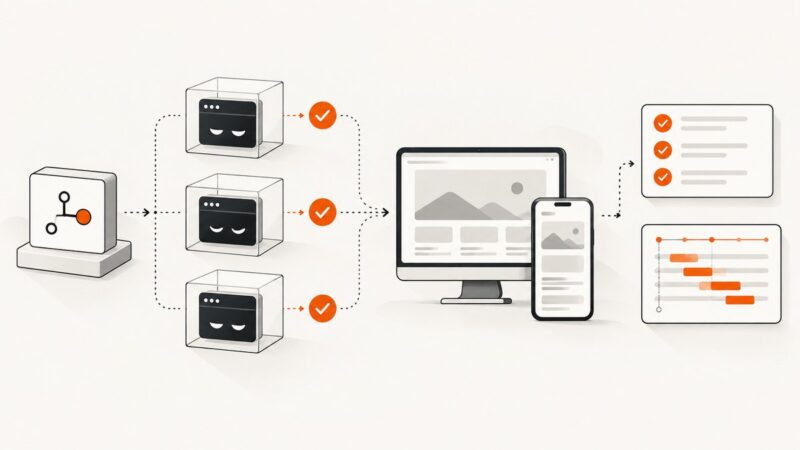
Run fast checks frequently and schedule broader checks where their runtime and infrastructure cost make sense. Android gives one example cadence:
| When | Example checks | Why |
|---|---|---|
| Each commit | Unit and component tests | Fast feedback during active development |
| Before merge | Feature integration checks | Catch interactions before code joins the main branch |
| After merge | Application-level checks | Exercise the integrated app build |
| Nightly and before release | Release-candidate journeys across a broader device set | Spend more time on high-risk compatibility and release paths |
This is an example, not a fixed schedule. Revise it if test volume slows delivery, if a layer becomes unreliable, or if the risk of a missed failure changes. Track whether failures are actionable and whether broad tests provide signal beyond checks already running earlier.
5. Ratios, tradeoffs, and when to change the shape
The often-repeated 70% unit, 20% integration, 10% end-to-end split comes from a 2015 Google Testing Blog post. It is a simplified rule of thumb, not a universal allocation and not a mobile-specific standard. Current Android and Apple guidance supports the qualitative idea of many fast, isolated tests and fewer broad tests, while allowing teams to adapt the model. Google Testing Blog, 2015
Broad UI-driven checks can be slower, more expensive to maintain, and vulnerable to nondeterminism. They can still be the right choice when high-level checks are fast, reliable, and inexpensive to change, or when only the full app can expose the risk. Conversely, not every behavior can be covered adequately by unit tests. Treat the pyramid as a way to reason about scope, isolation, runtime, and fidelity rather than a quota. Martin Fowler on the test pyramid
6. A practical setup checklist
- Define what unit, component, feature, application, and release-candidate tests mean for your app.
- For each important behavior, identify the lowest layer that gives an actionable signal.
- Keep broad tests for real integration boundaries, platform behavior, and critical journeys.
- List relevant OS/API levels, locales, orientations, devices, and form factors.
- Include physical devices if your app depends on hardware or behavior that simulators do not represent.
- Run fast tests on commits and schedule slower checks according to release risk and team feedback needs.
- Review flaky or redundant tests and adjust the strategy as test volume changes.
7. Capturing screenshots for visual checks
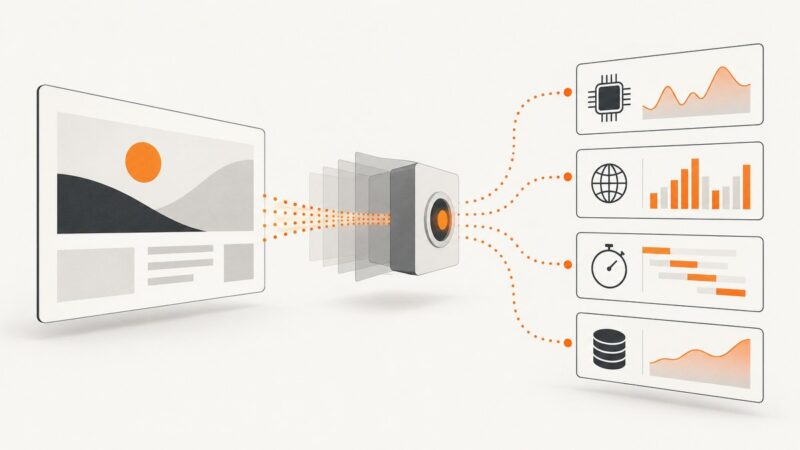
Screenshot comparisons can help verify a component’s appearance, but they are one technique in the strategy, not a substitute for behavior tests or device compatibility coverage. For a web page used in visual checks, a browser can capture a full page or a selected element; stable viewport, state, and timing help make the resulting image useful for comparison.
DIY: capture a page with Playwright
This runnable Node.js example launches Chromium, waits for page rendering, and saves a full-page screenshot. Install the dependency with npm install playwright and install its browser with npx playwright install chromium. Save as capture.mjs and run node capture.mjs.
import { chromium } from 'playwright';

const browser = await chromium.launch({ headless: true });
try {
  const page = await browser.newPage({
    viewport: { width: 1280, height: 800 },
    deviceScaleFactor: 1,
  });
  const response = await page.goto('https://example.com', {
    waitUntil: 'networkidle',
    timeout: 30000,
  });
  if (!response?.ok()) {
    throw new Error(`Page returned ${response?.status() ?? 'no response'}`);
  }
  await page.screenshot({ path: 'page.png', fullPage: true });
} finally {
  await browser.close();
}
For pages that keep background connections open, networkidle may never occur. Prefer waiting for a meaningful selector or a short explicit delay when that better represents the state to capture. Freeze or control dynamic content, use a consistent viewport and device scale factor, and avoid comparing images captured under different fonts, locale, or app state.
Capture with cURL
curl -G "https://api.screenshotneo.com/v1/shot" \
  -d access_key=YOUR_API_KEY \
  --data-urlencode url=https://stripe.com \
  -o shot.webp
Capture with Python
import requests

r = requests.get(
    "https://api.screenshotneo.com/v1/shot",
    params={"access_key": "YOUR_API_KEY", "url": "https://stripe.com"},
    timeout=90,
)
r.raise_for_status()
open("shot.webp", "wb").write(r.content)
Capture with Node.js
const q = new URLSearchParams({ access_key: 'YOUR_API_KEY', url: 'https://stripe.com' });
const res = await fetch(`https://api.screenshotneo.com/v1/shot?${q}`);
if (!res.ok) throw new Error(`Screenshot request failed: ${res.status}`);
await import('node:fs/promises').then(({ writeFile }) =>
  writeFile('shot.webp', Buffer.from(await res.arrayBuffer()))
);
8. Or skip the browser setup
ScreenshotNeo is a website screenshot API and MCP server for developers. One GET request returns a PNG, JPEG, WebP, or PDF, and its documentation describes the request options. Cookie banners are accepted and removed before capture, along with 60+ known consent platforms, newsletter popups, and chat widgets; each cleanup step can be turned off. Bot checks, blank pages, timeouts, failed loads, and cache hits cost nothing, with the outcome indicated by X-Page-Verdict and X-Billed response headers. An MCP server gives AI agents tools to take screenshots, get page information, and capture PDFs.
curl -G "https://api.screenshotneo.com/v1/shot" -d access_key=YOUR_API_KEY --data-urlencode url=https://stripe.com -o shot.webpThere are 1,000 screenshots a month free with no card; paid plans start at $5 for 3,000. Sign up for ScreenshotNeo and start with 1,000 free screenshots a month, no card required.
9. Common problems and fixes
| Problem | Likely cause | What to do |
|---|---|---|
| A UI test fails intermittently | Uncontrolled timing, changing app state, or a dependency that is not isolated | Wait for a meaningful state, control the dependency or test data, and keep the test focused on one outcome. |
| A screenshot differs on every run | Animations, dynamic content, fonts, locale, viewport, or device scale factor changed | Fix the capture environment and app state; disable or wait out animation where appropriate, and standardize viewport, fonts, and locale. |
| A broad test is slow to diagnose | It covers many behaviors or crosses several boundaries at once | Keep it for its end-to-end signal, and add focused lower-layer checks that localize likely failures. |
| A test passes in a simulator but fails on a device | The relevant behavior depends on hardware or a platform difference the simulator does not reproduce | Add representative physical-device coverage for that risk. |
| Test runs delay the team | The suite is too large or expensive for its current cadence | Run quick checks more frequently, schedule broad coverage less often where risk allows, and remove redundant or low-signal checks. |
Playwright times out waiting for networkidle |
The page maintains long-lived network activity | Wait for a page-specific selector or a deliberate delay instead of network idle. |
| Screenshot request returns an error or unexpected content | Check credentials, URL encoding, response status, and API response headers | Check the ScreenshotNeo API documentation and inspect the returned status and verdict/billing headers. |
10. FAQ
Is a mobile testing pyramid mandatory?
No. It is a planning model. Use a different balance when hardware, risk, infrastructure, or the reliability of your tests calls for it.
Does every test belong to exactly one layer?
No. The names are not universally precise. Define layers by scope and purpose for your team; a screenshot or performance technique can be used at different scopes.
Should every mobile app have physical-device tests?
Use them when device hardware or platform behavior is part of the risk being checked. The needed coverage depends on the app.
Is 70/20/10 the recommended mobile test ratio?
No. It is a historical rule of thumb, not a measured universal distribution or a mobile-specific requirement.