What Is Next-Generation Cross-Browser Testing?
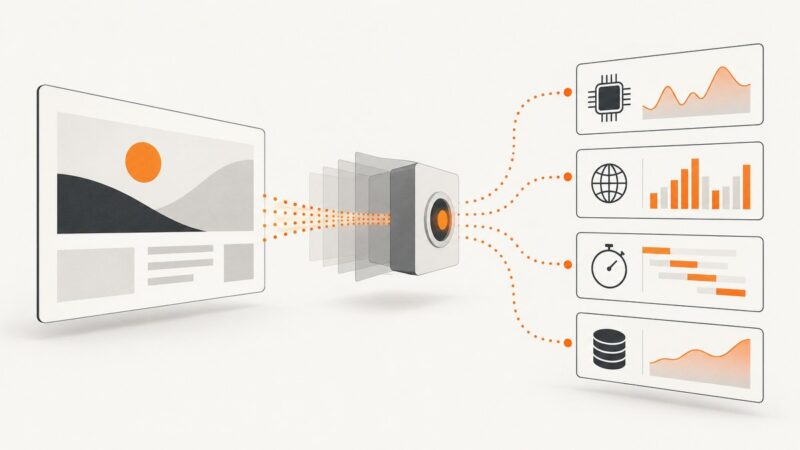
Next-generation cross-browser testing combines isolated, user-focused automation with deliberate browser coverage and useful failure diagnostics.
Next-generation cross-browser testing is a practical approach to checking that a website’s important user journeys work across the browsers and device conditions its audience uses. It combines user-visible assertions, isolated test state, deliberate browser coverage, and diagnostic artifacts such as traces and screenshots. “Next-generation” is descriptive, not a standardized technical category.
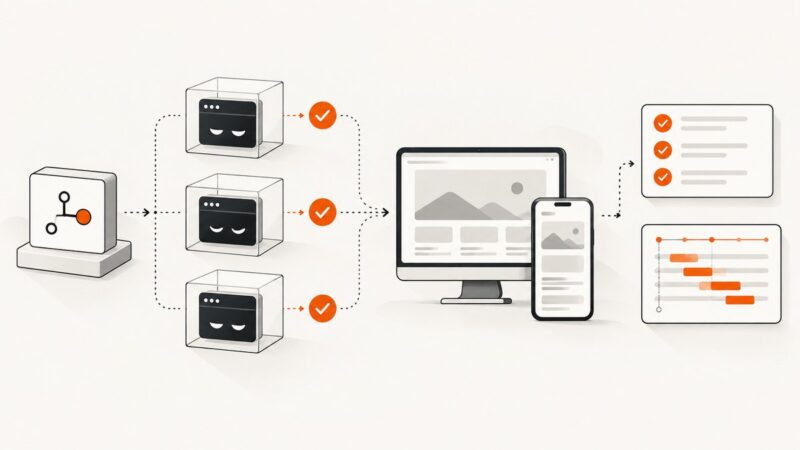
Chromium-only tests do not establish that a site works in Firefox or WebKit. A useful modern workflow selects representative browsers and devices, runs the same independent tests in each configuration, and records enough context to investigate failures.
1. What cross-browser testing covers
Cross-browser testing checks a site’s behavior across browser engines, browser distributions, operating systems, viewports, and device conditions relevant to the product. The goal is not to multiply configurations indiscriminately. It is to verify the flows and environments the product promises to support.
Playwright documents projects for Chromium, Firefox, and WebKit, plus branded Google Chrome and Microsoft Edge channels and selected emulated mobile and tablet devices. These are useful ways to select repeatable configurations. Emulation helps model device settings and viewports, but it does not by itself prove behavior on every physical device and operating system combination. [Playwright browser documentation]
2. What makes the workflow modern
Test what users can see and do
Prefer assertions about visible content and interactions: a user can find a product, submit a form, or reach a confirmation state. Avoid coupling tests to internal implementation details such as private class names. User-facing assertions are more likely to detect regressions that matter to users. [Playwright best practices]
Keep tests independent
A test should set up the state it needs and cleanly finish without relying on another test’s order or side effects. Playwright browser contexts provide isolated browser environments with separate cookies and storage; contexts can also represent settings such as locale, permissions, color scheme, and mobile device configuration. [Playwright browser contexts]
Run a deliberate browser matrix
Start with the engines your support policy requires. Add a branded browser channel when the product depends on behavior specific to that distribution. Add mobile or tablet projects for important responsive journeys. Keep the matrix understandable: each additional project adds execution time and more results to maintain.
Collect evidence when a test fails
A pass/fail result alone often does not explain a failure. Playwright tracing can capture a timeline, DOM snapshots, network activity, console logs, and screenshots for later inspection. Use reports and traces to establish where the behavior diverged. [Playwright Trace Viewer]
3. A runnable Playwright setup
The following example uses JavaScript and Playwright Test. It runs a user-visible smoke test against Chromium, Firefox, and WebKit, and retains a trace when a test fails on its first retry.
npm init playwright@latest
npx playwright install
Choose JavaScript when prompted, or add the following files to an existing JavaScript project. Save this as playwright.config.js:
// playwright.config.js
const { defineConfig } = require('@playwright/test');

module.exports = defineConfig({
  testDir: './tests',
  fullyParallel: true,
  retries: 1,
  reporter: 'html',
  use: {
    baseURL: 'https://example.com',
    trace: 'on-first-retry',
  },
  projects: [
    { name: 'chromium', use: { browserName: 'chromium' } },
    { name: 'firefox', use: { browserName: 'firefox' } },
    { name: 'webkit', use: { browserName: 'webkit' } },
  ],
});
Save this as tests/homepage.spec.js:
// tests/homepage.spec.js
const { test, expect } = require('@playwright/test');

test('homepage presents its main navigation', async ({ page }) => {
  await page.goto('/');
  await expect(page.getByRole('navigation')).toBeVisible();
  await expect(page.getByRole('main')).toBeVisible();
});
Run the matrix and open the report:
npx playwright test
npx playwright show-report
Replace the example URL and assertions with a real critical journey. Use accessible roles and names where possible, and assert the outcome a user needs rather than a particular internal rendering detail.
4. Choosing browsers and device configurations
| Configuration | When it fits | Tradeoff |
|---|---|---|
| Playwright Chromium, Firefox, and WebKit | Baseline coverage across the three engines represented in the default Playwright setup. | You still need to choose relevant versions, operating systems, and device conditions. |
| Bundled recent Chromium | A useful default and a way to find issues against an upcoming stable browser release. | It is not identical to every branded browser setup. |
| Branded Chrome or Edge channel | A product depends on a branded browser behavior or needs a check against that browser distribution. | Playwright does not install Chrome or Edge by default; enterprise policies can affect automation. |
| Emulated mobile or tablet | Repeatable viewport and device-oriented test configurations. | Emulation alone does not establish real-device behavior across all OS and hardware combinations. |
Playwright’s browser versions are tied to Playwright releases. Updating Playwright can require reinstalling its browser binaries. Keep the dependency current and record the Playwright version, browser channel and version, operating system, and device configuration with failure reports. [Browser versions and channels; Best practices]
5. Making the test suite dependable
- Choose flows by user impact. Cover the actions central to the product, such as sign-in, purchase, or publishing, before low-value page permutations.
- Make setup explicit. Each test should create or load its own required state rather than depending on prior tests.
- Keep assertions observable. Assert meaningful visible outcomes and wait for the condition that matters, not an arbitrary delay.
- Separate engine coverage from device coverage. A mobile viewport is one dimension; browser engine and operating system are separate dimensions.
- Capture run context. Include the code revision, dependency version, project, browser version, and relevant environment configuration in failure triage.
- Use traces selectively. Retain them on failures or retries so diagnosis is possible without collecting unnecessary artifacts for every successful run.
6. Screenshot checks and visual evidence
Functional assertions tell you whether an interaction or state is available. A screenshot can help inspect layout, responsive composition, or a visual regression. Screenshot comparison needs stable inputs: use a known page state, viewport, and browser configuration, and account for dynamic content that changes between runs.
For a local screenshot in a Playwright test, you can capture the page after its meaningful state is ready:
const { test, expect } = require('@playwright/test');

test('catalog page screenshot', async ({ page }) => {
  await page.goto('/catalog');
  await expect(page.getByRole('heading', { name: 'Catalog' })).toBeVisible();
  await page.screenshot({ path: 'artifacts/catalog.png', fullPage: true });
});
For broader visual inspection or a screenshot without managing browser binaries and capture code, ScreenshotNeo is a website screenshot API and MCP server. Its capture options include full-page screenshots, element capture, device presets, custom CSS and JavaScript, waiting for page conditions, and PDF output. A screenshot is useful evidence alongside browser tests; it does not replace assertions that verify behavior.
7. Or skip the browser setup
ScreenshotNeo returns a screenshot or PDF from one GET request. See the ScreenshotNeo API documentation for parameters and response details.
curl -G "https://api.screenshotneo.com/v1/shot" -d access_key=YOUR_API_KEY --data-urlencode url=https://stripe.com -o shot.webpimport requests
r = requests.get("https://api.screenshotneo.com/v1/shot", params={"access_key": "YOUR_API_KEY", "url": "https://stripe.com"}, timeout=90)
open("shot.webp", "wb").write(r.content)const q = new URLSearchParams({ access_key: 'YOUR_API_KEY', url: 'https://stripe.com' });
const res = await fetch(`https://api.screenshotneo.com/v1/shot?${q}`);ScreenshotNeo accepts cookie and consent banners like a visitor and removes more than 60 known consent platforms, newsletter popups, and chat widgets before capture; each step can be turned off. Bot checks, blank pages, failed loads, timeouts, and cache hits are not billed, and response headers identify the page verdict and billing status. Its MCP server gives AI agents tools for screenshots, page information, and PDF capture. The free plan includes 1,000 screenshots per month with no card; paid plans start at $5 for 3,000 shots. Every feature is on every plan.
Sign up free for 1,000 screenshots a month, with no card.
8. Performance, reliability, and cost
Performance
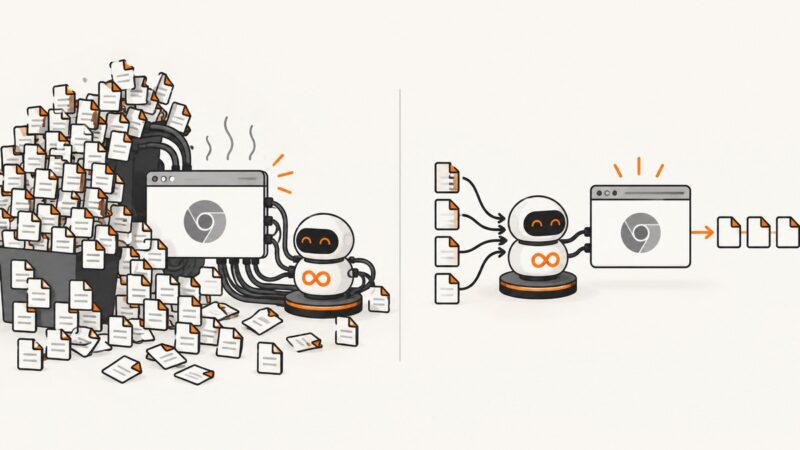
Parallel execution can reduce elapsed time, but it uses more workers and browser processes. Begin with a small number of workers and tune based on available CI resources. Running every test in every browser and device configuration multiplies work; prioritize critical journeys and expand coverage where risk warrants it.
Reliability
Browser automation depends on compatible browser binaries and a stable environment. Keep Playwright and its installed browsers aligned, make state independent, and preserve traces for failure investigation. A retry can help reveal intermittent failures, but a test that only passes after retries still deserves investigation.
Cost
For a self-managed Playwright setup, account for CI compute, runtime, artifact storage, and ongoing maintenance of browser versions and test fixtures. The dossier does not establish pricing or guarantees for hosted browser services, so compare those separately when evaluating them. ScreenshotNeo usage is billed only for clean shots; the listed free allowance is 1,000 monthly and paid plans start at $5 for 3,000.
9. Troubleshooting
| Symptom | Likely cause | Fix |
|---|---|---|
| Browser executable is missing | The Playwright package was installed or updated without its matching browser binaries. | Run npx playwright install after installing or updating Playwright. |
| A test passes alone but fails in the suite | State leaks between tests, shared resources collide, or execution order changes behavior. | Make setup independent, use isolated contexts, and avoid shared mutable test data. |
| A test is flaky around navigation or content | The test proceeds before the user-visible condition is ready or the page contains variable content. | Wait for a specific visible state and stabilize the data or environment used by the assertion. |
| Works in Chromium, fails in Firefox or WebKit | The engines can differ in behavior, or the application relies on an unsupported assumption. | Inspect the failing project’s trace and browser console; fix the application or narrow the supported behavior based on product requirements. |
| Branded Chrome or Edge is not found | The branded browser is not installed by default, or the requested channel is unavailable in the environment. | Install the required browser in the environment and configure the intended channel explicitly. |
| Mobile emulation looks correct but a real device differs | Emulation covers selected device settings, not every physical device and OS detail. | Use emulation for repeatable checks, then validate on physical devices when the support commitment requires it. |
| Failure is hard to reproduce from CI | The report lacks the original browser, version, environment, or page evidence. | Record configuration and retain a trace on retry or failure; inspect its timeline, snapshots, network, and console data. |
10. Frequently asked questions
Is “next-generation cross-browser testing” a formal standard?
No. It describes a modern testing approach; the reviewed technical documentation does not define it as a standard or product category.
Does passing Chromium mean a site works in Safari?
No. Chromium coverage does not establish WebKit behavior. Configure a WebKit project if that engine matters to your support policy.
Should every test run on every browser?
Not necessarily. Run high-impact flows across the required engines, then allocate broader device and channel coverage according to product risk and support commitments.
Can screenshots prove the site works?
A screenshot documents appearance at a point in time. Use functional assertions to verify actions and outcomes, and screenshots as visual evidence.