BlogScreenshots on your device
How to Take a Page Snapshot in Windows
Learn the fastest Windows shortcuts for selected, full-screen, and long-page snapshots, plus an automated ScreenshotNeo option.
Use Windows+Shift+S to capture a selected part of a webpage with Snipping Tool. Use Windows+PrtScn to save the entire display automatically. If you need a long webpage in a document, use Microsoft Edge’s print preview and inspect the pagination before saving or printing.
The best method depends on what “page snapshot” means in your case:
| Goal | Best method | Output |
|---|---|---|
| Capture a visible passage, image, or control | Windows+Shift+S | Image copied to the clipboard and opened in Snipping Tool |
| Capture everything currently visible on the monitor | Windows+PrtScn | Image saved in Pictures\Screenshots |
| Preserve more of a long webpage | Edge print preview with Ctrl+P | Print-oriented document or PDF destination, with pagination |
| Capture pages automatically from code | ScreenshotNeo | PNG, JPEG, WebP, or PDF from one HTTP request |
1. Capture a selected part of a webpage
- Open the page in your browser and scroll until the content you need is visible.
- Press Windows+Shift+S.
- Choose a rectangular, freeform, window, or full-screen snip from the toolbar.
- Drag over the page area. For a window capture, select the browser window.
- Click the notification to open the capture in Snipping Tool. From there you can annotate, crop, copy, or save it.
Microsoft describes Snipping Tool as a way to copy words or images from all or part of your PC screen, and documents it for Windows 10 and Windows 11. See Microsoft’s Snipping Tool instructions.
When this method is the right choice
- You need a small, readable excerpt for a bug report or support ticket.
- You want to remove browser chrome, bookmarks, or unrelated content by selecting only the page region.
- You need to mark up the image immediately.
2. Save the whole screen directly
- Arrange the browser and any surrounding context exactly as you want it captured.
- Press Windows+PrtScn.
- Open File Explorer and go to
Pictures\Screenshots. Windows saves the image there.
On some keyboards the key is labelled PrtSc, PrtScn, or Print Screen. Hardware without that key may support Fn+Windows+Space; the exact shortcut varies by device. Microsoft’s Windows keyboard-shortcut reference lists the current combinations.
Clipboard versus saved-file shortcuts
| Shortcut | What it does |
|---|---|
| PrtScn | Copies the screen to the clipboard on many Windows configurations. |
| Alt+PrtScn | Copies the active window on many configurations. |
| Windows+PrtScn | Saves a full-screen image to Pictures\Screenshots. |
| Windows+Shift+S | Opens Snipping Tool for a selected, window, or full-screen capture. |
Keyboard behavior can differ by laptop manufacturer and accessibility settings. If a shortcut appears to do nothing, try the function key modifier or use Snipping Tool from the Start menu.
3. Preserve a long webpage with Microsoft Edge
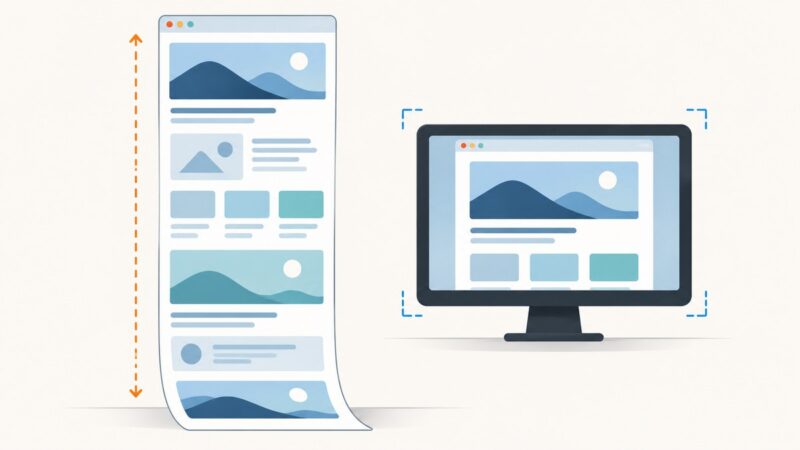
A screen shortcut captures pixels currently on the display. It does not reliably create one tall image of an entire page. For a long article, invoice, or documentation page, use Edge’s print workflow:
- Open the page in Microsoft Edge.
- Press Ctrl+P, or open Settings and more (…) > Print.
- Review the preview page by page. Check margins, scale, headers and footers, page breaks, and whether images loaded.
- Enable Background graphics when the preview needs the page’s colors or backgrounds.
- Choose the available printer or file destination and complete the save or print operation.
This produces a print-oriented document, not a guaranteed single, continuous screenshot. Responsive layouts, lazy-loaded images, advertisements, navigation, and scripts can change between the live page and the print preview. Microsoft documents the workflow in Print in Microsoft Edge.
Reduce clutter before printing
When a site supports it, open Edge’s Immersive Reader before printing. It can remove navigation and other page furniture, but availability depends on the website. Always inspect the preview because the simplified view may change images, headings, or spacing.
4. Pick the correct Windows method
| Question | Choose |
|---|---|
| Do you need only one visible section? | Windows+Shift+S and a rectangular snip |
| Should the browser, desktop, or other windows remain visible? | Windows+PrtScn or a full-screen snip |
| Do you need an editable document covering many sections? | Edge print preview |
| Do you need repeatable captures, a full page, or a capture from a server? | An API such as ScreenshotNeo |
5. Troubleshooting Windows page snapshots
The shortcut does nothing
Confirm that the Windows key is not disabled by a gaming mode or keyboard utility. On a laptop, try Fn with the print-screen key. You can also launch Snipping Tool from Start and capture with its New button.
The saved image is not in Pictures\Screenshots
Only the Windows+PrtScn workflow normally saves there automatically. A Snipping Tool capture may still be in the clipboard or editor. Open the notification, select Save, and choose a folder yourself.
The capture is blurry or too small
Zoom the browser to a readable level before selecting the area. Avoid enlarging the saved bitmap repeatedly. For a high-resolution automated image, request a larger viewport or retina scale from a screenshot API.
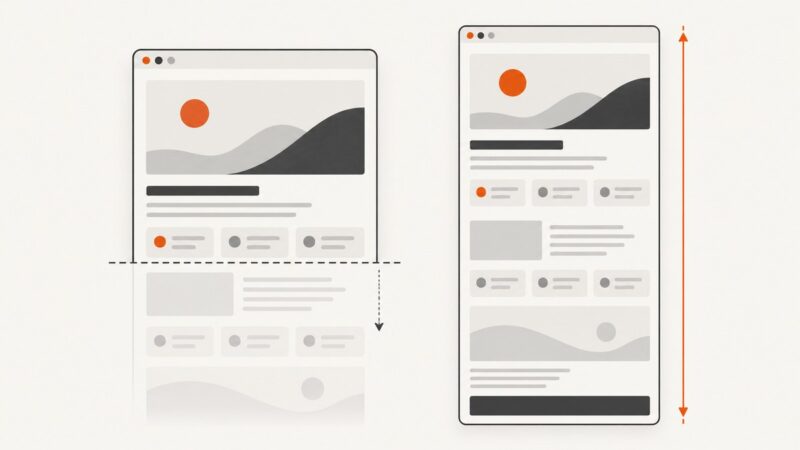
The bottom of the page is missing
A screen capture includes only what was visible. Scroll and capture additional sections, or use Edge print preview for a document-like result. A print preview can paginate a long page but will not always match the live layout.
Images, colors, or backgrounds are missing in print preview
Wait for the page to finish loading, then refresh the preview. Enable Background graphics when appropriate. Some sites intentionally provide a different print stylesheet or lazy-load media only after scrolling.
Popups or cookie banners cover the content
Dismiss them before using a local shortcut. If the site repeatedly shows consent dialogs or chat widgets, an automated capture service that handles those elements before rendering can produce a cleaner result.
6. Or skip the browser setup
ScreenshotNeo captures a URL with one GET request, returning a PNG, JPEG, WebP, or PDF. Its browser handles common capture work before the image is produced: cookie and consent banners, newsletter popups, and chat widgets are removed; each step can be turned off. Bot checks, blank pages, timeouts, failed loads, and cache hits are not billed, and the response identifies the result with X-Page-Verdict and X-Billed headers. An MCP server also lets Claude, Cursor, and other MCP clients call take_screenshot, get_page_info, and capture_pdf.
See the ScreenshotNeo API documentation for all options, including full-page capture, selectors, device presets, dark mode, custom CSS and JavaScript, waits, blocking rules, cookies, headers, geolocation, PDF settings, caching, signed links, async jobs, bulk capture, and usage reporting.
cURL
curl -G "https://api.screenshotneo.com/v1/shot" -d access_key=YOUR_API_KEY --data-urlencode url=https://example.com -o shot.webpPython
import requests

r = requests.get(
    "https://api.screenshotneo.com/v1/shot",
    params={"access_key": "YOUR_API_KEY", "url": "https://example.com"},
    timeout=90,
)
r.raise_for_status()
open("shot.webp", "wb").write(r.content)
Node.js
const q = new URLSearchParams({ access_key: 'YOUR_API_KEY', url: 'https://example.com' });
const res = await fetch(`https://api.screenshotneo.com/v1/shot?${q}`);
if (!res.ok) throw new Error(`Screenshot failed: ${res.status}`);
const fs = await import('node:fs/promises');
await fs.writeFile('shot.webp', Buffer.from(await res.arrayBuffer()));
Useful automation options
- Full page: load lazy images and capture the page beyond the initial viewport.
- Element capture: target one CSS selector instead of the whole document.
- Timing: wait for a selector, a fixed delay, or network idle.
- Rendering: choose a device preset or any viewport, retina scale, dark mode, timezone, and geolocation.
- Page control: inject CSS or JavaScript, click an element, hide selectors, and block ads, trackers, requests, or resource types.
- Authentication: send custom headers, cookies, a user agent, or an Authorization header.
- Output: resize images, use a transparent background, or create PDFs with paper size, margins, landscape mode, and page ranges.
Performance, reliability, and cost
For repeated captures, choose a cache TTL when the page does not change often. Use async jobs and signed webhooks for slower pages, and bulk capture for up to 100 URLs per call. Check X-Page-Verdict and X-Billed instead of assuming every HTTP response represents a successful paid image.
The Free plan includes 1,000 shots per month with no card. Paid plans start at $5 for 3,000 shots; Growth is $15 for 15,000, Pro $39 for 60,000, Scale $99 for 250,000, and Business $249 for 1,000,000. Yearly billing gives two months free, and every feature is on every plan.
Create a free ScreenshotNeo account to get 1,000 screenshots a month with no card.
7. FAQ
Is a page snapshot the same as a screenshot?
Usually yes. “Snapshot,” “screenshot,” and “screen capture” describe saving what a screen or webpage looks like. The required scope determines the best Windows method.
Can Windows create one image of an entire webpage?
The built-in shortcuts capture the visible display or a selected region. For a long page, Edge print preview preserves more content as a paginated document; an API can create a full-page image.
Which format should I use?
Use PNG for crisp interface text and diagrams, JPEG for smaller photographic files, WebP for compact web delivery, and PDF when pagination or printing matters.
Can I automate Windows screenshots without keeping a browser open?
Yes. A screenshot API such as ScreenshotNeo can render a URL on request, while the local Windows shortcuts require the page to be open on the display.