How Real Device Testing Can Speed Up Your Release Cycle
Real devices reveal hardware and OS issues virtual checks can miss. Learn how to parallelize tests, control bottlenecks, and get actionable failures sooner.
Real-device testing can shorten release feedback loops when you automate suitable checks on actual phones or tablets, run independent work in parallel, and give developers logs and visual artifacts that make failures easy to diagnose. It does not automatically shorten the time to release: queues, limited device capacity, flaky tests, oversized test suites, and poorly chosen parallel runs can erase the gains.
The practical approach is to keep a fast smoke suite on every change, expand to a representative device and OS matrix at an appropriate CI stage, and measure commit-to-actionable-result time in your own environment. Real devices complement emulators; they do not make every test faster or replace coverage across virtual configurations.
1. What real-device testing catches
A physical phone exposes its actual hardware and device configuration. That matters when behavior varies with form factor, chipset, operating system version, screen characteristics, installation state, or other device-specific conditions. A bug that cannot be reproduced on one developer handset may be reproducible on a particular model and OS combination.
AWS lists reproducing device bugs, checking rendering across screen types, and validating install and upgrade sequences among the uses for its device testing service. Hosted access can make a specific device easier to reproduce without requiring every developer to own it. See the AWS Device Farm documentation and Google Cloud’s Developer Device Platform announcement.
Virtual devices remain useful for fast, broad checks early in development. Physical-device checks add evidence about actual handsets and device configurations. The right mix depends on the failure modes your app has to handle.
2. Where the time savings come from
Run independent checks concurrently
Parallel execution is the direct mechanism that can reduce test execution time: divide work across available devices instead of making each device wait for the previous run. Google describes parallel runs across hundreds of devices and smart sharding for its platform; AWS documents automated runs across multiple devices. These are capabilities, not guarantees of a particular team’s release-time reduction.
Apple reported that its own XCTest suites achieved a 30 percent speedup with two devices in a 2020 WWDC session. That result belongs to Apple’s suites and should not be treated as a forecast for another app or test suite. Apple’s session, “Get your test results faster”, also explains distributed testing and destination allocation.
Make failures actionable
Device logs, screenshots, recordings, and clear device identity can cut the time between a failed run and a useful diagnosis. AWS describes reports with high-level results, logs, screenshots, and artifacts, and remote sessions with action logs and video. Google documents device logs and artifacts as well. Artifact processing and upload take time, so collect what helps diagnose failures and avoid treating artifact volume as free.
Catch issues before a release candidate
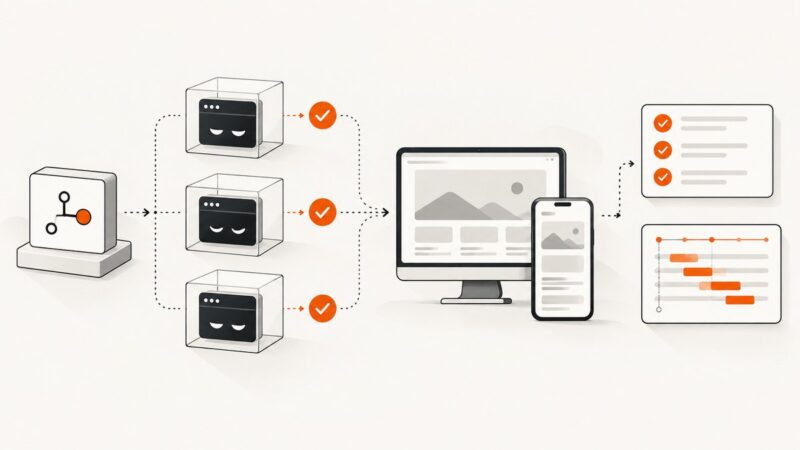
Running checks in CI makes device-specific failures visible while a change is still fresh. A quick smoke suite on each change gives a short feedback loop; a broader matrix can run at a suitable stage, such as before a release candidate. The exact stage and matrix should follow your app’s risk and available capacity.
3. Build a useful device and test matrix
Do not equate “more devices” with “better coverage.” Select devices and OS versions that represent your users, support your critical workflows, and help reproduce known problems. Keep the matrix explicit so a failure includes the device model and OS version that produced it.
| Testing need | Useful approach | Watch for |
|---|---|---|
| Fast feedback on each change | Small automated smoke suite on a limited representative set | Too many slow end-to-end checks in the blocking path |
| Broad compatibility confidence | Expanded device and OS matrix at an appropriate CI stage | Device capacity, queue time, and suite duration |
| Reproduce a device-specific bug | Run against the affected model and OS; retain device logs and visual artifacts | Rerun to see whether the failure is reproducible |
| Test different OS or device destinations | Allocate tests deliberately across the destination matrix | Distributed test allocation can be nondeterministic |
| Test a suite that can be split safely | Shard independent tests across available devices | Oversharding, setup duplication, and uneven shard duration |
Apple notes that test allocation across distributed run destinations is nondeterministic. It recommends identical device and OS pools for distributed tests to avoid hard-to-reproduce failures. If the goal is to test across different destinations, use parallel destination testing for that purpose rather than assuming a distributed run will allocate each test to each destination. See Apple’s WWDC guidance.
4. Put real-device checks in CI
- Identify the critical paths. Start with app launch, sign-in or another essential entry path, a key user workflow, and any install or upgrade path that has caused defects. Keep the blocking smoke suite small enough to return useful feedback quickly.
- Choose representative devices. Pick a manageable set of models and OS versions that reflect your users and known risk areas. Record the selection and revisit it when the app or user base changes.
- Separate test types. Mark tests that can safely run on any equivalent device separately from tests that must run against each target OS or model. Avoid shared accounts or mutable backend data that cause concurrent runs to interfere.
- Connect the runner to CI. Have the pipeline submit the app build and test run to your chosen local lab or hosted device service. Configure the service’s supported framework and result collection based on its current documentation; service capabilities and supported frameworks differ.
- Set parallelism to available capacity. Begin with a shard count that the device pool can actually serve. Increase it only when measured execution time improves and queues, setup, and artifact handling stay under control.
- Preserve diagnostic context. Attach the build identifier, test name, device model, OS version, logs, and relevant screenshots or video to the CI result. Make it easy to open the run that failed.
- Handle uncertain results deliberately. Rerun a suspicious failure to check reproducibility. Keep the original result visible; a retry should not silently turn an unexplained failure into a pass.
Provider setup syntax is service- and framework-specific, so use the provider’s current integration instructions rather than copying a generic command that may not fit your runner. For example, Google labels its Developer Device Platform documentation as Preview and warns that support may be limited; its troubleshooting page also says framework support can vary. Confirm your framework, device availability, and current service terms before committing a pipeline to a provider: Google’s troubleshooting guide.
5. Choose a device strategy
Local device lab or hosted devices
A local lab gives a team direct control of its physical devices and can be useful for a small number of frequent checks or hands-on reproduction. It also requires the team to procure, maintain, connect, and make those devices available to CI. Hosted physical-device access can broaden access to models without each developer managing the hardware, but introduces provider availability, queueing, capacity, data-handling, and pricing considerations.
Shared public devices or dedicated access
Where a provider offers a choice, shared access may be convenient, while dedicated or private capacity may suit predictable throughput or stricter isolation needs. Offerings differ; confirm what the provider actually includes, how devices are reserved, and how concurrency affects queues. Do not assume every service offers both models.
Physical devices or emulators
Emulators are useful for fast checks across virtual configurations. Physical devices are useful when the actual handset and its configuration matter. Many teams use both: broad virtual checks early, plus selected physical-device tests for critical workflows, device-specific behavior, and release confidence.
Manual sessions or automated CI
A remote interactive session can help investigate a bug or inspect behavior manually. Automated CI runs are better suited to repeatable checks on each change or release candidate. A debugging session does not provide the same repeatability as a stable automated suite; automation also cannot explain a failure without useful diagnostics.
Sequential or sharded runs
Parallel sharding can reduce elapsed execution time when tests are independent and devices are available. Sequential runs may be simpler for tests that share state or depend on order. Splitting a suite poorly can increase setup overhead, create data collisions, or leave one long shard determining the finish time.
6. Compare hosted device services carefully
Evaluate services against your framework and operational needs, not just the largest device count in a product description. Compare target OS and model coverage, supported frameworks, availability and capacity, parallel execution, CI integration, diagnostic artifacts, regions and data handling, pricing basis, queue behavior, and how retries or infrastructure failures are reported.
- Google Cloud Developer Device Platform: Google’s announcement describes physical devices and virtual emulators, remote device streaming, parallel Device Run tests, smart sharding, and retries. The announcement says public preview began August 12, 2026, and describes pay-per-active-minute preview billing with different virtual and physical rates. The documentation is marked Preview; Google warns support may be limited, and framework support should be confirmed. See the announcement and troubleshooting page.
- AWS Device Farm: AWS describes hosted physical Android and iOS devices, web-app testing, browser-based remote interaction, Appium access, automated parallel runs, and reports with logs and screenshots. The cited documentation says the service is available only in us-west-2 (Oregon). Check regional suitability and framework needs in the AWS documentation.
- Sauce Labs Real Device Cloud: its March 2026 data sheet describes real-device coverage, parallel execution, and CI/CD integration as ways to reduce execution time. Treat that as a vendor claim; the research for this article did not establish an independent outcome measurement. See the Sauce Labs data sheet.
Service status, supported frameworks, regional availability, device catalog, and pricing can change. Verify current details directly before choosing or budgeting for a provider.
7. Diagnose slow or inconclusive runs
Measure the entire path from commit to an actionable result, not just the test runner’s execution time. Google calls out queues, device capacity, traffic, infrastructure failures, too many shards for the available devices, and large artifacts as possible causes of slow runs. Its troubleshooting guide uses questions such as “Why is my test taking so long to run?” and “Why did sharding make my tests run longer?” as practical diagnostic prompts.
| Symptom | Likely cause | What to check or change |
|---|---|---|
| More shards made the run slower | More shards than available devices, repeated setup, or uneven work | Match shard count to actual capacity; compare per-shard duration and setup overhead |
| Run waits a long time before starting | Queueing or insufficient capacity for the requested devices | Record queue time separately; reduce simultaneous demand or choose a realistic matrix |
| One shard finishes much later | Tests are unevenly distributed or one test is unusually slow | Inspect per-test timing and rebalance independent work |
| Results are inconclusive or inconsistent | Flaky tests, infrastructure issues, contention, or nondeterministic destination allocation | Inspect device and infrastructure logs, rerun to check reproducibility, and make destination pools explicit |
| Test time is acceptable but CI feedback is late | Artifact processing or upload adds time after execution | Check artifact size and processing time; retain the logs and visuals needed to diagnose failures |
| Only one model or OS fails | Device-specific behavior or a matrix/configuration difference | Keep the failing device identity and OS version; reproduce on that target before broadening the fix |
For Google’s platform-specific troubleshooting details, see Google’s guide. These are general operational checks; another provider may expose different controls and failure categories.
8. Measure whether the release loop improved
Use your own pipeline data to tell whether a change actually helps. Track:
- Commit to actionable result: wall-clock time until a developer has a useful pass or failure signal.
- Queue time and execution time: separate waiting for devices from running tests.
- Rerun rate: how often failures require another run to determine whether they reproduce.
- Device utilization: whether capacity is idle, saturated, or overwhelmed at the times CI needs it.
- Defect escape rate: whether device-related problems still reach later stages or users.
These are suggested measures, not published industry benchmarks. Compare equivalent changes and test scope; adding more tests can increase total time while improving coverage, so report the suite and matrix alongside timing.
9. Performance, reliability, and cost
Performance
Parallelism helps only when work can be distributed and device capacity is available. Queueing, test setup, uneven shard sizes, retries, and artifact processing all contribute to elapsed time. Optimize the commit-to-result path by keeping the blocking suite focused, matching shard count to capacity, and moving broader checks to a stage where their coverage is valuable.
Reliability
A physical device can expose real device behavior, but a test can still fail for reasons unrelated to the app, including infrastructure problems or flaky test logic. Preserve logs and device identity, distinguish app failures from infrastructure failures when the service allows it, and rerun uncertain results to check reproducibility. Treat a retry as diagnostic evidence, not proof that the original failure was harmless.
Cost
Compare the provider’s billing unit with your run pattern: device-active time, reservation or capacity, concurrency, retries, and artifact handling may affect the bill depending on the service. Google’s announcement describes active-minute preview billing with different rates for virtual and physical devices; no general current price comparison is established here. A small local fleet also has procurement and maintenance costs. Estimate using your own suite duration, schedule, device matrix, and retry rate, then verify current provider pricing.
10. Website release visuals and ScreenshotNeo
Real-device app testing and website screenshot capture solve different problems. A device-testing service runs mobile app checks on physical devices; ScreenshotNeo captures web pages through a screenshot API and MCP server. If a release also includes a website, landing page, or web flow, ScreenshotNeo can produce a consistent visual capture for that web surface. It does not replace testing a native app on a real phone.
ScreenshotNeo accepts a URL in one GET request and returns a PNG, JPEG, WebP, or PDF. Its clean-capture flow accepts cookie and consent banners like a visitor and removes 60+ known consent platforms, newsletter popups, and chat widgets; each step can be turned off. Only clean shots are billed: bot checks or CAPTCHAs, blank pages, timeouts, failed loads, and cache hits cost nothing, and response headers report the page verdict and billing status. Its MCP server provides take_screenshot, get_page_info, and capture_pdf for Claude, Cursor, and other MCP clients. See the ScreenshotNeo API documentation.
For a release webpage, a basic capture can be requested with cURL:
curl -G "https://api.screenshotneo.com/v1/shot" -d access_key=YOUR_API_KEY --data-urlencode url=https://stripe.com -o shot.webpThe equivalent Python request is:
import requests

r = requests.get(
    "https://api.screenshotneo.com/v1/shot",
    params={"access_key": "YOUR_API_KEY", "url": "https://stripe.com"},
    timeout=90,
)
open("shot.webp", "wb").write(r.content)
And in Node.js:
const q = new URLSearchParams({ access_key: 'YOUR_API_KEY', url: 'https://stripe.com' });
const res = await fetch(`https://api.screenshotneo.com/v1/shot?${q}`);
if (!res.ok) throw new Error(`Screenshot request failed: ${res.status}`);
await import('node:fs/promises').then(fs => fs.writeFile('shot.webp', Buffer.from(await res.arrayBuffer())));
Or skip the browser setup
Use one API request for a website screenshot; the other capture options are in the ScreenshotNeo docs.
curl -G "https://api.screenshotneo.com/v1/shot" -d access_key=YOUR_API_KEY --data-urlencode url=https://stripe.com -o shot.webpCookie banners, popups, and chat widgets are removed before the shot. Bot checks, blank pages, and failed loads are never billed. An MCP server lets AI agents take screenshots. The free plan includes 1,000 screenshots a month with no card; paid plans start at $5 for 3,000. Sign up for 1,000 free screenshots a month, with no card.
11. Troubleshooting checklist
- Confirm the requested device and OS are actually available in the selected pool.
- Check whether time is spent waiting in a queue, executing tests, or processing artifacts.
- Reduce shard count if shards outnumber usable devices or duplicate expensive setup.
- Check tests for shared mutable accounts, backend data, or order dependencies before increasing parallelism.
- Retain device model, OS version, logs, screenshots, and video when they help explain a failure.
- Rerun an uncertain failure and compare it with the original; keep both results visible.
- For distributed Apple tests, use equivalent device and OS pools when that is the intended allocation model; use destination testing to cover different targets.
- Verify the provider’s current framework support, regional availability, preview status, capacity, and pricing.
12. Frequently asked questions
Will real-device testing always make a release faster?
No. It can shorten feedback when suitable checks run in parallel and failures are diagnosable. Queues, capacity, flakiness, and overhead can offset the time saved.
Can emulators replace physical devices?
They are useful for fast virtual coverage, but they do not provide the same check on actual device hardware and configuration. Use physical devices where those differences matter.
How many devices should run in parallel?
Start with the capacity you can reliably use and measure queue time and end-to-end result time. Add concurrency only when it improves those measurements for your suite.
Does a retry mean the failure can be ignored?
No. A retry helps assess reproducibility. Keep the initial failure and its diagnostics available until its cause is understood.
Can ScreenshotNeo test my native app on a phone?
No. ScreenshotNeo captures web pages and provides an MCP server for screenshot and page-info tasks. Native app testing on physical devices requires a device-testing workflow.