How to Reduce Production Failures with Automated Testing
Build fast, layered tests and safer releases to catch defects earlier, limit their impact, and learn from failures that reach production.
Reduce production failures by running fast, dependable automated checks on every change, adding broader qualification tests for the risks that matter, keeping changes small, and releasing in monitored stages. Testing catches some defects before release; staged rollout and monitoring help find and contain defects that escape. No test suite can guarantee a failure-free production environment.
This guide lays out a practical testing and release workflow, explains what to measure, and shows where browser screenshots can support visual checks.
1. Make every change pass fast checks
Run a small, reliable set of automated checks whenever code changes. The aim is to give the author actionable feedback while the change is still fresh in their mind. DORA recommends curating dependable test suites and giving developers feedback in less than ten minutes. Treat that as a useful target for the fast feedback loop, not a requirement that every large integration suite finish within ten minutes. DORA’s test automation guidance discusses fast, reliable feedback.
- Run checks locally before submitting. Include the quick checks that catch common regressions in the normal development workflow.
- Run them again in continuous integration (CI). A check-in should trigger quick tests that can reveal serious regressions. Fix failures promptly rather than allowing known failures to become background noise. DORA’s continuous integration guidance describes this pattern.
- Keep the results trustworthy. Remove or repair flaky tests, make failures diagnosable, and keep the quick suite focused. A test that regularly fails for reasons unrelated to a change teaches developers to ignore failures.
- Add regression coverage when you find a defect. When practical, reproduce the defect in a test before fixing it. This helps prevent the same behavior from returning.
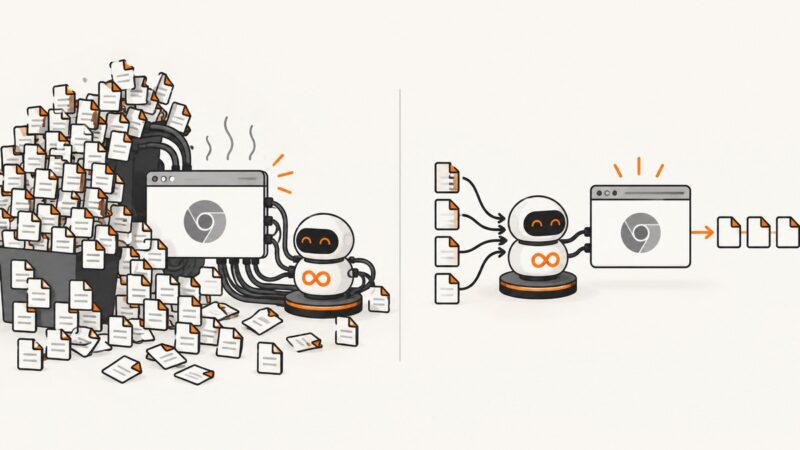
Choose the fastest check that can catch each class of defect. A quick unit test should not have to wait for a browser environment if it can verify the behavior directly. Keep broader checks in the pipeline too; fast feedback is not a reason to skip coverage for important risks.
2. Use layers of tests for different risks
Different checks answer different questions. Google’s published change process describes presubmit unit tests, fuzz tests, hermetic integration tests, and static and dynamic analysis, followed by broader qualification tests for functionality, customer workloads, infrastructure failures, serving capacity, and rollback safety. Google Cloud’s change process is one example of how to organize those layers.
| Layer | What it can help catch | Practical consideration |
|---|---|---|
| Unit tests | Incorrect behavior in a small function or component | Keep them fast and focused on observable behavior. |
| Fuzz tests | Unexpected behavior across generated or unusual inputs | Make failures reproducible by recording the input or seed. |
| Hermetic integration tests | Problems in interactions between components under controlled dependencies | Control dependencies and test data so failures are explainable. |
| Static and dynamic analysis | Issues detectable by examining code or observing it during execution | Use findings as signals to investigate; tune noisy checks. |
| Functional qualification | Behavior of the candidate release across important end-to-end flows | Prioritize user-critical paths and relevant configurations. |
| Workload and capacity qualification | Performance or serving-capacity problems under representative demand | Use workloads that resemble the service’s expected use. |
| Resilience and rollback checks | Infrastructure failure handling and whether a release can be safely reversed | Verify recovery procedures before relying on them during an incident. |
| Visual checks | Unintended changes in rendered pages, layout, or visible content | Control viewport, state, data, and other capture conditions. |
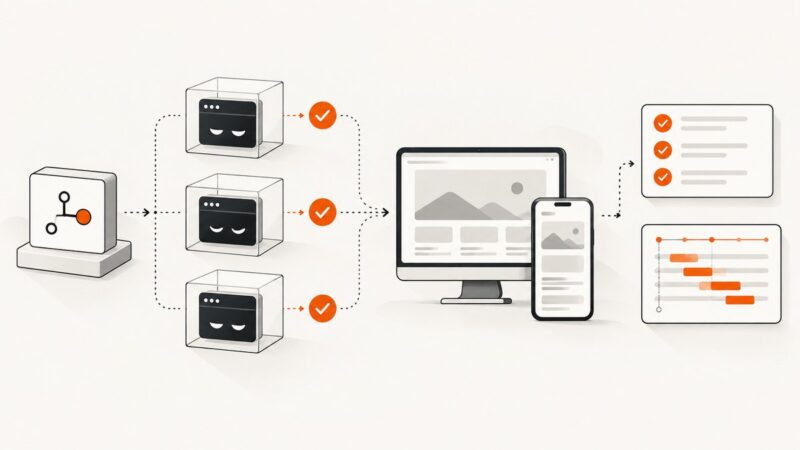
Do not make every change wait for every possible test. Run checks in stages: fast checks first, then broader qualification suited to the change’s risk. A change that affects a high-impact flow, a shared component, or capacity-sensitive behavior may justify more extensive qualification than a small isolated change.
3. Add browser visual checks where appearance is a production risk
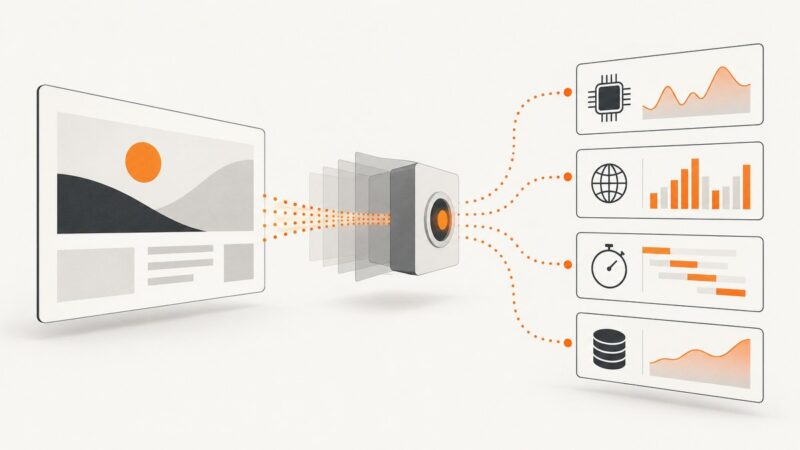
Automated browser checks can verify that important pages still load and display expected content. A screenshot comparison can also help reveal visual changes such as a shifted layout or missing element. It complements functional assertions: an image diff alone does not explain whether a change is correct, and dynamic content can create differences unrelated to a defect.
A basic do-it-yourself approach is to use a browser automation library in your existing test suite, navigate to a controlled page state, set a stable viewport, and save a screenshot for comparison. The exact commands and comparison APIs depend on the browser library and test framework already used by the project. Keep the target environment and test data stable, and review visual diffs when expected content changes.
Visual test checklist
- Choose a small set of high-value pages and states, such as a key form or checkout step.
- Fix the viewport and device scale factor so images are comparable.
- Control test data, account state, locale, timezone, and other inputs that affect rendering.
- Wait for the page’s meaningful content before capture; avoid relying on an arbitrary delay when a reliable readiness condition exists.
- Decide how to handle animations, timestamps, rotating content, and other expected variation.
- Review intentional changes and update reference images deliberately.
For visual regression checks against public pages, screenshots can also help inspect rendered output without maintaining browser capture infrastructure in your own code. They are not a substitute for tests of application behavior, private authenticated flows, or production monitoring.
Or skip the browser setup
ScreenshotNeo is a website screenshot API and MCP server for developers. A single request can capture a URL as PNG, JPEG, WebP, or PDF. For API options and configuration, see the ScreenshotNeo documentation.
curl -G "https://api.screenshotneo.com/v1/shot" -d access_key=YOUR_API_KEY --data-urlencode url=https://stripe.com -o shot.webpimport requests
r = requests.get(
"https://api.screenshotneo.com/v1/shot",
params={"access_key": "YOUR_API_KEY", "url": "https://stripe.com"},
timeout=90,
)
r.raise_for_status()
open("shot.webp", "wb").write(r.content)const q = new URLSearchParams({ access_key: 'YOUR_API_KEY', url: 'https://stripe.com' });
const res = await fetch(`https://api.screenshotneo.com/v1/shot?${q}`);
if (!res.ok) throw new Error(`Screenshot request failed: ${res.status}`);
await Bun.write('shot.webp', res);- Cookie and consent banners, newsletter popups, and chat widgets are removed before the shot; each cleanup step can be turned off.
- Bot checks and CAPTCHAs, blank pages, timeouts, failed loads, and cache hits are not billed. Response headers report the page verdict and whether the request was billed.
- An MCP server provides
take_screenshot,get_page_info, andcapture_pdftools for AI agents and MCP clients. - The free plan includes 1,000 screenshots a month with no card. Paid plans start at $5 for 3,000 shots.
Sign up free for 1,000 screenshots a month, with no card required.
4. Qualify releases against the risks they introduce
A green presubmit suite is evidence about the checks it ran, not proof that a release is safe under every condition. Before rollout, match qualification testing to the change and its likely failure modes. Google Cloud describes qualification coverage that includes functionality, customer workloads, infrastructure failures, capacity, and rollback safety. Read Google Cloud’s approach to change.
For each release, ask:
- Which user-visible behaviors changed, and which tests exercise them?
- Could representative customer workloads expose a problem that small test fixtures miss?
- Does the change affect resource use, serving capacity, or dependency behavior?
- What happens if an infrastructure dependency fails?
- Can the team detect a regression and roll back or otherwise recover safely?
Use the answers to select tests and rollout safeguards. Avoid treating a large number of tests as an objective by itself; focus on whether the checks cover meaningful risks and produce results the team can act on.
5. Keep changes small and release in stages
Smaller changes are generally easier to understand, diagnose, and recover from when something goes wrong. DORA recommends reducing batch size as a delivery improvement. DORA’s software delivery metrics guide explains the relationship between delivery practices and performance measurement.
- Break large work into changes that can be reviewed and released independently where practical.
- Deploy in stages so that a problem can be noticed before it affects the entire service or user base.
- Monitor relevant service and user-facing signals during rollout.
- Pause, roll back, or fix forward according to the service’s response plan when signals indicate degradation.
- After an incident, add appropriate regression coverage and improve the detection or recovery step that failed.
Even strong development, testing, and qualification processes cannot catch every defect. Google Cloud explicitly notes that defects sometimes reach production and affect users. Staged rollout and post-rollout monitoring are therefore part of failure reduction, not optional replacements for testing. Google Cloud’s guidance covers this limitation.
6. Measure failures consistently and learn over time
Track delivery stability for a particular application or service over time, alongside throughput and recovery measures. DORA’s current framework groups five measures into throughput—change lead time, deployment frequency, and failed deployment recovery time—and instability—change fail rate and deployment rework rate. Definitions have evolved, so state the framework and period when reporting historical comparisons. DORA’s metrics guide provides the current framing.
Change fail rate concerns the share or ratio of production changes that cause degraded service and require intervention. Depending on the definition used, intervention can include a hotfix, rollback, fix forward, or patch. DORA’s questionnaire gives a consistent question for estimating the measure: what percentage of production changes result in degraded service and require remediation? See the 2024 DORA research questions.
- Choose a definition and apply it consistently across the service and reporting period.
- Pair failure rate with recovery time and throughput so a single number does not hide operational context.
- Use trends to identify a constraint, make an improvement, and review the result with the responsible cross-functional team.
- Treat the measures as improvement signals, not targets detached from service quality or user impact.
These measures describe team- or service-level outcomes. They do not establish that one testing practice alone caused a change in failure rate. The available sources do not provide a named statistic isolating how much automated testing reduces production failures; avoid promising a specific percentage reduction.
7. Troubleshooting common testing and release problems
| Symptom | Likely cause | What to do |
|---|---|---|
| CI feedback arrives too late | The fast suite includes slow broad checks, or work is queued behind other jobs. | Separate quick presubmit checks from broader qualification and inspect where time is spent. Keep the fast feedback loop useful and dependable. |
| A test fails intermittently | Uncontrolled state, timing, dependencies, or external services make the outcome inconsistent. | Capture failure details, control dependencies where possible, and repair or quarantine unreliable checks so they do not undermine confidence. |
| A test passes but users still see a regression | The relevant behavior, workload, environment, or failure mode was not covered. | Reproduce the issue, add the closest useful regression check, and review whether qualification or monitoring should cover the missing risk. |
| Visual diffs change on every run | Dynamic content, animation, timestamps, different viewport settings, or inconsistent page state. | Stabilize state and capture conditions, and handle known variable regions deliberately. |
| A rollout causes degradation despite a green suite | The issue escaped the tested conditions or arose in production dependencies, workload, or infrastructure. | Use rollout signals to contain impact, recover using the service procedure, and add coverage or detection based on the incident. |
| Change fail rate is hard to compare | The definition, service boundary, or reporting period changed. | Document the definition and framework version, keep the service scope consistent, and annotate changes before comparing periods. |
8. Keep the system sustainable
Automated testing has a cost: engineering time to write and maintain checks, time spent waiting for results, and infrastructure used to run them. Keep the suite useful by prioritizing tests around real failure risks, removing obsolete checks, and investigating repeated flakes or slowdowns. Fast tests that developers trust can shorten diagnosis; broad qualification remains important where the risk warrants its cost.
Reliability also depends on the release process around the tests. Use small changes, clear ownership for failures, staged rollout, monitoring, and a recovery path. Review outcomes together rather than optimizing a metric in isolation. DORA recommends applying its measures to a service and comparing performance over time; they are not a guarantee that a particular test count or CI duration will prevent incidents. DORA metrics guidance.
FAQ
Can automated testing eliminate production failures?
No. Tests catch defects within the behaviors and conditions they cover. Production monitoring and staged rollout help detect and contain failures that escape.
Should every test run before every deployment?
Run checks in stages. Fast checks should give prompt feedback on each change; broader qualification should match the change’s risk and release context.
Is a screenshot comparison enough to test a website?
No. It can reveal visible changes, but it does not establish that interactions, backend behavior, accessibility, or every dynamic state works correctly. Combine it with appropriate functional and service-level checks.
What is a useful first improvement?
Measure how long a dependable quick suite takes, identify a recent escaped defect or recurring failure, and improve the check or release safeguard most directly related to that risk.