How to Reduce and Simplify Test Cases
Learn when to minimize, select, or prioritize tests, how to preserve meaningful coverage, and how to reduce configuration combinations without hiding risk.
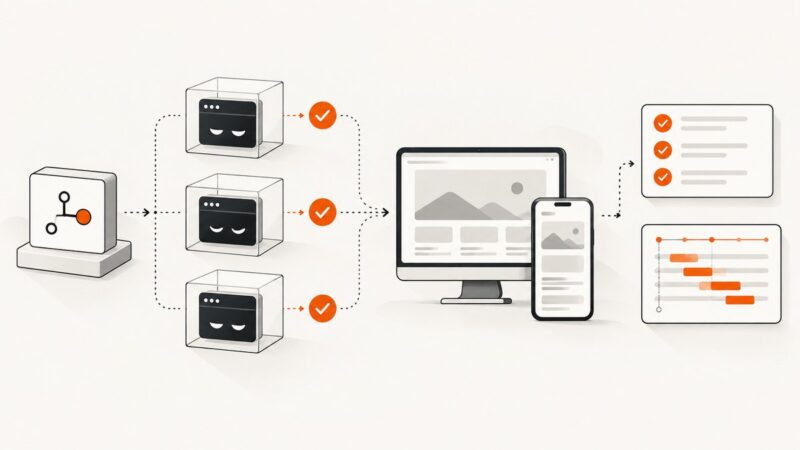
To reduce a test suite safely, first decide what it must continue to protect. Then choose the right method: minimization removes redundant tests from the retained suite, selection chooses tests relevant to a particular change, and prioritization orders tests so useful feedback arrives sooner. These solve different problems. A lower test count by itself says nothing about whether required behavior remains covered.
This guide focuses on test design and regression suites. If browser screenshots are part of your verification workflow, see ScreenshotNeo, a website screenshot API and MCP server for developers. Its usage is covered in the callout below; it does not replace the coverage decisions in this guide.
1. Define what the suite must protect
Before deleting or skipping cases, write down the obligations the suite serves. Depending on the project, these may include requirements, user-visible behavior, structural coverage, security properties, supported configurations, or regression protection for past defects.
- List behaviors and requirements. Include important error handling, boundaries, state transitions, and externally observable results.
- Map tests to obligations. Link cases to requirements, components, risk areas, or bug reports where practical. A traceable suite makes gaps easier to spot after changes.
- Record the coverage objective. Say what must remain covered: for example, all critical requirements, a structural threshold, selected parameter interactions, or all tests associated with changed components.
- Set a risk threshold. Consider the impact and likelihood of an undetected fault. A test that protects a safety-critical boundary deserves different treatment from one checking a low-impact cosmetic detail.
- Choose an approach. Permanently remove redundancy, select a change-specific subset, or reorder execution. Do not treat these as interchangeable.
Coverage evidence is useful, but it is not a complete relevance test. A test with little incremental line coverage can still protect a distinct requirement, input boundary, state, or interaction. NIST IR 8397 recommends a varied verification approach, including automated, black-box, structural, historical, and fuzz testing. It is minimum broadly applicable guidance, not an exhaustive verification standard. NIST IR 8397
2. Choose between minimization, selection, and prioritization
| Approach | What changes | Use it when | Main risk |
|---|---|---|---|
| Minimization | The tests retained in the suite | The permanent suite has redundant cases and the team wants to reduce maintenance or execution cost | Removing a case that covers a distinct behavior or condition |
| Selection | The subset run for a particular change | Running the entire regression suite for every change is too slow | Failing to select a test that would expose a fault in changed software |
| Prioritization | The execution order | The full suite still needs to run, but early feedback matters | Mistaking earlier results for complete results; tests later in the queue still need to run |
Yoo and Harman survey minimization, selection, and prioritization as separate responses to the cost of regression suites that grow as software evolves. Regression testing minimization, selection and prioritization: a survey
Minimize only against an explicit criterion
Two tests are not redundant just because they call the same function or produce the same output for one input. To remove a case, identify the criterion it adds no longer satisfies: such as requirement coverage, a structural element, a fault-detection objective, or a particular configuration interaction. Preserve at least one test for each obligation the team has decided to retain.
Select tests with evidence about change impact
Selection uses information such as changed files, dependency relationships, test-to-component mappings, requirements, and historical failures. A selection strategy is safe only under defined assumptions and conditions. NASA describes safe regression selection as choosing a subset that excludes no test that would expose a fault in modified software. If the mapping is incomplete, dependencies are dynamic, or the change crosses poorly tracked boundaries, run a broader suite. NASA SWE-191: Software Regression Testing
Prioritize for feedback, then complete the run
Order high-risk, fast, historically useful, or change-relevant tests earlier when that helps developers get actionable feedback quickly. Record that prioritization changes timing, not the coverage obligation: if the plan calls for the full suite, the later tests still have to finish before the run is complete.
3. Reduce large configuration spaces with interaction testing
Testing every possible combination of configuration values can produce a huge Cartesian product. Combinatorial testing chooses cases to cover interactions among parameter values without enumerating every combination. For example, parameters might include browser, operating system, locale, account type, and feature flag. A pairwise plan aims to include every relevant pair of values; higher interaction strengths cover larger groups together.
- List the parameters and valid values, including constraints that make some combinations impossible.
- Identify interactions with known defects, high consequences, or complex dependencies.
- Choose interaction strength to match risk and execution budget. Pairwise coverage is not a guarantee against faults that require three or more interacting conditions.
- Keep targeted tests for known risky combinations and critical boundaries even if a generated covering array omits them.
- Review the generated cases against requirements and configuration constraints, then retain the mapping from each selected case to the combinations it covers.
NIST presents combination coverage as a supplement to structural coverage. Its research page reports studies with test-set reductions of 20X to 700X and fault detection equal to exhaustive testing. Those are reported study results, not a promised reduction for every system. NIST: Combinatorial Methods for Trust and Assurance · Combinatorial Testing for Building Reliable Systems
4. A practical workflow for simplifying a suite
- Establish a baseline. Capture current suite duration, flaky-test rate, maintenance pain, coverage reports, and the requirements or risks the suite is meant to address.
- Find candidates. Look for duplicated assertions, repeated setup, overlapping inputs, obsolete requirements, and tests that are expensive or unstable. Treat each as a review candidate, not an automatic deletion.
- Check what each candidate uniquely protects. Inspect its assertions, fixtures, boundary values, configuration, state setup, and historical defect links. Compare behavior rather than just test names or lines executed.
- Make one change at a time. Consolidate duplicated setup or assertions where possible. If removing a case, document which remaining test or other verification method covers the same obligation.
- Re-evaluate coverage and risk. Review requirement mappings, changed-code relevance, parameter interactions, and any uncovered boundary. Reconsider the change if the evidence is ambiguous.
- Keep a rollback path. Preserve the old case in version history and state why it was removed. Reintroduce or replace it if a later defect shows the retained criterion was insufficient.
- Measure the outcome. Compare execution and maintenance cost against the original baseline, while checking that the coverage objective still holds.
Example decision record
Test removed: checkout_guest_empty_postal_code
Reason: same required validation outcome and boundary as checkout_guest_missing_postal_code
Retained protection: requirement CHECKOUT-14, validation tests A-118 and A-143
Distinct conditions reviewed: country-specific rules, whitespace input, guest account state
Coverage objective checked: required behavior mapping and supported locale cases
Risk owner: checkout team
Revisit if: postal-code rules or country support changes
This record is a template. Fill it with evidence from the project; do not claim equivalence based only on similar names or current line coverage.
5. Trade-offs, performance, reliability, and cost
- Execution time: Selection can reduce work for a change, while prioritization can improve time to first useful result. Minimization may reduce ongoing runtime, but only if removed cases are genuinely redundant under the chosen objective.
- Maintenance: Fewer duplicated cases can make intent clearer. Overly compact, data-driven tests can also make failures harder to diagnose, so keep case names and failure output specific.
- Reliability: A selection mechanism depends on trustworthy change-to-test relationships and assumptions about dependencies. Schedule broader regression runs where the cost and risk justify them, and revisit selection rules as the system evolves.
- Flakiness: Removing a flaky test can hide a product defect or an environment problem. Investigate whether failures are nondeterministic, repair the cause, and preserve coverage of the behavior before retiring it.
- Coverage limits: Structural, requirements, and interaction coverage answer different questions. One metric cannot establish that all important faults will be found.
- Cost: Include compute time, developer waiting, test maintenance, triage, and the expected cost of a missed fault. A smaller suite is useful when the total cost falls without breaching the coverage and risk obligations.
6. Troubleshooting common reduction mistakes
| Symptom | Likely cause | Fix |
|---|---|---|
| A regression escaped after a test was removed | The removed case covered a distinct input, state, requirement, or interaction | Reconstruct the missed condition, add a focused test, and update the mapping and reduction criterion |
| Change-based selection misses failures | Incomplete dependency or test mapping, generated code, reflection, runtime configuration, or indirect effects | Broaden selection for uncertain changes, improve dependency evidence, and periodically compare selected runs with full regression runs |
| Pairwise coverage passes but a defect remains | The defect depends on a higher-order interaction, boundary, or unmodeled constraint | Add targeted higher-strength or risk-based combinations and validate the parameter model |
| The suite is shorter but harder to debug | Cases were compressed into generic data or shared setup obscures which behavior failed | Use descriptive case identifiers, isolate assertions, and keep diagnostic context in failure output |
| A flaky test was deleted to make results stable | Instability was treated as redundancy | Find the source of nondeterminism, quarantine only with an owner and follow-up, and preserve the behavior check elsewhere |
| Coverage percentage is unchanged but confidence fell | The metric did not capture requirements, state, boundaries, or parameter interactions that were lost | Review the coverage objective and add traceability for the missing dimension |
7. How browser screenshots fit into test workflows
For web interfaces, screenshot checks can add visual evidence for a page or component across selected viewports and states. They are one verification technique alongside functional and structural tests. Keep the capture inputs, viewport, state, and comparison rules explicit so a screenshot is reproducible and tied to a behavior or requirement.
Do it yourself with a browser
A browser automation library can capture a page directly. This runnable Node.js example uses Playwright, which must be installed in the project with npm install -D playwright; install the browser with npx playwright install chromium. Save it as screenshot.mjs and run node screenshot.mjs https://example.com.
import { chromium } from 'playwright';

const target = process.argv[2];
if (!target) throw new Error('Usage: node screenshot.mjs https://example.com');

const browser = await chromium.launch({ headless: true });
try {
  const page = await browser.newPage({ viewport: { width: 1440, height: 900 } });
  await page.goto(target, { waitUntil: 'networkidle', timeout: 60_000 });
  await page.screenshot({ path: 'page.png', fullPage: true });
} finally {
  await browser.close();
}
For dynamic sites, replace networkidle with a known readiness condition such as a selector or application-specific state; background polling can prevent network idle from occurring. Set a stable viewport, use deterministic test data, and wait for fonts or animations when they affect the captured output. Keep screenshots as supporting evidence with a clear purpose rather than adding them without an associated verification obligation.
Or skip the browser setup
ScreenshotNeo returns an image or PDF from one GET request. This cURL example saves a WebP screenshot of Stripe:
curl -G "https://api.screenshotneo.com/v1/shot" \
  -d access_key=YOUR_API_KEY \
  --data-urlencode url=https://stripe.com \
  -o shot.webp
Cookie banners are accepted and removed before the shot, along with known newsletter popups and chat widgets. Bot checks, blank pages, and failed loads are never billed; response headers indicate the page verdict and billing status. An MCP server lets AI agents use screenshot, page-info, and PDF tools. The free plan includes 1,000 screenshots a month with no card; paid plans start at $5 for 3,000. Sign up for free and get 1,000 screenshots a month with no card.
Frequently asked questions
Should I aim for the smallest possible test suite?
No. Aim for the least costly suite that still meets the stated coverage and risk objectives. Test count is not a quality measure.
Can code coverage prove that a removed test was redundant?
No. It can show structural overlap, but does not by itself establish that requirements, boundaries, states, or interactions remain protected.
Does pairwise testing replace exhaustive testing?
It can reduce the number of tested combinations, but it does not guarantee detection of faults requiring higher-order interactions. Use risk evidence to decide where broader combinations are needed.
When should a team rerun the full regression suite?
Use a full run when selection assumptions are uncertain, for changes with broad or high-impact effects, and at planned integration or release checkpoints according to the project’s risk policy.
Sources
- NIST IR 8397, Guidelines on Minimum Standards for Developer Verification of Software
- NIST, Combinatorial Methods for Trust and Assurance
- Yoo and Harman, Regression testing minimization, selection and prioritization: a survey
- NASA Software Engineering Handbook, SWE-191
- Raunak, Kuhn, Kacker, and Lei, Combinatorial Testing for Building Reliable Systems