How to Refine Test Automation for a Microservices Architecture
Build a faster, more reliable microservices test strategy with service level checks, contract tests, targeted integration tests, and a small set of end-to-end journeys.
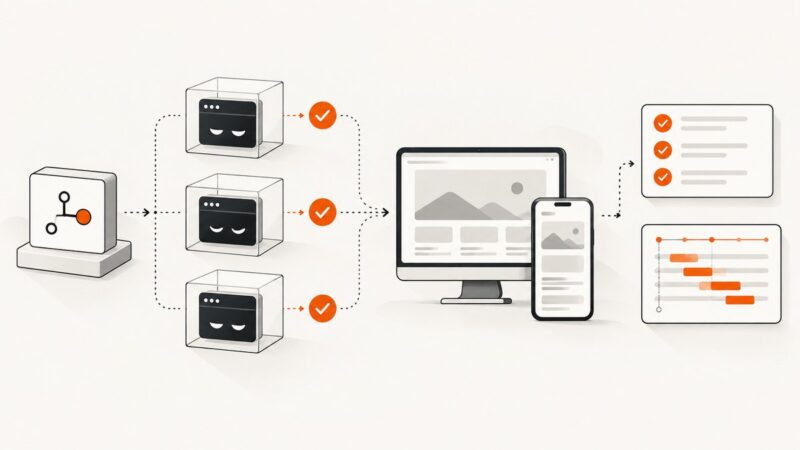
Refine microservices test automation by matching each check to a service boundary and a specific risk. Keep fast unit and component tests close to each service, use integration tests where real infrastructure behavior matters, verify consumer/provider expectations with contract tests, and reserve end-to-end tests for a small number of critical business outcomes. Run the right checks at the right points in CI and release qualification.
This gives teams useful compatibility evidence without making a large, shared, whole-system test suite the only proof that independently deployed services still work together. There is no universal test ratio: choose checks based on your system’s failure risks, feedback needs, ownership, and operating constraints. Martin Fowler’s microservice testing guidance and practical test-pyramid guidance describe the underlying tradeoffs.
1. Map service boundaries and failure risks
Start with the relationships between services, not with the tools your team already uses. For each important interaction, record the caller, provider, interface type, and business outcome that depends on it.
| Question | What to record |
|---|---|
| Who communicates? | Consumer and provider services, including external dependencies. |
| How do they communicate? | HTTP, RPC, or messages, plus the relevant request, response, event, or schema. |
| What does the consumer rely on? | Required fields, status codes, message attributes, ordering assumptions, and error behavior. |
| What can fail? | Business logic, compatibility, storage or network integration, deployment configuration, or a user-visible flow. |
| Who owns the check? | The team maintaining it, the pipeline that runs it, and the dependencies or environment it needs. |
Use this map to identify gaps and duplicated coverage. If a failure is about one service’s rule, test that rule close to the service. If it is about what a consumer and provider agree on, test their boundary. If it is about whether a user can complete a business journey, keep an end-to-end check for that outcome.
2. Choose the check that matches the risk
| Check | Question it answers | Good fit | Limit |
|---|---|---|---|
| Unit | Does isolated logic produce the expected result? | Business rules, transformations, and error handling inside a service. | Does not prove network or infrastructure behavior. |
| Component | Does a bounded service component behave correctly as a unit? | A service tested through its public interface with unrelated dependencies controlled or replaced. | Does not prove that every real dependency is configured correctly. |
| Integration | Does this service work with a real infrastructure or external integration? | Selected datastore, broker, or external-service paths where mocks cannot catch relevant failures. | More dependencies can make setup, execution, and diagnosis harder. |
| Contract | Does the provider satisfy expectations that a consumer actually uses? | HTTP and message compatibility between independently developed services. | Does not prove UI behavior, all business logic, or every deployed-system journey. |
| End-to-end | Does a critical deployed business flow work across the system? | A small, purposeful set of representative user or business journeys. | More moving parts can make failures slower to diagnose and tests more brittle. |
These checks answer different questions. A useful portfolio combines them rather than trying to make one type of test prove everything. Broad tests exercise more of the system, but usually carry higher execution and maintenance costs. The test pyramid is qualitative guidance for balancing scope, not a universal numerical ratio. Fowler’s test-pyramid article explains why broad GUI-driven tests should not carry the entire suite.
3. Keep service logic checks fast and local
Test business rules with unit tests that do not need unrelated services or a shared environment. Add component tests for behavior exposed by a bounded service, using deliberate test doubles for dependencies that are outside the behavior under test.
Keep doubles honest: they are useful for controlling a dependency and checking how the service responds, but they cannot prove that the real provider or infrastructure behaves the same way. Cover that separate risk with a contract or targeted integration check.
// Illustrative JavaScript example: test a service rule without network dependencies.
import { describe, it } from 'node:test';
import assert from 'node:assert/strict';

function canShip(order) {
  return order.status === 'paid' && order.items.length > 0;
}

describe('canShip', () => {
  it('allows a paid order with items', () => {
    assert.equal(canShip({ status: 'paid', items: ['sku-1'] }), true);
  });

  it('rejects an unpaid order', () => {
    assert.equal(canShip({ status: 'pending', items: ['sku-1'] }), false);
  });
});
Run local tests with the project’s chosen language and test runner. The example illustrates the scope decision; adapt the function and commands to your service rather than treating this snippet as a framework requirement.
4. Add targeted integration checks
Use an integration test when the risk depends on real infrastructure behavior: for example, a service’s datastore interaction, broker integration, or a specific external-service path. Keep the test focused on that boundary, and control its data and dependencies so failures are diagnosable.
- Prefer isolated test data and repeatable setup and cleanup.
- Make dependency availability and configuration explicit.
- Separate checks that need a shared or external environment from the fastest presubmit feedback when that dependency is not reliable or necessary for every edit.
- Use hermetic integration tests where practical. Google Cloud’s published change-management guidance includes hermetic integration tests among presubmit checks, alongside unit tests, fuzzing, and static and dynamic analysis. That is one organization’s approach, not a required stage model for every team. Google Cloud: test automation in the change-management process.
A mock-only test is not a substitute for an integration check when the failure risk is in the real storage, protocol, or infrastructure behavior. Conversely, putting every change behind a large environment-dependent suite can slow feedback without improving the check’s relevance.
5. Verify service interfaces with contract tests
A contract test checks an integration boundary against the expectations shared by its consumer and provider. The consumer describes the requests, messages, and response details it relies on; the provider is verified against those expectations. This can expose compatibility problems without requiring every service to be deployed together for each check.
Pact is one example of a contract-testing tool. Its documentation covers HTTP and message contracts, consumer tests that produce interactions, provider verification, and CI workflows. Confirm that a tool’s language support, message transport, workflow, hosting, and security fit your system before adopting it. How Pact works.
- Identify the consumer/provider boundary and the behavior the consumer truly depends on.
- Write consumer expectations for those interactions, avoiding assumptions about fields or behavior the consumer does not use.
- Run consumer checks and publish or otherwise make the resulting contract available to the provider verification workflow.
- Verify the provider against the relevant consumer expectations.
- Make the compatibility result visible to the deployment decision for the services involved.
- Update expectations and provider behavior deliberately when an interface changes, and coordinate the rollout when compatibility cannot be maintained during transition.
Contract tests complement unit, integration, and end-to-end checks. They do not prove that all business rules are correct, that a web interface behaves properly, or that an entire deployed user journey works. Pact’s documentation describes contracts for HTTP and messages and testing applications in isolation against shared expectations.
6. Keep end-to-end tests few and business-focused
Retain end-to-end tests for outcomes that matter across service boundaries: a representative checkout, account creation, or another critical journey in your product. Choose examples based on your own system. Avoid repeating every unit and contract assertion through a full deployed environment; broad tests have more dependencies and can be slower to diagnose and maintain.
For each end-to-end test, state the business outcome it protects, the services and environment it needs, and who owns failures. Keep assertions focused on the outcome rather than incidental details that change often. If the same defect is already caught reliably at a narrower level, decide whether the broad duplicate adds enough risk coverage to justify its cost.
7. Arrange checks in CI and release qualification
Order checks by feedback value and by the decision they support. A practical pipeline might run local service checks first, then selected contract and integration checks, and then the small end-to-end set required for a release decision. The exact gates depend on deployment risk and how quickly teams need feedback.
| Stage | Typical checks | Decision supported |
|---|---|---|
| Developer or presubmit | Fast unit and component checks, static analysis, and suitable hermetic checks. | Is this change ready for the next qualification step? |
| Compatibility qualification | Consumer/provider contract verification and targeted integration checks. | Can the affected services safely interact under the checked expectations? |
| Pre-release or staged rollout | Critical end-to-end journeys and any required environment-specific checks. | Is there enough evidence to promote this release? |
These are useful categories, not a prescribed universal sequence. Google Cloud describes design, development, qualification, and rollout, with presubmit qualification including unit, fuzz, hermetic integration, and static and dynamic analysis. Treat it as a documented example of staged change management, then fit gates to your release process. Google Cloud: change-management process.
8. Improve the portfolio from failure data
Establish a baseline before setting goals. Track measures that help answer whether your tests give useful feedback and catch the risks they were designed for:
- Where defects are found: service checks, contracts, integration, or end-to-end.
- Time from change to actionable test feedback.
- Flaky-test frequency and the time teams spend investigating it.
- Recurring interface and integration failures.
- Ownership gaps, tests with unstable dependencies, and checks that duplicate other coverage.
These are team-specific operational measures. The reviewed sources do not establish universal thresholds or coverage targets. Use the data to remove redundant checks, repair unreliable ones, and add coverage at the narrowest boundary that would have caught a real failure.
Common failure modes and fixes
| Symptom | Likely cause | Fix |
|---|---|---|
| One end-to-end suite is slow and blocks most changes. | Too many risks are being checked only through the deployed system. | Move isolated logic to unit or component checks, verify interface expectations with contracts, and keep end-to-end coverage for critical outcomes. |
| Mocks pass but consumers break after deployment. | The tests verify a local double, not the provider’s actual interface. | Add consumer/provider contract verification for the behavior consumers rely on, plus targeted integration checks where needed. |
| A contract suite passes but users still hit a broken journey. | Contract checks prove interface expectations, not the complete UI or business flow. | Keep a small end-to-end test for the affected critical outcome and focused service tests for its logic. |
| Integration tests fail intermittently. | Shared state, uncontrolled dependencies, timing assumptions, or environment instability. | Isolate data, control dependencies where practical, make setup deterministic, and separate unstable environment checks from fast feedback until they are reliable. |
| A provider change surprises a consumer team. | Consumer assumptions were not captured or provider verification was not part of the relevant decision. | Record the actual consumer expectations, verify them against provider changes, and make results visible to the affected pipeline or teams. |
| CI is green but a deployment still fails. | The suite did not cover the deployment-specific risk, or the checks did not run at the right qualification point. | Trace the failure to a missing boundary or release assumption; add the narrowest useful check and review where it belongs in staged qualification. |
Capture screenshots for visual checks in a service workflow
Some microservice systems expose user-facing pages assembled from multiple services. If a critical page has visual behavior that matters, a screenshot can be an artifact for a focused visual review or comparison. A screenshot alone does not establish API compatibility or prove a business flow; pair it with the relevant service and interface checks.
For a do-it-yourself capture, use a browser automation tool in the existing visual test setup, navigate to the target page, wait for the required state, and save a screenshot. Keep authentication, test data, viewport, and readiness conditions deterministic so visual changes are interpretable. Browser-specific setup and API details depend on the automation framework selected by the team.
Or skip the browser setup
Use ScreenshotNeo to capture a page with one GET request. See the ScreenshotNeo API documentation for configuration and response details.
curl -G "https://api.screenshotneo.com/v1/shot" -d access_key=YOUR_API_KEY --data-urlencode url=https://stripe.com -o shot.webpimport requests
r = requests.get("https://api.screenshotneo.com/v1/shot", params={"access_key": "YOUR_API_KEY", "url": "https://stripe.com"}, timeout=90)
open("shot.webp", "wb").write(r.content)const q = new URLSearchParams({ access_key: 'YOUR_API_KEY', url: 'https://stripe.com' });
const res = await fetch(`https://api.screenshotneo.com/v1/shot?${q}`);- Cookie banners, newsletter popups, and chat widgets are removed before the shot; each cleanup step can be turned off.
- Bot checks, blank pages, timeouts, failed loads, and cache hits are never billed. Response headers say the page verdict and billing status.
- An MCP server provides
take_screenshot,get_page_info, andcapture_pdftools for Claude, Cursor, and other MCP clients. - The Free plan includes 1,000 screenshots a month with no card; paid plans start at $5 for 3,000 screenshots.
Sign up for ScreenshotNeo’s free plan to get 1,000 screenshots a month with no card.
Performance, reliability, and cost
Test cost is not just execution time. Include setup, environment maintenance, failure diagnosis, and ownership. Narrow checks generally have fewer moving parts and faster, more precise feedback; broad checks can validate deployed behavior but require more infrastructure and care. Run each check at the point where its result can inform a real decision.
- Performance: keep fast local checks frequent; avoid making every code change wait on broad environments unless the risk warrants it.
- Reliability: deterministic data and controlled dependencies improve diagnosis. Treat flaky results as an engineering issue, not as useful signal to ignore.
- Cost: account for compute, shared environments, maintenance, and developer time. Remove duplicated checks when they add little coverage, but retain checks for distinct risks.
- Change safety: combine compatibility evidence with appropriate staged qualification. A passing test suite is evidence about the checks it ran, not a guarantee against every production failure.
FAQ
How do we test microservices without deploying the whole system?
Test service logic locally, test bounded components with controlled dependencies, and verify consumer/provider contracts independently. Use targeted integration checks for real infrastructure risks and retain only the end-to-end journeys needed to qualify critical outcomes.
How should contract tests fit into CI?
Run consumer expectations and provider verification in a workflow that makes compatibility results available before the relevant promotion or deployment decision. The exact pipeline and contract management approach depend on your tooling and release process.
Do contract tests replace end-to-end tests?
No. Contracts check agreed interface behavior; end-to-end checks cover selected outcomes across the deployed system. They address different risks.
How many end-to-end tests should a microservices system have?
There is no universal count or ratio. Keep tests for critical outcomes that need cross-system evidence, then use narrower checks for the remaining logic and interface risks.
Should every service use the same test framework?
Not necessarily. Shared conventions for reporting, ownership, and CI visibility can help, while language and framework choices should fit each service and its team.