BlogScreenshots on your device
Why Safari Full-Page Screenshots Fail and How to Fix Them
Safari full-page screenshots differ on iPhone, iPad and Mac. Learn the documented workflows, limits, fixes and a reliable API fallback.
Short answer: On iPhone, take a normal screenshot, open its preview, choose Full Page, then save the result as a PDF. On Mac, Safari’s documented File > Save As workflow creates a Web Archive or Page Source; it is not the same Full Page editor available on iPhone. If Full Page is missing or the result is incomplete, Apple’s public guidance explains the workflows but does not identify one universal cause or fix.
Which Safari full-page capture are you trying to use?
| Situation | Documented method | Output |
|---|---|---|
| iPhone or iPad webpage | Screenshot preview → Full Page | Long capture, saved as PDF |
| iPhone or iPad webpage PDF | Safari Share → Markup → save | Webpage PDF, with optional annotation |
| Mac Safari page | File → Save As | Web Archive or Page Source |
| Mac or another desktop browser | Safari extension listed for full-page capture | PNG or PDF, depending on the extension |
Apple documents the iPhone screenshot flow in its iPhone User Guide. Its separate webpage-to-PDF instructions cover the Share and Markup route. For Mac, see Apple’s Safari User Guide.
Fix an iPhone or iPad full-page screenshot
- Open the target webpage in Safari. Wait until the page content you need has loaded.
- Take a regular screenshot with your device’s screenshot buttons.
- Tap the screenshot thumbnail before it disappears, or open the screenshot from Photos if your version provides the editor there.
- Choose Full Page at the top of the preview.
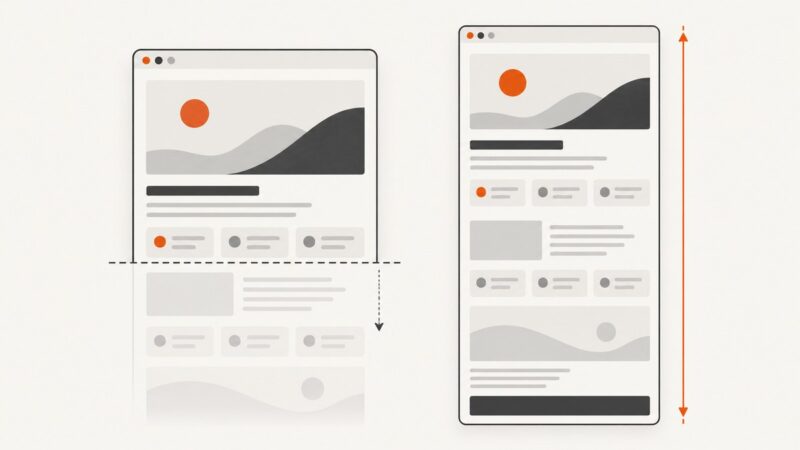
- Scroll the preview to inspect the complete capture. This is where you can confirm that the page extends beyond the visible screen.
- Use the save control and choose Save PDF to Files when that option is offered.
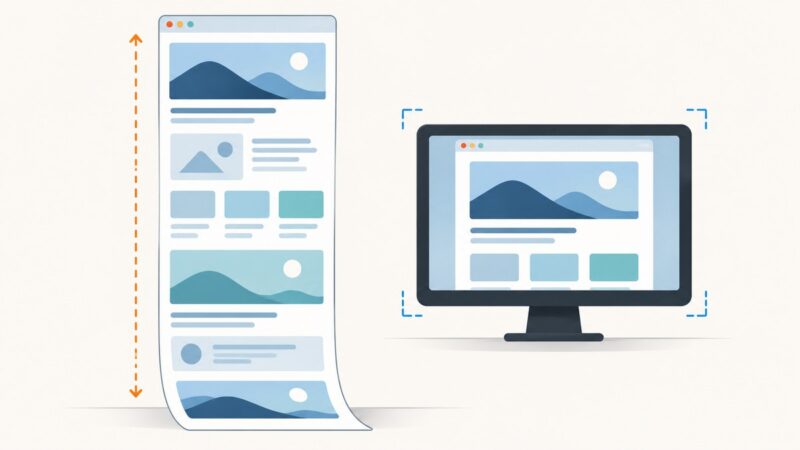
Apple describes Full Page as a way to capture content beyond the screen, including an entire Safari webpage. The documented output is a PDF rather than a normal camera-roll PNG.
If Full Page is missing
First confirm that you are in the screenshot preview for a Safari webpage, rather than viewing an image or another app. Then repeat the capture from the page itself and open the thumbnail immediately. If the control is still absent, record the device model, iOS or iPadOS version, Safari version if known, exact URL and whether the problem is a missing control or a partial result. Apple’s cited documentation does not establish a single setting, site rule or operating-system change that explains every missing Full Page control, so avoid assuming that one restart or preference change is a universal fix.
If the capture stops partway down
- Inspect the Full Page preview before saving so you know whether the missing area is absent from the capture or merely outside the visible preview.
- Reload the page, wait for its content to settle, and take a new screenshot.
- For pages that continually load or replace content while scrolling, use Safari’s Share → Markup PDF workflow or a controlled capture tool instead.
- Keep the original URL and timestamp with the PDF. Dynamic pages can change between attempts.
Use Safari’s Share and Markup PDF route
This is a separate workflow from Screenshot → Full Page. Use it when your goal is a saved webpage PDF, especially when you need to annotate it.
- In Safari, tap Share.
- Choose Markup (the exact placement can vary with the tab layout and iOS version).
- Review or annotate the generated document.
- Use the share or save controls to store the PDF in Files or another destination.
Because Safari’s tab layout affects button placement, the labels and location may differ slightly on your device. This route should not be described as a fix for every Full Page screenshot failure; it is an alternative way to create a webpage PDF.
What to do on Mac
Do not follow the iPhone screenshot-preview instructions on Mac. Apple’s Mac documentation describes File → Save As instead:
- Open the page in Safari.
- Choose File → Save As.
- Select Web Archive to keep the page and its graphics and links together, or Page Source to save the HTML source.
- Choose a destination and save.
Apple cautions that some webpages may prevent Safari from saving items shown on the page. A Web Archive is also different from a pixel-perfect screenshot: it preserves a browsable page package, not a single rendered image.
Try a Safari extension when you need PNG or PDF
A Safari extension listed in the App Store offers full-page and visible-area capture with PNG/PDF export. Treat it as an optional fallback. Check that it is enabled in Safari’s extension settings and that it has the permissions it requests, then fully quit and reopen Safari. The listing also notes that some sites may still need troubleshooting, so an extension is not a guarantee for every page.
Why pages are especially difficult to capture
Long pages often combine lazy-loaded images, infinite scroll, sticky headers, embedded frames, consent dialogs, chat widgets and content that changes while you scroll. A browser’s built-in capture has to render those states in one session. If the page changes during capture, the saved PDF or image may contain gaps, repeated sections or a different state from the one you saw initially. These are practical reasons to inspect the output; they are not a documented Apple diagnosis for a particular failure.
Troubleshooting checklist
| Symptom | Likely scope | Action |
|---|---|---|
| No Full Page tab on iPhone | Wrong preview context or an undocumented device/page condition | Capture the Safari webpage again, open the thumbnail immediately, then document device, OS and URL if it remains absent. |
| Only the visible screen is saved | Full Page was not selected, or the alternate PDF route was used | Return to the screenshot preview and select Full Page; verify the PDF after saving. |
| Lower sections are blank | Page content was still loading or changed during capture | Reload, wait for content, retry, or use a controlled capture service. |
| Mac has no iPhone-style editor | Platform difference | Use File → Save As, a Safari extension, or an API. |
| Web Archive omits an item | The webpage may prevent saving displayed items | Use a PDF or screenshot workflow and retain the source URL. |
| Extension does nothing | Inactive extension, missing permission or stale Safari process | Enable it, review permissions, fully quit Safari, reopen it, and retry. |
Or skip the browser setup
If you need repeatable screenshots from a script or build job, ScreenshotNeo returns a screenshot or PDF from one GET request. Its capture can accept the cookie or consent banner like a visitor and remove more than 60 known consent platforms, newsletter popups and chat widgets before the shot; each step can be turned off. Only clean shots are billed: bot checks or CAPTCHAs, blank pages, timeouts, failed loads and cache hits cost nothing, and the response identifies the result with X-Page-Verdict and X-Billed headers. It also provides an MCP server for Claude, Cursor and other MCP clients.
See the complete option list and parameter reference in the ScreenshotNeo docs.
cURL
curl -G "https://api.screenshotneo.com/v1/shot" -d access_key=YOUR_API_KEY --data-urlencode url=https://stripe.com -o shot.webpPython
import requests
r = requests.get("https://api.screenshotneo.com/v1/shot", params={"access_key": "YOUR_API_KEY", "url": "https://stripe.com"}, timeout=90)
open("shot.webp", "wb").write(r.content)
Node.js
const q = new URLSearchParams({ access_key: 'YOUR_API_KEY', url: 'https://stripe.com' });
const res = await fetch(`https://api.screenshotneo.com/v1/shot?${q}`);
For production captures, set the options you need: full-page mode, a device or viewport, retina scale, a CSS selector for one element, dark mode, custom CSS or JavaScript, a selector or delay to wait for, network-idle waiting, blocked ads/trackers/resources, custom headers/cookies/user agent/Authorization, timezone, geolocation, transparent background, resizing, a chosen cache TTL, signed image links, asynchronous jobs with signed webhooks, bulk capture for up to 100 URLs per call, PDF paper size/margins/orientation/page ranges, and the usage API. Parameter names used by other screenshot APIs also work, which can simplify migration.
For reliability, wait for a meaningful selector or network idle on pages that render late, use a delay for animations, hide sticky or irrelevant selectors, and cache stable pages with a TTL you choose. For cost control, cache repeated URLs and inspect the billing headers. The Free plan includes 1,000 shots per month without a card; paid plans start at $5 for 3,000 shots. Every feature is available on every plan, and yearly billing gives two months free.
Create a free ScreenshotNeo account with 1,000 screenshots each month and no card.
FAQ
Does iPhone Full Page save a PNG?
Apple’s documented Full Page workflow saves the long capture as a PDF. Use a separate screenshot tool or API when you need a PNG, JPEG or WebP.
Is Safari’s Mac Save As the same as Full Page?
No. Mac Save As creates a Web Archive or Page Source. The iPhone screenshot editor’s Full Page control is a different workflow.
Can every Safari webpage be captured end to end?
No method is universal. Pages can change while loading, prevent saving, or behave differently in an extension or automated browser. Record the exact URL and output when reporting a failure.
Should I change a Safari setting first?
There is no single setting identified by the cited Apple guidance as a universal fix for a missing Full Page control or incomplete capture.