How to Scale Headless Chrome Horizontally
Scale headless Chrome with a bounded worker pool, measured concurrency, pinned browser versions, and autoscaling that protects jobs and memory.
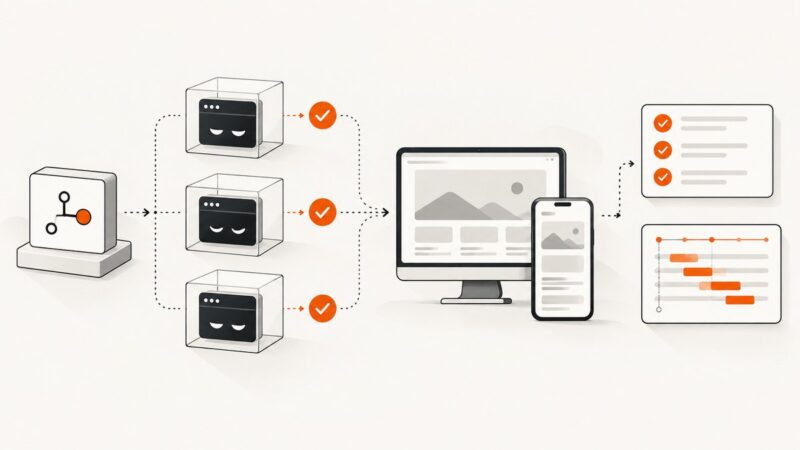
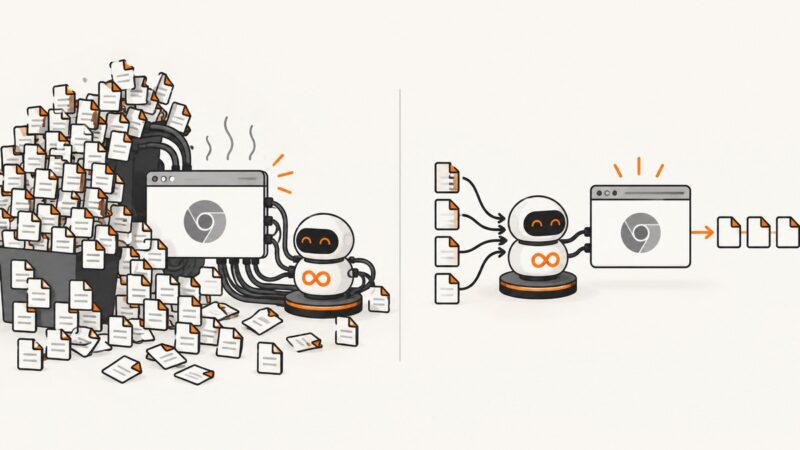
Scale headless Chrome horizontally by putting browser jobs behind a durable queue and processing them with a pool of bounded workers. Add worker replicas as demand grows, while limiting concurrent jobs per worker so memory pressure, browser crashes, and downstream limits do not turn a traffic burst into a failure cascade. There is no universal safe number of Chrome sessions per worker: benchmark your own page mix and container limits before setting capacity.
Each worker should use a pinned Chrome and automation-tool version, report structured job outcomes, and recycle unhealthy browser processes. Measure queue age, job latency, CPU, memory, launch failures, crashes, and timeouts. Use those measurements to establish concurrency limits and autoscaling thresholds.
1. Choose the browser mode and control layer
Modern Chrome Headless uses the same browser implementation as regular Chrome while creating platform windows without displaying them. It is a sensible default when realistic Chrome behavior and broad feature compatibility matter. The separate chrome-headless-shell is lighter and can be more performant for some workloads, including screenshotting and scraping, but trades some authenticity and feature completeness for that reduced footprint. Check mode-specific requirements against the Chrome release you deploy. Chrome Headless documentation
Choose the control layer that fits your existing automation stack. Puppeteer controls Chrome through the Chrome DevTools Protocol (CDP) or WebDriver BiDi; ChromeDriver supports WebDriver-based frameworks. Adding replicas does not require changing frameworks. ChromeDriver documentation · Puppeteer documentation
Do not use tab count as a proxy for process count or capacity. Chromium’s multi-process architecture places site instances and related documents into processes to improve responsiveness and limit the impact of renderer failures. That separation consumes memory, and a tab does not map to exactly one process. Chromium multi-process architecture
2. Build a bounded worker-pool architecture
A typical design has five parts: a durable queue, a worker pool, a browser lifecycle policy, structured job results, and an autoscaler. This is an architecture pattern, not a Chrome-mandated setup.
- Queue jobs durably. Store the URL, capture or automation options, deadline, retry policy, and an idempotency key. Make queue delivery semantics explicit; workers should tolerate a job being delivered again.
- Claim within a limit. Each worker claims only as many jobs as its measured concurrency permits. Apply backpressure rather than letting an unbounded number of requests launch browsers at once.
- Manage browser lifetimes. Launch a browser per job when strong process isolation is needed. Reuse a browser process with separate contexts when startup cost matters and the workload permits it. Recycle processes after crashes, hangs, or a configured amount of work. These are workload decisions; neither Chrome nor Chromium specifies a universal reuse policy.
- Return structured outcomes. Record success, navigation or rendering failure, timeout, browser crash, and retry status separately. Keep enough context to diagnose failures without logging secrets such as cookies or authorization headers.
- Scale and drain workers deliberately. Scale out when queue pressure and worker saturation indicate sustained demand. On scale-in, stop assigning jobs to draining workers and let active work finish up to an explicit deadline; then terminate or requeue according to the job’s retry policy.
Browser process isolation is not tenant isolation. Chromium’s site isolation does not guarantee that arbitrary application sessions are safe to share. Use separate browser contexts or processes according to your security and state requirements, and avoid sharing cookies or authenticated state across tenants.
3. Pin versions in every worker
Chrome for Testing provides versioned browser binaries and matching ChromeDriver releases for automation. Puppeteer can download a compatible Chrome for Testing browser by default. In a distributed fleet, pin browser and driver versions together in an immutable worker image or equivalent deployment artifact. Roll upgrades through a canary and watch for rendering changes, automation failures, and resource shifts before replacing the fleet. Chrome for Testing overview
Confirm that the base image’s operating system and CPU architecture meet the current browser requirements. Puppeteer documents supported Debian/Ubuntu and openSUSE/Fedora Linux environments and supported architectures; the requirements page does not specify a production container image or per-browser memory requirement. Puppeteer system requirements
4. Measure capacity instead of guessing
Official Chrome sources do not publish a universal browser-per-worker ratio, RAM-per-session figure, or autoscaler threshold. Establish capacity with a benchmark that reflects your production conditions; do not transfer a number from a different site mix or machine shape.
- Use the pinned browser version, the same container CPU and memory limits, viewport, navigation wait strategy, and network conditions planned for production.
- Build a representative page mix: include light and heavy pages, slow or failed loads, pages with many resources, and cases that time out.
- Start at low concurrency. Increase it in controlled steps, recording throughput, median and tail job latency, CPU saturation, memory peak, browser crashes, launch failures, and timeouts.
- Find where latency or failures begin to rise or memory approaches the container limit. Set the worker limit below that point with a safety margin.
- Repeat after changing browser versions, page mix, container limits, or wait behavior. Recheck under burst load as well as steady load.
This is an engineering measurement method, not a published Chrome benchmark. The multi-process design’s memory overhead is one reason to measure actual pages instead of estimating from tab count alone.
5. Autoscale on queue pressure and worker health
Queue depth and queue age help show demand, but either metric alone can mislead: a few long jobs can age while a large number of short jobs complete quickly. Combine queue signals with active jobs per worker, job duration, CPU and memory, and recent failure rates. Set policy using observed workload behavior rather than an assumed universal threshold.
- Scale out when queue pressure persists and workers have reached their safe concurrency. Confirm that downstream sites, proxies, storage, and external service quotas can accept the added traffic.
- Keep a hard cap on concurrent jobs per worker and total replicas. This bounds resource use during bursts or when a queue is unusually large.
- Scale in gradually by draining workers, stopping new assignments, and allowing active work to complete until its deadline.
- Alert on failure signals such as browser launch errors, crash loops, rising timeout rates, and workers repeatedly reaching their memory limit.
- Keep retries bounded and use backoff for transient failures. A broken target or bad deployment should not create an endless retry storm.
6. Run a Puppeteer worker with bounded concurrency
The following Node.js example shows a single worker process that accepts jobs, limits concurrent browser work, times out navigation, and closes each browser after the job. It is a runnable local starting point, not a queue or autoscaler. Install Puppeteer with npm install puppeteer; Puppeteer downloads a compatible browser by default. For a fleet, feed the worker from your durable queue, report outcomes to your job store, and apply your measured concurrency limit.
// worker.mjs
import puppeteer from 'puppeteer';

const maxConcurrent = Number(process.env.MAX_CONCURRENT_JOBS ?? 2);
if (!Number.isInteger(maxConcurrent) || maxConcurrent < 1) {
  throw new Error('MAX_CONCURRENT_JOBS must be a positive integer');
}

const pending = [];
let active = 0;

function submit(url) {
  return new Promise((resolve, reject) => {
    pending.push({ url, resolve, reject });
    drain();
  });
}

function drain() {
  while (active < maxConcurrent && pending.length > 0) {
    const job = pending.shift();
    active++;
    capture(job.url)
      .then(job.resolve, job.reject)
      .finally(() => {
        active--;
        drain();
      });
  }
}

async function capture(url) {
  const browser = await puppeteer.launch({ headless: true });
  try {
    const page = await browser.newPage();
    page.setDefaultNavigationTimeout(30_000);
    await page.goto(url, { waitUntil: 'domcontentloaded' });
    return await page.screenshot({ type: 'png' });
  } finally {
    await browser.close();
  }
}

// Example local jobs. Replace with a durable queue consumer in production.
const urls = process.argv.slice(2);
if (urls.length === 0) {
  console.error('Usage: node worker.mjs https://example.com [https://example.org ...]');
  process.exitCode = 2;
} else {
  const results = await Promise.allSettled(urls.map(submit));
  for (let i = 0; i < results.length; i++) {
    const result = results[i];
    if (result.status === 'fulfilled') {
      const { writeFile } = await import('node:fs/promises');
      await writeFile(`capture-${i}.png`, result.value);
      console.log(JSON.stringify({ url: urls[i], status: 'ok', file: `capture-${i}.png` }));
    } else {
      console.error(JSON.stringify({ url: urls[i], status: 'error', error: String(result.reason) }));
    }
  }
}
The example launches one browser per job to make lifecycle and failure boundaries clear. That has startup overhead. A production worker may reuse a browser process and create a fresh context per job, provided it closes contexts reliably and has a policy to recycle unhealthy or long-lived processes. Benchmark both approaches against your workload. Add job cancellation and a total job deadline in the queue consumer; a navigation timeout alone does not bound every possible hang.
7. Reliability, performance, and cost considerations
Reliability
- Make jobs idempotent or store completion state so redelivery does not duplicate side effects.
- Set a total deadline for each job, including queue claim, browser launch, navigation, capture, and result storage.
- Distinguish target failures from worker failures. Retry transient worker or network errors with a limit; avoid repeatedly retrying deterministic invalid URLs or blocked targets.
- Recycle a browser after a crash or suspected hang. Use a health check and allow the supervisor to restart a worker that stops making progress.
- Drain workers during deployments and version rollouts instead of changing browser binaries underneath active jobs.
Performance
- Browser reuse can reduce repeated launch work, while per-job processes can improve isolation. Compare them under representative load.
- Choose navigation waits that match the task. Waiting for every network request to stop can be inappropriate for pages with persistent connections; a DOM-ready milestone plus a specific selector or bounded delay may be more predictable.
- Limit unnecessary resources only when the resulting page remains valid for the task. Blocking images or scripts may speed a job but can change the rendered result.
- Watch tail latency and memory peaks, not just average completion time. A small number of heavy pages may determine safe concurrency.
Cost
For a self-hosted pool, cost depends on allocated worker CPU and memory, idle capacity kept for bursts, queue and result storage, network egress, and operations time. The sources do not give a cost per Chrome session. Reduce idle waste with gradual scaling, but retain enough warm capacity if launch latency matters. Compare total operating cost with managed browser services using your actual request volume, concurrency, retention, and reliability needs.
8. Troubleshooting common scaling failures
| Symptom | Likely cause | What to do |
|---|---|---|
| Workers are killed or Chrome crashes under load | Too many simultaneous heavy pages or insufficient memory headroom. | Lower per-worker concurrency, inspect memory peaks, and repeat the workload benchmark. Scale out only if the downstream targets can accept more traffic. |
| Queue grows despite adding replicas | Workers may be saturated elsewhere, jobs may be slow, or a downstream service may be limiting throughput. | Compare active jobs, job duration, CPU, memory, and error rates. Check proxy, storage, and target-site limits before increasing replicas again. |
| Chrome fails to launch after deployment | Browser and driver versions may not match, or the image may not meet current OS or architecture requirements. | Pin compatible versions, verify the worker image against current system requirements, and roll back the canary if launch failures began with the update. |
| Screenshots or page behavior changed after a rollout | Browser version or Headless mode changed rendering or automation behavior. | Compare the pinned versions and mode, reproduce with the same viewport and wait strategy, and use a controlled canary before fleet-wide rollout. |
| Jobs hang or hit navigation timeouts | The target is slow, a wait condition is unsuitable, or the job lacks a total deadline. | Record stage timings, choose a wait condition that matches the task, set navigation and total deadlines, and classify timeout outcomes for bounded retry. |
| One worker handles fewer jobs than expected | Page complexity, process overhead, or shared CPU and memory limits may dominate; tab count does not reveal the true process footprint. | Measure representative pages per worker and inspect CPU and memory under concurrency. Set capacity from observed saturation rather than tab count. |
| Scaling causes more failures at target sites | Parallel requests may exceed target, proxy, or external service limits. | Apply rate limits and backpressure, coordinate per-domain concurrency, and scale only within downstream capacity. |
9. Or skip the browser setup
For screenshot jobs, ScreenshotNeo is a website screenshot API and MCP server. One GET request returns a PNG, JPEG, WebP, or PDF. The code below saves a screenshot of the target page; see the API documentation for options and response details.
curl -G "https://api.screenshotneo.com/v1/shot" -d access_key=YOUR_API_KEY --data-urlencode url=https://stripe.com -o shot.webpimport requests
r = requests.get("https://api.screenshotneo.com/v1/shot", params={"access_key": "YOUR_API_KEY", "url": "https://stripe.com"}, timeout=90)
open("shot.webp", "wb").write(r.content)const q = new URLSearchParams({ access_key: 'YOUR_API_KEY', url: 'https://stripe.com' });
const res = await fetch(`https://api.screenshotneo.com/v1/shot?${q}`);ScreenshotNeo removes cookie banners, newsletter popups, and chat widgets before capture; bot checks, blank pages, and failed loads are never billed. Its MCP server gives AI agents tools to take screenshots, get page information, and capture PDFs. The free plan includes 1,000 screenshots a month with no card; paid plans start at $5 for 3,000. Sign up for 1,000 free screenshots a month, no card required.
10. Frequently asked questions
Should I use one browser process per job?
Use it when process isolation is more important than launch overhead. Reuse may reduce startup work, but requires reliable context cleanup and process recycling. Measure both under your page mix.
Does a separate tab guarantee a separate process?
No. Chromium process placement depends on site instances and related documents; do not infer process or memory use directly from tab count.
Should every workload use the separate Headless shell?
No. Use unified Headless when behavior parity and compatibility are priorities. Consider the shell for a suitable screenshotting or scraping workload after checking current mode support and benchmarking your pages.
How often should I rerun the capacity benchmark?
Rerun it when the browser version, container limits, workload composition, navigation strategy, or downstream conditions change. Those changes can alter throughput and resource use.