How to Scale Test Automation: Key Strategies
Speed up automated tests safely with a measured path from baseline to parallel execution, sharding, and reliable CI feedback.
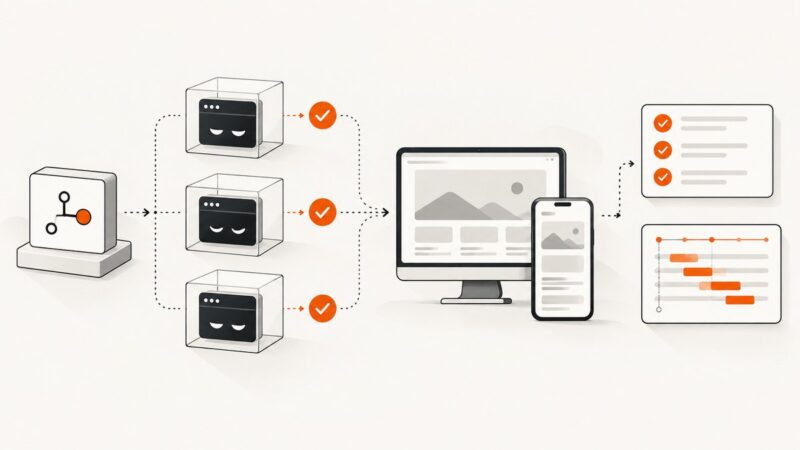
Scale test automation by first measuring where time and failures come from, then making tests and test data safe to run independently, and only then increasing workers, CI jobs, or distributed capacity. More machines do not guarantee proportional speedups: setup overhead, uneven test durations, application capacity, shared data, and runner limits can all become the new bottleneck.
This guide covers a practical rollout for Playwright, Cypress, and Selenium, along with ways to measure gains, control flakes, and diagnose slow or unstable runs.
1. Establish a baseline before adding concurrency
Record enough information to tell whether a change improved the suite or merely moved the bottleneck. Save results from multiple representative runs; one unusually fast or slow CI run is not a useful baseline.
- Wall-clock duration: total time from the start of the workflow to the final test result.
- Test and spec durations: identify the longest files and groups, plus how uneven their durations are.
- Queue and setup time: separate waiting for a runner, dependency installation, application startup, and test execution.
- Runner utilization: inspect CPU, memory, disk, and network use while the suite runs.
- Failure profile: track pass rate, retries, timeouts, and recurring failures by test, environment, and failure type.
- Application-side capacity: where available, check whether test traffic is saturating the app, database, or dependent services.
Keep the same test scope and environment when comparing runs. If a change also alters browsers, data, or runner size, record that alongside the result. Cypress offers recorded-run diagnostics; use equivalent timing and failure visibility with other stacks.
2. Make tests safe to distribute
Parallel workers cannot safely share mutable state unless the test system explicitly coordinates access. Playwright documents that workers do not communicate with one another and that file execution order is not guaranteed. Treat every test as if it could start at the same time as any other test.
Test independence checklist
- Give tests unique records, accounts, namespaces, or other data where concurrent writes could conflict.
- Make setup repeatable and cleanup safe to run even after an assertion fails.
- Avoid order-dependent tests that rely on a prior test to create state.
- Use isolated environments or explicitly partitioned data for parallel jobs.
- Decide how to handle shared external limits, such as rate-limited services, before raising concurrency.
- Ensure retries do not reuse partially modified data without resetting it.
Data setup and infrastructure are part of the automation design, not incidental details. Selenium’s overview of test automation includes both among the practices teams need to plan for.
3. Choose the distribution method that fits your stack
| Stack and method | What it does | What to evaluate |
|---|---|---|
| Playwright workers | Runs tests in worker processes on a machine; worker count is configurable. | Machine capacity, isolation, stability, and whether more workers reduce wall time. |
| Playwright CI sharding | Splits a suite into shards that separate CI jobs can run in parallel. | Job startup cost, shard balance, duplicated setup, and environment capacity. |
| Cypress Cloud parallelization | Distributes spec files across available CI machines in recorded runs; prior durations inform assignment. | Cloud dependency, machine availability, spec granularity, and run visibility. |
| Selenium Grid | Runs browser tests across multiple machines and browsers. | Grid operations, browser and OS coverage, capacity, and maintenance effort. |
These mechanisms describe different operating models, not a controlled performance comparison. Choose based on your existing framework and CI design, then validate against your own workload. See the official documentation for Playwright parallelism, Playwright CI and sharding, Cypress Cloud parallelization, Cypress CI, and Selenium Grid.
4. Increase concurrency in measured steps
- Start from the baseline. Keep a run with the current worker count and configuration for comparison.
- Change one concurrency setting. Add a modest number of workers or CI jobs, keeping test scope and runner type stable.
- Compare time and health. Review wall time, CPU and memory use, queue and setup overhead, failure rate, and test data collisions.
- Repeat only while gains justify the cost. Stop increasing capacity when elapsed time flattens, failures rise, or infrastructure cost grows faster than the benefit.
- Investigate the limiting factor. Check for long-tail specs, repeated setup, application saturation, constrained runners, or shared state before adding more jobs.
Playwright recommends one worker in CI when stability and reproducibility are the priority, while also supporting parallel work and sharding where the environment can support them. This is a useful conservative starting point for a new or noisy CI setup, not a universal worker-count rule. Cypress advises checking machine utilization when adding machines does not improve runtime as expected.
5. Balance work so parallel capacity is useful
Parallel execution only helps when work can be divided into pieces that finish at similar times. File-based distribution can leave machines idle if one spec is much longer than the rest. Cypress Cloud uses prior run durations to inform assignment and notes that similarly sized specs parallelize best.
- Compare per-spec duration and machine completion times to see whether a few specs dominate the tail.
- Break oversized specs into smaller independent units when that is safe and improves assignment granularity.
- Account for work repeated on every job, such as environment startup, dependency installation, and migrations.
- Inspect shard durations; a balanced number of tests does not necessarily mean balanced execution time.
6. Treat flakes as reliability work
Retries can keep an intermittent failure from immediately blocking a pipeline, but a green retry is still evidence that a test or environment is unreliable. Cypress recommends keeping retry counts low and using flake data to address causes.
- Keep failure output, logs, screenshots or traces where your framework supports them, and relevant environment details.
- Track tests that fail and then pass on retry, and group them by likely cause: test synchronization, product defect, data collision, environment, or infrastructure.
- Fix the recurring cause and watch whether the flaky rate drops across subsequent runs.
- Keep retries bounded so a broken test does not multiply CI time indefinitely.
7. Common scaling problems and fixes
| Symptom | Likely cause | What to check or change |
|---|---|---|
| More workers do not reduce wall time | CPU or memory saturation, app capacity, setup overhead, or an imbalanced long tail. | Inspect runner utilization and per-spec timings; address the constrained resource or split the long work safely. |
| Failures appear only in parallel runs | Shared mutable data, account collisions, or order-dependent setup. | Isolate test data, make setup self-contained, and remove assumptions about execution order. |
| One CI job finishes much later than others | Uneven shard or spec durations. | Use duration history where available, inspect the slow specs, and improve assignment granularity. |
| Runtime rises sharply as jobs are added | Environment startup, shared service load, rate limits, or runner contention. | Separate startup from test time, check application and service capacity, and increase concurrency more gradually. |
| Retries make the suite green but slow | Flaky tests are being masked rather than fixed. | Keep retry counts low, retain failure context, and prioritize recurring flaky tests for repair. |
| Tests pass locally but fail in CI | Different resources, timing, configuration, or test data in CI. | Compare browser, environment variables, service dependencies, data setup, and runner pressure between environments. |
8. Performance, reliability, and cost trade-offs
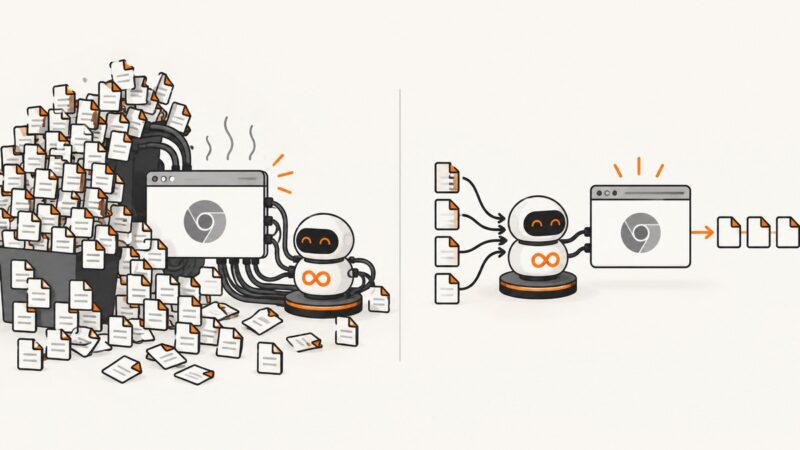
More workers or CI machines can shorten elapsed time, but they also increase simultaneous load on runners, applications, databases, and external services. They may add job startup and duplicated setup costs. Measure the full workflow rather than test execution alone, and compare the saved engineering wait time with the added infrastructure and orchestration cost.
For reliability, prefer the concurrency level at which the suite remains reproducible and failures are diagnosable. Keep data boundaries explicit, retries limited, and run history available. For performance, address the measured bottleneck first; buying capacity will not fix a serial setup step or one oversized spec.
Or skip the browser setup
If part of your workflow is capturing pages for visual review or documentation, ScreenshotNeo provides a website screenshot API and MCP server. One GET request returns a PNG, JPEG, WebP, or PDF. See the API documentation.
curl -G "https://api.screenshotneo.com/v1/shot" -d access_key=YOUR_API_KEY --data-urlencode url=https://stripe.com -o shot.webpimport requests
r = requests.get("https://api.screenshotneo.com/v1/shot", params={"access_key": "YOUR_API_KEY", "url": "https://stripe.com"}, timeout=90)
open("shot.webp", "wb").write(r.content)const q = new URLSearchParams({ access_key: 'YOUR_API_KEY', url: 'https://stripe.com' });
const res = await fetch(`https://api.screenshotneo.com/v1/shot?${q}`);- Cookie and consent banners, newsletter popups, and chat widgets are removed before the shot; each step can be turned off.
- Bot checks, blank pages, and failed loads are never billed; response headers report the page verdict and billing status.
- An MCP server provides
take_screenshot,get_page_info, andcapture_pdftools for AI agents. - 1,000 screenshots a month are free with no card; paid plans start at $5 for 3,000 screenshots.
Create a free ScreenshotNeo account and get 1,000 screenshots a month with no card.
FAQ
Should every test suite run in parallel?
No. Parallelize tests that are independent and whose environment can handle the resulting load. Keep serial execution where shared state or stability requirements demand it.
How do I know whether a shard is balanced?
Compare each shard’s elapsed time over repeated runs. Similar test counts can hide large duration differences, so use timing data where the tool provides it.
Is a retry a pass?
It may let a pipeline continue, but a test that needs a retry is a reliability signal. Track it and investigate the cause.
How should I approach a very large suite?
Use the same sequence at larger scale: trustworthy timing, safe data boundaries, incremental distribution, then measured tuning. A question like “How can I run 20K functional automated tests in shortest amount of time” has no universal worker-count answer; the right configuration depends on test duration, environment capacity, setup cost, and stability requirements.