BlogScreenshots on your device
How to Capture a Website Screenshot with the URL and Date Visible for Documentation
Capture a page and its browser URL in one screenshot, record the date and timezone, and preserve the original with enough context to review later.
To document a website visually, take a screenshot of the full browser window so the address bar and the relevant rendered page content appear together. Record the capture date and time with a timezone—UTC is a clear choice—in the filename or a separate capture note if the clock is not visible. Keep the original file unchanged, and label any crop or annotation as a derivative.
A screenshot records what appeared in a browser at a moment in time. It does not, by itself, prove that the page was authentic, that its contents were unchanged before capture, or that the image was not edited afterward. For important records, preserve the collection details and consider keeping a PDF or fuller web capture too.
1. Decide what the record needs to show
Before capturing, decide whether the record is about a particular visible state or about the page as a whole. That choice determines whether a browser-window capture or a full-page image is more useful.
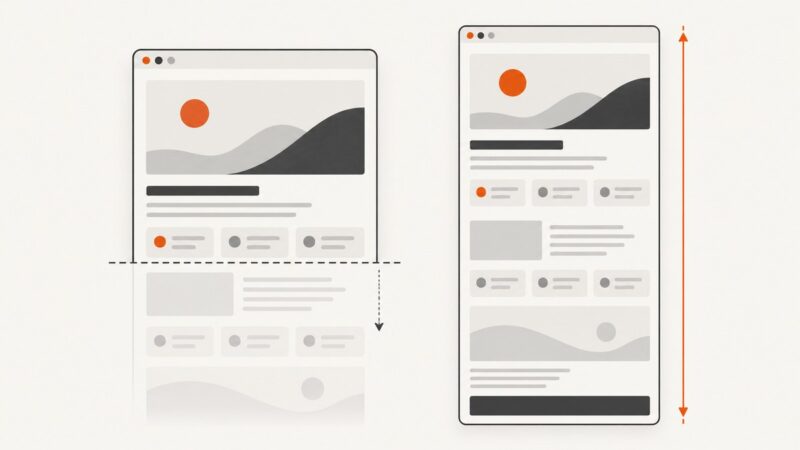
- Use a browser-window screenshot when the URL and a particular visible state need to be seen together. Keep the browser chrome, including the address bar, in frame.
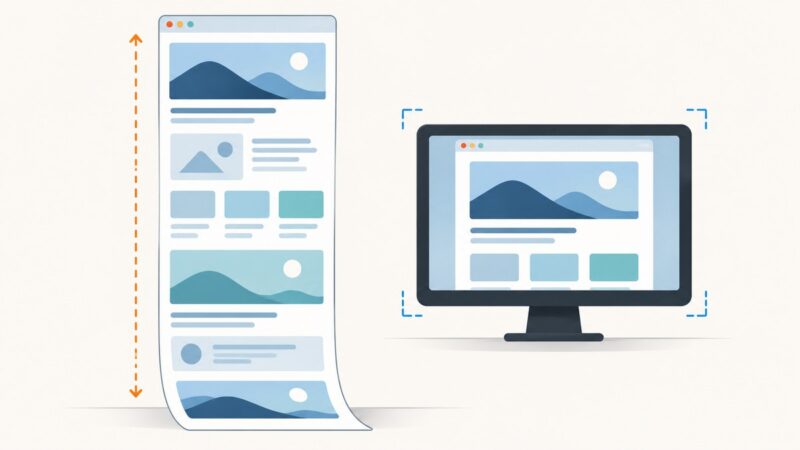
- Use a full-page screenshot when relevant content extends below the viewport. It can show more page context, though it may be less suitable for documenting a transient state or interaction.
- Save or print to PDF when a paginated, reviewable copy is useful alongside the screenshot.
- Use a web archive or harvest when links, page structure, or broader site content may matter for later access. A static screenshot does not retain functional hyperlinks or full site structure.
For records management and transfer, the US National Archives and Records Administration (NARA) discusses web harvesting, PDF capture, and manual downloading or copying as distinct approaches. Its guidance is specifically about US federal records, not a universal legal rule. NARA’s web records guidance describes “print and file” as a basic manual approach for relatively stable website content, and cautions that a web page can comprise multiple files sent to a browser.
2. Prepare the browser and capture
- Open the exact page you need in a desktop browser. Wait until the page has finished loading and any relevant content is visible.
- Check the address bar. Make sure it shows the complete URL you intend to document, including the relevant path and query string if those are part of the record.
- Arrange the browser window so the address bar and the important page content are both legible. Avoid cropping away the browser chrome.
- Capture the full browser window. If the page is long, take a separate full-page capture as a companion, but keep a browser-window image when the visible URL is required.
- Review the saved image at its actual size. Confirm the URL and the relevant content are readable, and that neither has been cut off.
Browser shortcuts and full-page capture controls differ by browser and version, so use the capture command available in your browser or operating system and verify the resulting file instead of relying on a particular key combination.
3. Record date, time, URL, and capture context
If the system clock is not visible in the image, put the date and time, including timezone, in a filename or an accompanying note. A filename can follow a consistent pattern such as 2026-10-04T1430Z_example-com_page-record.png; replace the example timestamp and name with the actual capture details. Do not infer a timestamp from this sample.
Keep a short capture note with these fields:
- Exact URL shown after the page finished loading.
- Capture date and time, including timezone, such as UTC.
- What portion of the page is shown and what visible content is relevant.
- Capture method, such as browser-window screenshot or full-page capture.
- For a higher-value record: browser and version, operating system, and the person who made the capture.
NARA’s transfer guidance calls for website URL, capture method and date, capture software and version for PDF captures, and capture-contact information where applicable. Its recommendations are useful recordkeeping context, but their scope is federal records transfer.
4. Preserve the original and make derivatives traceable
- Keep the original image as captured. Store it in a location with appropriate access controls for the sensitivity of the record.
- If a report needs a crop, highlight, or annotation, save a separate copy. Identify it as edited or annotated and retain the untouched original.
- Keep the capture note with the file or in a record system that maintains the association.
- For important records, preserve a PDF or fuller web capture as an additional layer when page structure, links, or later review matter.
- Use a consistent naming and filing scheme so the image can be matched to its URL and capture note later.
NARA frames trustworthy records in terms of reliability, authenticity, integrity, and usability, and recommends documented procedures and controls to protect records from unauthorized alteration. Those concepts support keeping originals and recording how a capture was made.
5. Understand what a dated screenshot can establish
The image shows the browser’s rendered view, and the visible URL and documented time add useful context. A date displayed in the browser or written in a note is still a contextual indicator; it is not independent proof that the page existed in that state at that time. A screenshot alone also cannot establish authenticity or rule out prior modification of the page or later editing of the file.
If later verification matters, preserve the original, document collection steps, and use additional capture or archive material suited to the purpose. Requirements for independent timestamping or legal evidence depend on intended use and jurisdiction; there is no universal evidentiary standard established by the sources here.
The UK Government Web Archive can help locate archived captures by URL and date. Its archive metadata includes capture timestamp and URL fields. An archived capture may provide useful context, but it is a distinct record from your own browser screenshot.
6. Common problems and fixes
| Problem | Likely cause | Fix |
|---|---|---|
| The URL is missing from the image. | The capture was cropped to page content or used a page-only capture mode. | Capture the full browser window with the address bar visible. Review the saved image before filing it. |
| The address bar or page text is too small to read. | The browser window was too small, or the image was scaled down for sharing. | Enlarge the browser window before capture and preserve the original-resolution image. If a report copy is resized, retain the original separately. |
| The date has no timezone. | A local clock time was written without its zone or offset. | Record a timezone explicitly, for example UTC, and use the same convention in the filename and note. |
| The capture shows a loading state or missing content. | The page had not finished loading, or content depended on delayed rendering. | Wait for the relevant page content to appear, then capture. Note any content that did not load rather than implying it was present. |
| A full-page image omits or changes an interactive state. | Full-page capture may not preserve transient or viewport-specific behavior. | Capture the relevant visible state in a browser-window screenshot as well; keep the full-page image as a companion if it adds context. |
| An annotated image is mistaken for the original. | The edited copy was saved over the initial capture or not identified. | Keep the unedited original and name or record the annotated version as a derivative. |
| A reviewer treats the screenshot as proof of authenticity or time. | The image is being asked to establish more than a visual snapshot can establish. | Explain its limits in the record note and preserve additional capture or archive material appropriate to the verification need. |
7. Choose an additional preservation method when needed
| Method | Useful when | Main limitation |
|---|---|---|
| Browser-window screenshot | A quick visual record of a page or state is sufficient and the URL should appear in-frame. | Does not preserve links or full site structure. |
| Full-page screenshot | Relevant content spans a long page. | May be less useful for proving a specific transient or interactive state. |
| Print or save to PDF | A reviewable, paginated copy is useful. | May not preserve all page behavior or dynamic content. |
| Web archive or harvest | Later access to broader content or structure matters. | Completeness depends on the page and archive method. |
For relatively stable website content, NARA recognizes a manual “print and file” approach; it also describes web harvesting and PDF capture as other methods. The UK Government Web Archive offers a URL timeline from which a reader can select a capture date. Select the preservation method based on what future readers need to inspect.
8. Automate repeatable image capture
A screenshot API can produce an image from a URL without opening a browser window manually. That is useful for repeatable visual monitoring or collecting page images, but an API image of page content does not automatically show a browser address bar or prove the capture time. For this documentation task, keep the URL and time in a linked capture note or filename, and use a desktop browser-window screenshot when the address bar itself must be visible in the image.
ScreenshotNeo is a website screenshot API and MCP server for developers. Its API can return PNG, JPEG, WebP, or PDF from one GET request. For repeat captures, use a consistent filename and record the exact URL and timestamp alongside the returned file.
curl -G "https://api.screenshotneo.com/v1/shot" \
  -d access_key=YOUR_API_KEY \
  --data-urlencode url=https://example.com \
  -o page.webp
See the ScreenshotNeo API documentation for the request options. The API code below captures a page image; it does not add a browser address bar or an evidentiary timestamp to the image.
import requests

r = requests.get(
    "https://api.screenshotneo.com/v1/shot",
    params={"access_key": "YOUR_API_KEY", "url": "https://example.com"},
    timeout=90,
)
r.raise_for_status()
with open("page.webp", "wb") as image:
    image.write(r.content)
const q = new URLSearchParams({
access_key: 'YOUR_API_KEY',
url: 'https://example.com',
});
const res = await fetch(`https://api.screenshotneo.com/v1/shot?${q}`);
if (!res.ok) throw new Error(`Screenshot request failed: ${res.status}`);
const bytes = Buffer.from(await res.arrayBuffer());
await import('node:fs/promises').then(fs => fs.writeFile('page.webp', bytes));When automating records, keep a manifest or capture note with the source URL, capture time and timezone, capture method, and resulting filename. Treat a failed load or bot check as an unsuccessful capture and record that outcome rather than treating an empty image as evidence of page content.
Or skip the browser setup
ScreenshotNeo accepts cookie and consent banners like a visitor and removes more than 60 known consent platforms, newsletter popups, and chat widgets before capture; each step can be turned off. Bot checks and CAPTCHAs, blank pages, timeouts, failed loads, and cache hits cost nothing, and response headers report the page verdict and billing status. Its MCP server provides take_screenshot, get_page_info, and capture_pdf for AI agents and MCP clients such as Claude and Cursor. The free plan includes 1,000 screenshots a month with no card; paid plans start at $5 for 3,000 shots.
curl -G "https://api.screenshotneo.com/v1/shot" \
  -d access_key=YOUR_API_KEY \
  --data-urlencode url=https://example.com \
  -o shot.webp
This one-call capture returns page imagery. Put the URL and timestamp in your record note or filename when documenting it; it does not include a browser address bar. See the API documentation, then sign up for 1,000 free screenshots a month with no card.
9. Performance, reliability, and cost considerations
- Performance: A manual viewport capture is quick. Full-page captures and separate PDF or archive copies take additional steps and can create larger files; capture only the material needed for the record.
- Reliability: Review each file after capture. Dynamic pages, delayed content, and temporary failures can make the result differ from the intended state. Record the method and any capture issue so later readers have context.
- Preservation: A screenshot is easy to view but loses hyperlink behavior and broader page structure. Keep a PDF or web archive when those matter.
- Cost: A manual screenshot has no service charge, though organizing and preserving it takes time. ScreenshotNeo has a free plan of 1,000 shots per month with no card. Paid plans are Starter $5 for 3,000, Growth $15 for 15,000, Pro $39 for 60,000, Scale $99 for 250,000, and Business $249 for 1,000,000; yearly billing gives two months free. Every feature is on every plan. An API image still needs separate URL and time documentation for this use case.
FAQ
Should the date be inside the screenshot?
Only if it can be displayed accurately and legibly. Otherwise, put the date, time, and timezone in a filename or capture note associated with the original image.
Does a visible URL prove the page came from that website?
No. It gives a reviewer context about the browser view, but a screenshot alone does not establish authenticity or rule out alteration.
Is a screenshot enough for permanent web-content preservation?
Usually not if links, page structure, or broader content need to remain usable. Keep a PDF or fuller web capture as an additional preservation copy when appropriate.
Should I use UTC or local time?
Choose a timezone and record it explicitly. UTC is a clear choice because it avoids ambiguity across locations; consistency matters more than the chosen zone.