BlogScreenshots on your device
How to Screenshot a Web Page at 4K Resolution on Windows
Capture a whole webpage or a 4K-sized browser viewport on Windows. Learn the Edge steps, what “4K” means for a screenshot, and how to check the saved dimensions.
On Windows, Microsoft Edge can capture a whole webpage with Web capture, or you can use Edge DevTools to capture the current viewport or the full page. These options do not guarantee an image exactly 3840 pixels wide. If exact 4K dimensions matter, check the saved image’s pixel dimensions; a full-page screenshot is usually taller than 2160 pixels and is not the same thing as a 3840 × 2160 viewport screenshot.
1. Understand what “4K screenshot” means
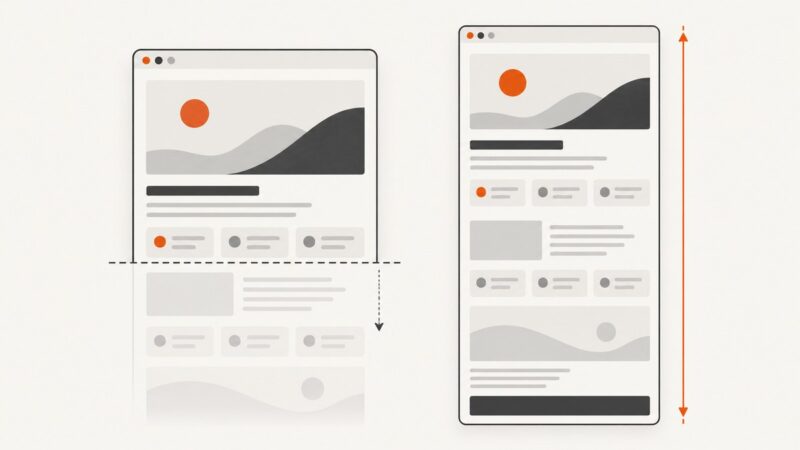
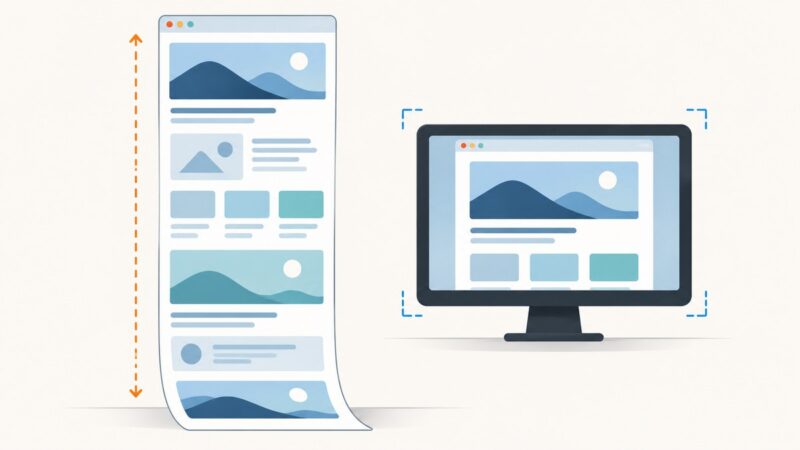
For a desktop image, 4K commonly means 3840 × 2160 pixels. That describes a fixed width and height. A full-page screenshot captures content beyond the visible browser window, so its height may be much greater than 2160 pixels. Its width depends on the page and capture viewport.
There are three different capture scopes:
- Viewport: what is currently visible in the browser content area.
- Selected area: a region you choose on screen.
- Full page: the webpage beyond the visible viewport, typically resulting in a tall image.
Choosing “Capture full page” does not set the output to 3840 × 2160. Browser zoom and device emulation also do not, by themselves, guarantee exact exported dimensions. Treat 4K as a target pixel size, then inspect the output.
2. Quick method: capture a full page with Edge Web capture
- Open the page in Microsoft Edge.
- Open Settings and more and choose Web capture, or press Ctrl+Shift+S.
- Choose Capture full page for the whole webpage. Choose the area option if you only need part of the page.
- Review the capture, then save it. Edge’s workflow also offers copy and markup options.
- Open the saved file in an image viewer or editor and inspect its pixel dimensions if a specific size is required.
This is the simplest route for a whole-page image. Microsoft notes that feature availability and behavior can vary by device, market, and browser version. Its feature page also describes capturing moving content, such as GIFs or carousels, so you can catch a frame.
3. Controlled method: capture with Edge DevTools
Use DevTools when you want to work with viewport dimensions or need to distinguish clearly between the visible viewport and the entire page.
- Open the webpage in Edge, then open DevTools.
- Enable Device Mode.
- Use the viewport controls and pixel rulers to frame or measure the emulated viewport.
- Open More options in Device Mode. Choose Capture screenshot for the current viewport, or Capture a full size screenshot to include content outside the viewport.
- Inspect the downloaded image’s dimensions and content.
Device Mode is for emulating layouts and gives you viewport tools. The documented workflow does not promise that a particular setting exports an image exactly 3840 pixels wide. If you need exact dimensions, verify the file and resize or recapture using a workflow that gives you the required output.
Keep zoom separate from viewport size
Page zoom changes how large page content is rendered. DevTools UI zoom changes the size of the DevTools interface. They are separate controls, and neither is a substitute for checking the exported pixel dimensions. Edge DevTools documents Ctrl+0 as a way to restore the focused surface to 100% zoom.
4. Choose a capture method
| Need | Use | What to verify |
|---|---|---|
| Whole page with minimal setup | Edge Web capture → Capture full page | Whether the saved image contains the whole page and has the required dimensions |
| Only the visible browser area | Edge DevTools → Capture screenshot | The resulting viewport dimensions |
| Whole page with developer viewport controls | Edge DevTools Device Mode → Capture a full size screenshot | Full-page content and actual file dimensions |
| Only a region | Edge Web capture area option | The selected region and saved output |
Chrome DevTools also lists full-page, area, and oversized-node screenshot techniques. The steps above focus on Edge because its documented Web capture and Device Mode instructions provide a direct workflow for Windows.
5. Check the saved image’s dimensions
- Save the screenshot to a known folder.
- Open it in an image viewer or editor that displays image properties or dimensions.
- Compare the reported width and height with your requirement. A 3840 × 2160 image is a fixed 4K-sized frame; a full-page image may be 3840 pixels wide but much taller, or may have a different width entirely.
- If the dimensions do not match, adjust the capture viewport or use an image editor to resize or crop, depending on whether preserving all page content or matching a fixed frame matters more.
Resizing can change sharpness, and cropping can remove content. Keep the original capture if you may need to revise the result.
6. Common problems and fixes
| Problem | Likely cause | What to do |
|---|---|---|
| The screenshot contains only what was visible on screen | A viewport screenshot was captured instead of a full-page screenshot. | In Web capture choose Capture full page, or in Device Mode choose Capture a full size screenshot. |
| The image is tall, not 3840 × 2160 | A full-page capture includes content below the viewport. | Decide whether you need a fixed 4K viewport or the whole page. Capture the viewport for a fixed frame, then verify the dimensions. |
| The file width is not 3840 pixels | The capture feature does not promise a precise 4K export; viewport and page settings affect output. | Inspect the saved file, adjust the viewport, and recapture. Resize only if changing the image is acceptable. |
| Some content is missing | The wrong capture scope may have been selected, or the page may not have finished rendering. | Review the result and repeat as a full-page capture after the page is ready. Check that you used the full-size command in DevTools. |
| The shortcut does not open Web capture | Feature availability or behavior can differ by Edge version, device, or market, or focus may be in another app. | Open Settings and more and look for Web capture. If unavailable, use Edge DevTools or check the browser version and feature availability. |
| The captured frame of a carousel or GIF is not the one you wanted | The content was moving during capture. | Use Edge’s screenshot workflow to catch the desired frame, then review before saving. |
7. Performance, reliability, and file considerations
A full-page capture processes more content than a viewport capture, so very long pages can take longer and produce larger files. Dynamic content can change while the page is being captured. Let the page finish loading, review the result, and capture again if an animation or delayed content produced an unsuitable frame.
For reliable dimension checks, use the dimensions reported by the saved file rather than relying on the monitor’s resolution, browser window size, or a “4K” label. Browser capture is suitable for occasional manual work; repeatable captures across many URLs benefit from a scripted browser workflow or screenshot API, where viewport and output settings can be supplied consistently.
8. Automate the capture with ScreenshotNeo
If you need repeatable captures across pages or want to avoid managing browser setup, ScreenshotNeo is a website screenshot API and MCP server from Yorker Media. One GET request returns an image or PDF. See the ScreenshotNeo API documentation for available parameters. For this page, request a 3840 × 2160 viewport using the documented viewport options, then inspect the returned file dimensions; do not assume a full-page image will be 2160 pixels tall.
curl -G "https://api.screenshotneo.com/v1/shot" -d access_key=YOUR_API_KEY --data-urlencode url=https://stripe.com -o shot.webpimport requests
r = requests.get("https://api.screenshotneo.com/v1/shot", params={"access_key": "YOUR_API_KEY", "url": "https://stripe.com"}, timeout=90)
open("shot.webp", "wb").write(r.content)const q = new URLSearchParams({ access_key: 'YOUR_API_KEY', url: 'https://stripe.com' });
const res = await fetch(`https://api.screenshotneo.com/v1/shot?${q}`);
const bytes = Buffer.from(await res.arrayBuffer());
await import('node:fs/promises').then(fs => fs.writeFile('shot.webp', bytes));These examples save a WebP response. Use the API’s documented format and viewport parameters when you need another format or a particular viewport. Keep your access key private; do not put it in browser-side code or a public repository.
What the service handles
- It accepts cookie or consent banners like a visitor and removes more than 60 known consent platforms, newsletter popups, and chat widgets before capture; each step can be turned off.
- Bot checks and CAPTCHAs, blank pages, timeouts, failed loads, and cache hits are not billed. Response headers report the page verdict and whether the request was billed.
- It has an MCP server with
take_screenshot,get_page_info, andcapture_pdftools for Claude, Cursor, and other MCP clients. - The free plan includes 1,000 shots per month with no card. Paid plans start at $5 for 3,000 shots; higher tiers are Growth at $15 for 15,000, Pro at $39 for 60,000, Scale at $99 for 250,000, and Business at $249 for 1,000,000. Yearly billing gives two months free, and every feature is on every plan.
Or skip the browser setup: use the one-call API for a clean screenshot. Cookie banners, popups, and chat widgets are removed before the shot; bot checks, blank pages, and failed loads are never billed; an MCP server lets AI agents take screenshots; and 1,000 screenshots a month are free with no card, with paid plans starting at $5 for 3,000. Create a free ScreenshotNeo account.
9. FAQ
Does full-page capture mean 4K?
No. Full-page describes how much page content is captured, not a guaranteed pixel width or fixed 3840 × 2160 output.
Can I screenshot only the part of a page I need?
Yes. Edge Web capture offers an area capture option, and DevTools offers a viewport screenshot.
Is a 4K monitor required?
The reviewed browser instructions do not establish a 4K monitor as necessary. Check the saved image dimensions to confirm the output you need.