BlogScreenshots on your device
How to Screenshot a Whole Web Page on Windows
Capture an entire webpage on Windows with Chrome DevTools, Snipping Tool, Edge, and an API workflow for reliable automated screenshots.
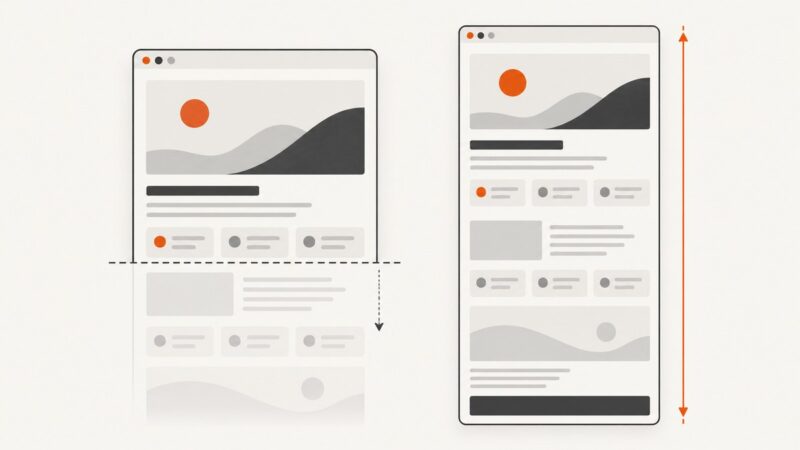
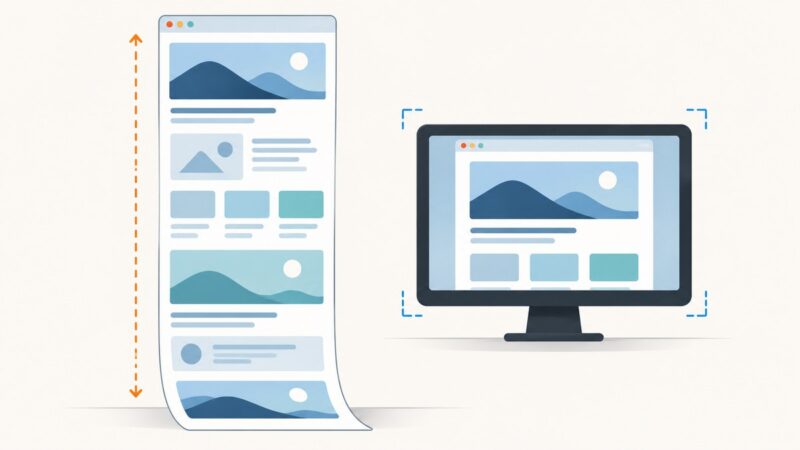
To screenshot content below the visible screen on Windows, use a browser’s full-page capture feature. The most directly documented built-in method is Chrome DevTools’ Capture node screenshot, which captures the selected page element, including content below the fold. Windows Snipping Tool captures the current screen, window, or selected region; its documented full-screen mode does not create a scrolling webpage image.
Choose the right method
| Method | Captures below the fold? | Best for | Output |
|---|---|---|---|
| Chrome DevTools | Yes, for the selected node | A complete webpage image | Downloaded PNG |
| Windows Snipping Tool | No scrolling capture documented | Visible screen, window, or region | Image copied or saved |
| Microsoft Edge Screenshot | Version-dependent; verify the menu | Web or PDF captures and annotation | Image or annotated capture |
| ScreenshotNeo API | Yes, with automation controls | Scripts, CI, repeatable captures, and many URLs | PNG, JPEG, WebP, or PDF |
Chrome: capture an entire webpage
Step 1: Open the page and DevTools
- Open the webpage in Chrome.
- Press Ctrl+Shift+I to open DevTools. You can also right-click the page and choose Inspect.
Step 2: Select the page root
- Open the Elements panel.
- Select the element that contains the page you want. For the whole document, select the document or root element rather than a small card or article container.
- Right-click the selected node.
- Choose Capture node screenshot.
Chrome documents this command as capturing the full selected node, including content below the viewport. The documented article describes Chrome 89-era DevTools, so menu wording or placement can differ in newer versions: Chrome for Developers: What’s New in DevTools (Chrome 89).
Step 3: Find and inspect the file
Chrome saves the image to its configured download folder. Open the file and check the top, middle, and bottom sections. A long page may include fixed headers, sticky navigation, lazy-loaded images, animations, or content that appears only after interaction.
Make lazy content appear before capture
If images or sections load only after scrolling, scroll through the page once before selecting the node. Wait for visible content to finish loading, then capture again. This is a practical precaution because a screenshot tool can only capture content that exists in the rendered page when the command runs.
Capture one section instead of the whole page
Select the article, report, table, or other container in Elements and choose Capture node screenshot. This avoids unrelated navigation and reduces the resulting image height.
Windows Snipping Tool: capture the visible screen
Snipping Tool is useful when you need what is currently visible rather than a scrolling webpage.
- Press Windows+Shift+S, or open Snipping Tool from the Start menu.
- Choose rectangular, freeform, window, or full-screen snip.
- Select the area or window.
- Use the notification preview to annotate and save the image.
Microsoft’s documentation describes these screen and region modes: Use Snipping Tool to capture screenshots. Full screen means the current display; it does not document automatic page scrolling. For a webpage longer than the viewport, use Chrome DevTools or an automated capture service.
Microsoft Edge: check the installed version
Microsoft calls its former Web Capture feature Screenshot. The policy documentation covers web and PDF capture, annotation, and the Ctrl+Shift+S shortcut when enabled, but it does not confirm a full scrolling-page command: Microsoft Edge WebCaptureEnabled policy documentation.
- Open the page in Edge.
- Press Ctrl+Shift+S, or open Screenshot from the browser menu.
- Look for an option named Capture full page or equivalent.
- If the option is missing, use Chrome DevTools’ node capture for a documented full-node workflow.
Feature labels and availability vary by Edge version and policy. Verify the command in the version installed on your PC before depending on it for a repeatable process.
Or skip the browser setup
ScreenshotNeo provides a one-request website screenshot API for PNG, JPEG, WebP, or PDF output. The API can capture full pages, load lazy images, select one element by CSS selector, set a viewport or device preset, use dark mode and retina scale, add custom CSS or JavaScript, click before capture, hide selectors, wait for a selector, delay, or network idle, and control headers, cookies, user agent, authorization, timezone, geolocation, blocked requests, caching, and more. See the ScreenshotNeo API documentation for the complete option list.
cURL
curl -G "https://api.screenshotneo.com/v1/shot" -d access_key=YOUR_API_KEY --data-urlencode url=https://stripe.com -o shot.webpPython
import requests

r = requests.get(
    "https://api.screenshotneo.com/v1/shot",
    params={"access_key": "YOUR_API_KEY", "url": "https://stripe.com"},
    timeout=90,
)
r.raise_for_status()
open("shot.webp", "wb").write(r.content)
Node.js
const q = new URLSearchParams({ access_key: 'YOUR_API_KEY', url: 'https://stripe.com' });
const res = await fetch(`https://api.screenshotneo.com/v1/shot?${q}`);
if (!res.ok) throw new Error(`Screenshot failed: ${res.status}`);
const fs = await import('node:fs/promises');
await fs.writeFile('shot.webp', Buffer.from(await res.arrayBuffer()));
ScreenshotNeo removes cookie and consent banners, newsletter popups, and chat widgets before the capture. Bot checks or CAPTCHAs, blank pages, timeouts, failed loads, and cache hits are not billed; response headers identify the page verdict and whether the shot was billed. Its MCP server provides take_screenshot, get_page_info, and capture_pdf tools for Claude, Cursor, and other MCP clients. The Free plan includes 1,000 shots per month with no card; paid plans start at $5 for 3,000 shots. Create a free ScreenshotNeo account.
Useful capture options
| Need | Chrome DevTools approach | ScreenshotNeo approach |
|---|---|---|
| Whole page | Select the root/document node | Use the default full-page capture |
| One element | Select that element in Elements | Pass a CSS selector |
| Lazy images | Scroll first and wait | Enable full-page capture with lazy images loaded |
| Mobile or retina output | Adjust DevTools emulation before capture | Choose a device preset, viewport, and retina scale |
| Use the browser print dialog | Set paper size, margins, landscape, and page ranges | |
| Repeatable automation | Manual DevTools steps or browser automation | HTTP requests, async jobs, webhooks, bulk capture, and a usage API |
Troubleshooting
The screenshot stops at the visible viewport
Cause: You used Snipping Tool or a screen capture shortcut. Fix: Use Chrome DevTools and select Capture node screenshot, or call ScreenshotNeo for an automated full-page image.
Capture node screenshot is missing
Cause: DevTools is closed, the wrong panel is open, or the context menu was opened outside the Elements tree. Fix: Open DevTools with Ctrl+Shift+I, select a node in Elements, then right-click that node. Chrome menu details can change between versions.
Images or sections are missing
Cause: Lazy loading, delayed JavaScript, blocked resources, or content that appears after scrolling or clicking. Fix: Scroll through the page, wait for network activity to settle, interact with required controls, and capture again. For automation, use a selector wait, delay, network-idle wait, custom JavaScript, or a click step.
The page is extremely tall or the file is too large
Cause: A full-page image can be many thousands of pixels high. Fix: Capture the relevant article element, resize the output, use JPEG or WebP when appropriate, or create a PDF for document-like pages.
Edge does not show a full-page option
Cause: The installed Edge version or policy may expose Screenshot without a scrolling command. Fix: Check the Screenshot menu, then use Chrome DevTools or ScreenshotNeo.
The API response is not a usable image
Cause: The request failed or returned an error body. Fix: Check the HTTP status before writing the file, set a practical timeout, keep the access key private, and inspect the X-Page-Verdict and X-Billed headers. Bot checks, blank pages, failed loads, timeouts, and cache hits are reported and are not billed by ScreenshotNeo.
Performance, reliability, and cost
- Manual captures: Chrome DevTools is fast for occasional work, but results depend on the current browser state, extensions, login session, viewport, and page timing.
- Dynamic pages: Wait for the specific selector or network idle instead of relying on a fixed short delay. Scroll-triggered content may need an explicit scroll or script.
- Large pages: Limit the capture to a CSS-selected element when possible. This reduces image dimensions and download size.
- Repeatability: Set viewport, device, timezone, geolocation, cookies, headers, user agent, and custom CSS explicitly when those values affect rendering.
- Retries: Retry transient network failures with a bounded backoff, but inspect the page verdict so a bot check or blank page is handled separately from a transport error.
- Caching: ScreenshotNeo supports a cache TTL you choose. Cache hits cost nothing and are identified in the response.
- Volume: Bulk capture supports up to 100 URLs per call. Async jobs and signed webhooks let long-running batches finish without keeping a request open.
- Pricing: ScreenshotNeo includes 1,000 free shots each month with no card. Paid plans are Starter $5 for 3,000, Growth $15 for 15,000, Pro $39 for 60,000, Scale $99 for 250,000, and Business $249 for 1,000,000; yearly billing gives two months free.
Checklist for a complete webpage screenshot
- Decide whether you need the visible screen or the entire document.
- For Chrome, select the correct root or content node in Elements.
- Scroll through pages with lazy-loaded content before a manual capture.
- Check the saved image at the top, middle, and bottom.
- Choose an element capture, resize, WebP/JPEG, or PDF for very long pages.
- For scripts, set waits, viewport, authentication, and resource blocking explicitly.
- Keep API keys out of client-side code and public repositories.
FAQ
Can Windows Snipping Tool take a scrolling screenshot?
Its Microsoft documentation describes screen, window, rectangular, and freeform captures, not automatic scrolling webpage capture. Use Chrome DevTools or an API for a whole page.
Does Chrome save a full-page screenshot as a PDF?
Capture node screenshot saves an image. Use the print dialog for a PDF, or use ScreenshotNeo’s PDF options when you need controlled paper size, margins, orientation, or page ranges.
Can I capture only an article or table?
Yes. Select that element in Chrome’s Elements panel, or pass its CSS selector to ScreenshotNeo.
Why does a full-page capture differ from what I see?
Responsive breakpoints, animations, lazy loading, login state, cookies, and timing can change the rendered document. Set the viewport and wait for the page state you need before capturing.
Is Edge’s Screenshot feature guaranteed to capture a whole webpage?
No. The cited Microsoft policy documentation confirms web/PDF capture and annotation but does not verify a full scrolling-page command. Check your installed version and use Chrome DevTools if the full-page option is absent.