BlogScreenshots on your device
How to Take a Scrolling Webpage Screenshot in Chrome on Windows
Capture a full webpage in Chrome on Windows with DevTools, troubleshoot common issues, and learn when a screenshot API is a better fit.
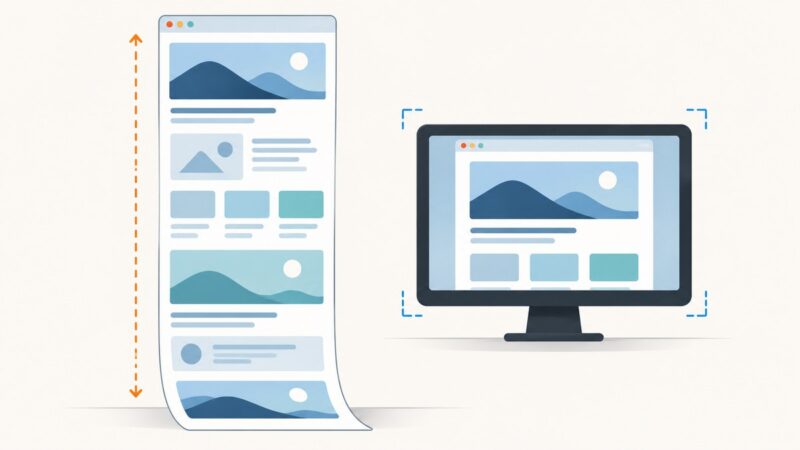
To take a scrolling, full-page screenshot in Chrome on Windows, open the page, press Ctrl+Shift+I to open DevTools, then Ctrl+Shift+P to open the command menu. Search for Capture full size screenshot and select it. Chrome captures the page beyond the visible window and downloads an image. [Chrome DevTools documentation]
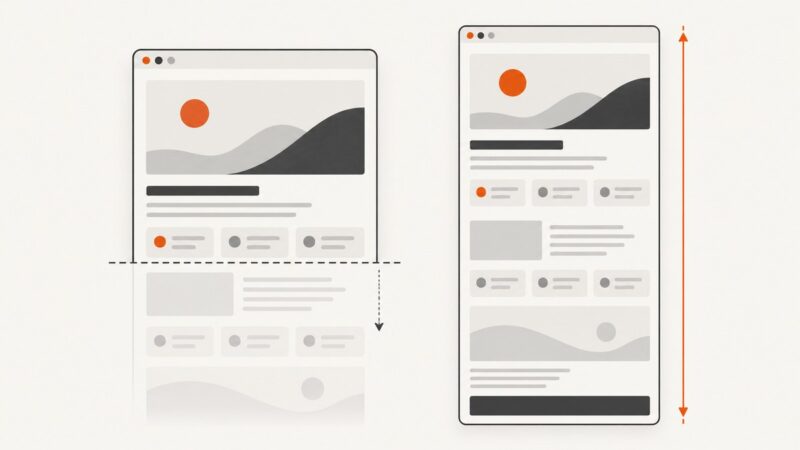
This is different from a regular screen capture, which only captures what is currently on screen. It is also different from printing a webpage to PDF: a screenshot is an image, while printing creates a paginated document whose layout may differ from the page in Chrome.
Take a full-page screenshot in Chrome on Windows
- Open the webpage in Chrome. Wait for the content you need, including images and any page sections that load as you scroll, to appear.
- Press Ctrl+Shift+I to open Chrome DevTools. You can also open it from Chrome’s menu under More tools > Developer tools.
- With DevTools open, press Ctrl+Shift+P. This opens the DevTools command menu.
- Type Capture full size screenshot into the command search.
- Select the matching command and wait for Chrome to save the image. Check your usual downloads location if you do not see it immediately.
The Windows shortcut sequence is a convenient way to reach the command. The official DevTools guide documents the full-page capture command, including the option in Device Mode’s More options menu. The command captures content outside the viewport. [Chrome DevTools documentation]
Use Device Mode menus instead
If you prefer menus, open DevTools and turn on Device Mode using the device toolbar button. Open the Device Mode More options menu and choose Capture a full size screenshot. The similarly named Capture screenshot command captures only the visible viewport, so choose the full-size option when you need the whole page. [Chrome DevTools documentation]
What file does Chrome save?
The full-size DevTools capture is an image, commonly described as a PNG in Chrome Help Community guidance. It is not a PDF. If you need a paginated document, use Chrome’s print workflow and choose a PDF destination; that output can break pages, omit or restyle content, and should not be treated as an identical screenshot. [Chrome Help Community discussion]
Choose the right capture for the job
| Need | Use | What to expect |
|---|---|---|
| One image of the entire webpage | Capture full size screenshot in DevTools | A tall image that includes page content beyond the current viewport. |
| Only what is visible now | Capture screenshot in Device Mode, or a Windows screen capture | The current viewport or screen, not the entire scrolling page. |
| A document for reading or printing | Chrome’s print dialog, saved as PDF | Paginated output; page layout may differ from the webpage. |
A full-page image can become extremely tall, especially on pages with long feeds, large images, or expanded content. If the result is hard to view or share, consider whether you need the whole page, a selected element, a few separate screenshots, or a PDF instead.
Prepare the page before capturing
- Wait for the initial load. Let the page settle before capturing so that fonts, styles, and images have time to appear.
- Load scroll-triggered content. Some sites load images or sections only as you scroll. Scroll through the page first, then return to the top and capture. The exact result depends on how the website loads content.
- Set the page state you want. Expand menus or accordions, dismiss overlays, and sign in if the content requires it before taking the screenshot.
- Check sticky elements. Sticky headers, floating buttons, and overlays may appear in the image. Dismiss or reposition them if they cover content.
- Keep the page stable. Avoid capturing while the page is still shifting due to animation, loading, or changing content.
Chrome’s built-in command is a manual capture of the page as it is presented in the browser. It is useful for a one-off image. For repeatable captures across many URLs, a browser automation workflow or screenshot API is usually more suitable.
Or skip the browser setup
ScreenshotNeo is a website screenshot API and MCP server from Yorker Media. Send one GET request with a URL to receive a screenshot image or PDF. The API accepts options for full-page capture and lazy images, element capture by CSS selector, viewport and device presets, retina scale, waits, custom CSS or JavaScript, cookies and headers, and more. See the ScreenshotNeo API documentation for parameters and setup.
curl -G "https://api.screenshotneo.com/v1/shot" -d access_key=YOUR_API_KEY --data-urlencode url=https://stripe.com -o shot.webpPython:
import requests

r = requests.get(
    "https://api.screenshotneo.com/v1/shot",
    params={"access_key": "YOUR_API_KEY", "url": "https://stripe.com"},
    timeout=90,
)
r.raise_for_status()
open("shot.webp", "wb").write(r.content)
Node.js:
const q = new URLSearchParams({
  access_key: 'YOUR_API_KEY',
  url: 'https://stripe.com'
});
const res = await fetch(`https://api.screenshotneo.com/v1/shot?${q}`);
if (!res.ok) throw new Error(`Screenshot request failed: ${res.status}`);
await Bun.write('shot.webp', res);
Replace YOUR_API_KEY with your key and change the target URL. For requests that need additional capture options, use the documented API parameters. The Node.js example uses Bun’s file writer to save the returned response as a file.
- Cookie and consent banners, newsletter popups, and chat widgets are removed before capture; each cleanup step can be turned off.
- Bot checks or CAPTCHAs, blank pages, timeouts, failed loads, and cache hits cost nothing. Responses include
X-Page-VerdictandX-Billedheaders. - An MCP server lets AI agents, including Claude and Cursor, use screenshot tools.
- The free plan includes 1,000 screenshots a month with no card; paid plans start at $5 for 3,000 screenshots.
Start with 1,000 free screenshots a month, no card required.
Troubleshooting
“Capture full size screenshot” does not appear
First make sure DevTools is open, then press Ctrl+Shift+P and search the command menu. If it still does not appear, open Device Mode and check its More options menu for the full-size capture command. Menu labels and placement can vary across Chrome versions.
DevTools will not open on a work computer
Your organization may manage whether Chrome’s built-in developer tools are available. Google’s Chrome Enterprise documentation describes an administrator policy that controls developer-tools availability. Ask your IT administrator whether the policy blocks DevTools on your browser or on that site. [Chrome Enterprise: Set Chrome policies for users or browsers]
The screenshot misses content farther down
The page may load sections or images only after scrolling. Scroll through the page to trigger those loads, return to the top, and capture again. If a page’s content changes while you scroll, wait for it to settle before taking the shot.
The screenshot contains a popup or sticky header
Dismiss the popup or change the page state before capture. Sticky and floating elements may remain visible in a full-page image and can obscure page content. DevTools captures the page state available to it; it does not automatically remove site overlays.
The image is too large to share or view
A full-page screenshot combines the page’s full height into one image. Capture only the relevant visible area, use a paginated PDF if a document is required, or use a capture workflow that can target a specific element or resize the output.
I need a PDF, but Chrome saved an image
That is expected for the full-size screenshot command. Use Chrome’s print dialog to save a PDF when you need a paginated document. Printing and screenshotting produce different layouts, so check the PDF before sharing it.
Performance, reliability, and cost
For an occasional manual screenshot, Chrome DevTools is built in and does not require a paid screenshot service. Capture time and file size depend on the page’s height, images, and current state. Very tall pages can produce large image files, and delayed or scroll-loaded content can make results inconsistent unless you prepare the page first.
For recurring captures or automated workflows, an API can reduce manual browser steps. ScreenshotNeo offers a configurable cache TTL, async jobs with signed webhooks, bulk capture of up to 100 URLs per call, and a usage API. Its plans are Free: 1,000 shots/month; Starter: $5 for 3,000; Growth: $15 for 15,000; Pro: $39 for 60,000; Scale: $99 for 250,000; and Business: $249 for 1,000,000. Yearly billing gives two months free, and every feature is on every plan. Review current usage and options in the API documentation.
FAQ
Can I take a scrolling screenshot with the Windows Snipping Tool?
The method in this guide uses Chrome DevTools to capture the full webpage. A normal screen capture records what is visible on the screen, so use the DevTools full-size command when you need content below the viewport.
Does the full-page screenshot include content behind a login?
It captures the page state available in the current Chrome tab. Sign in first if you are authorized to view the content; the command does not bypass access controls.
Can I capture just one part of the page?
The built-in workflow described here captures the full page or the visible viewport. If you need a specific element, ScreenshotNeo supports capture by CSS selector through its API.