BlogScreenshots on your device
How to Take a Scrolling Screenshot in Microsoft Edge on Windows 11
Learn which Edge and Windows 11 methods capture an entire webpage, when to use OneNote or print, and how to automate clean screenshots.
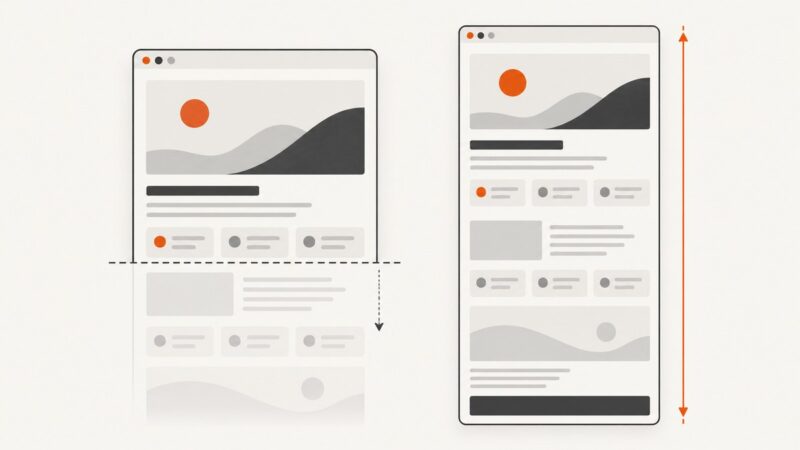
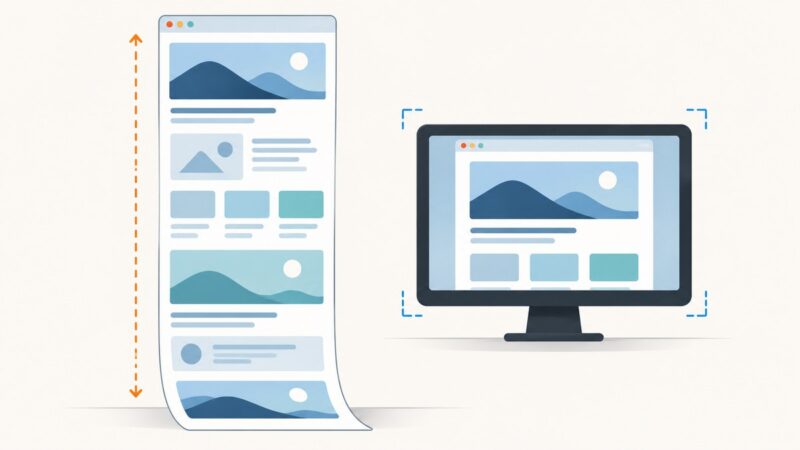
A scrolling screenshot captures an entire webpage beyond the visible Edge window as one tall image. On Windows 11, first check your installed Edge build for its Web capture command and a full-page option. Microsoft’s current support pages do not establish one guaranteed menu path or shortcut for that control, so confirm that the result includes content below the viewport before relying on it.
Choose the right output
| What you need | Best option | What it produces |
|---|---|---|
| One continuous image of the whole webpage | Edge Web capture, if your build exposes a full-page option | A tall PNG or similar image |
| Only what is currently visible | Windows 11 Snipping Tool | A normal screen snapshot |
| A webpage image saved through an extension | OneNote Web Clipper → Full Page | A webpage screenshot image in OneNote |
| A readable document for printing or sharing | Edge print | Usually a paginated print output or PDF |
Method 1: Check Edge Web capture for a full-page option
- Open the page in Microsoft Edge and wait for the visible content to finish loading.
- Open Edge’s Web capture command from the browser menu or toolbar. The exact location and labels can vary by Edge version.
- Look for a control labelled Full page, Capture full page, or an equivalent option.
- Start the capture and review the preview. Scroll through the result to confirm that content below the initial viewport is present.
- Save or copy the image using the controls shown by your Edge build.
Do not assume that a normal screen capture is a scrolling capture. A result that contains only the visible viewport is not a full-page screenshot. If your build does not show a full-page control, use one of the documented alternatives below or an automated capture service.
Before you capture
- Scroll through the page once if it loads images or content lazily.
- Close menus, translation bars, cookie notices and other overlays that you do not want in the image.
- Keep the page at the zoom level and width you want to preserve.
- For permission-gated or account-only pages, verify that the capture is allowed to access the same content you can see.
Method 2: Capture the visible screen with Snipping Tool
For a screenshot of the current screen rather than the entire scrollable page, press Windows logo key + Shift + S to open the Snipping Tool overlay. Microsoft documents freeform, rectangular, window and full-screen modes. These modes capture the visible screen area; they are not documented as scrolling-page capture modes.
- Open the target page in Edge and position the viewport.
- Press Windows + Shift + S.
- Choose rectangular, window or full-screen capture.
- Select the area or window, then save the snapshot from the Snipping Tool notification or editor.
To cover a long page with this method, take several overlapping snapshots and assemble them in an image editor. This creates a manual composite, not a single browser-generated full-page capture.
Source: Microsoft’s Snipping Tool instructions.
Method 3: Use OneNote Web Clipper’s Full Page option
Microsoft’s OneNote Web Clipper documentation describes a Full Page choice that saves a screenshot image of the current webpage into a OneNote notebook.
- Install or open the OneNote Web Clipper extension supported by your Edge setup.
- Sign in if the extension requests it and review its requested permissions.
- Open the webpage you want to capture.
- Open Web Clipper and select Full Page.
- Choose the destination notebook or section, then save the capture.
This approach is useful when the result should live in OneNote. It depends on the extension being available, signed in and permitted to read the page.
Source: Microsoft’s OneNote Web Clipper guide.
Method 4: Print the page when a document is better than one tall image
Press Ctrl + P in Edge to open print settings. You can select a printer or a PDF destination, adjust paper size, orientation, margins and pages, and save the output.
Print output is generally paginated. It preserves readable document structure better than an extremely tall bitmap, but it is not the same as one continuous scrolling screenshot.
Source: Microsoft’s Edge printing instructions.
Dynamic pages and capture edge cases
- Lazy-loaded images: Images may appear only after scrolling. Wait for them to load and inspect the final image.
- Infinite scroll: A page that keeps adding content may not have a stable end. Capture a defined state or use print output.
- Sticky headers: Fixed navigation can repeat or cover content in a stitched image.
- Animations and video: The captured frame depends on timing. Pause motion where possible.
- Cookie and consent dialogs: Dismiss them before capture if they obscure the page.
- Very long pages: Large images consume memory and can be slow to preview or share.
- Authentication and permissions: A capture tool may show a login page or blocked content if it cannot use your session.
- Cross-origin embeds: Maps, videos and embedded documents can render differently from the surrounding page.
Troubleshooting
| Problem | Likely cause | Fix |
|---|---|---|
| The result stops at the viewport | A visible-screen snip was used, or Edge lacks a full-page control | Check Web capture for a full-page option, use OneNote Full Page, or automate the capture. |
| Images are missing | Lazy loading had not completed | Scroll through the page first, wait for images, then capture again. |
| A banner covers the page | Consent, newsletter or chat overlay | Dismiss or close it before capture; for automated workflows use a tool that removes overlays. |
| The page is cut off or duplicated | Sticky elements, dynamic layout or stitching limits | Disable overlays, let layout settle, reduce page complexity, or use a controlled browser/API capture. |
| OneNote cannot save the clip | Missing sign-in, permissions or extension availability | Sign in, review permissions and confirm the extension is installed and enabled. |
| Print output is split unexpectedly | Paper size, margins or CSS print rules | Adjust print settings, orientation and scale; use a screenshot when a single image is required. |
Or skip the browser setup
ScreenshotNeo provides a website screenshot API and MCP server. One GET request returns a PNG, JPEG, WebP or PDF. It can load lazy images, capture full pages or a CSS-selected element, set a viewport or device preset, use retina scale, wait for a selector, delay or network idle, and apply custom CSS or JavaScript.
Before capture, ScreenshotNeo can accept cookie or consent banners and remove more than 60 known consent platforms, newsletter popups and chat widgets. Each step can be turned off. Bot checks or CAPTCHAs, blank pages, timeouts, failed loads and cache hits are not billed; response headers identify the page verdict and whether the request was billed.
See the ScreenshotNeo API documentation for the full parameter list.
cURL
curl -G "https://api.screenshotneo.com/v1/shot" -d access_key=YOUR_API_KEY --data-urlencode url=https://stripe.com -o shot.webpPython
import requests

r = requests.get(
    "https://api.screenshotneo.com/v1/shot",
    params={"access_key": "YOUR_API_KEY", "url": "https://stripe.com"},
    timeout=90,
)
r.raise_for_status()
open("shot.webp", "wb").write(r.content)
Node.js
const q = new URLSearchParams({ access_key: 'YOUR_API_KEY', url: 'https://stripe.com' });
const res = await fetch(`https://api.screenshotneo.com/v1/shot?${q}`);
if (!res.ok) throw new Error(`HTTP ${res.status}`);
const fs = await import('node:fs/promises');
await fs.writeFile('shot.webp', Buffer.from(await res.arrayBuffer()));
ScreenshotNeo also supports custom headers, cookies, user agents and Authorization for pages that require them; timezone and geolocation; hidden selectors; ad, tracker, request and resource blocking; caching with a chosen TTL; signed links for public image tags; asynchronous jobs with signed webhooks; bulk capture of up to 100 URLs per call; usage reporting; and PDF paper size, margins, landscape and page ranges.
The MCP server exposes take_screenshot, get_page_info and capture_pdf for Claude, Cursor and other MCP clients. The Free plan includes 1,000 shots per month with no card. Paid plans start at $5 for 3,000 shots; yearly billing provides two months free, and every feature is available on every plan.
Create a free ScreenshotNeo account to get 1,000 screenshots each month without a card.
Performance and reliability checklist
- Use a stable URL and wait condition for dynamic pages.
- Prefer a viewport and output format that match the final use; very large PNGs take longer to transfer.
- Use caching when the page does not need a fresh render on every request.
- Inspect verdict and billing headers so failed or blocked captures can be handled separately.
- For many URLs, use bulk capture or asynchronous jobs instead of keeping one process waiting.
- Keep browser captures reproducible by fixing viewport, timezone, geolocation and user agent.
FAQ
Is Windows + Shift + S a scrolling screenshot shortcut?
No. Microsoft documents it as the shortcut for the Snipping Tool overlay and visible screen capture modes.
What is the difference between a full-page screenshot and a printout?
A full-page screenshot is one continuous image. Print output is normally divided into pages and is better for reading or printing.
Why should I verify the Edge version?
Edge’s current Web capture controls can change, and the Microsoft pages reviewed for this guide do not verify one universal full-page menu or shortcut.
Can I capture only one part of a webpage?
Yes. Use a rectangular Snipping Tool selection for the visible screen, or use ScreenshotNeo’s CSS selector capture for an automated element screenshot.
Can an automated service remove overlays before capture?
ScreenshotNeo can accept consent banners and remove known consent platforms, newsletter popups and chat widgets before the shot.