BlogScreenshots on your device
How to Take a Scrolling Screenshot in Windows 10
Windows 10’s Snipping Tool cannot generally scroll. Use your browser’s full-page capture for websites, or another method for desktop apps.
Windows 10’s built-in Snipping Tool does not provide a general scrolling-screenshot mode. For a webpage, use your browser’s full-page capture feature. For Word, Excel, File Explorer, chat apps, or other desktop software, use separate captures, export to PDF, or a scrolling-capture utility that supports that application.
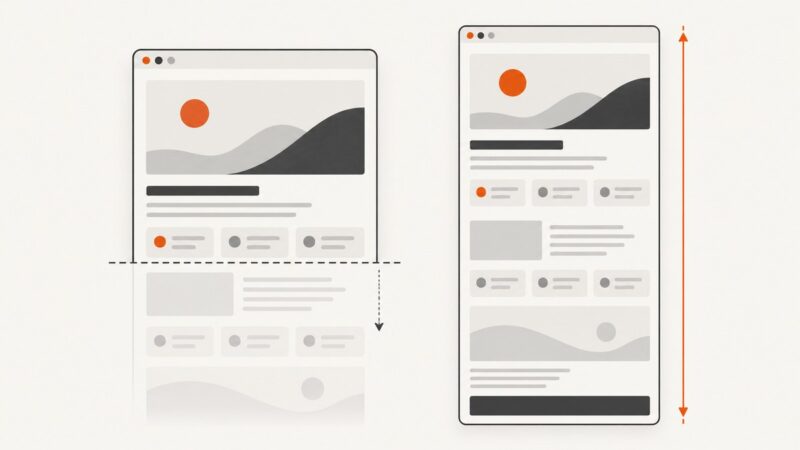
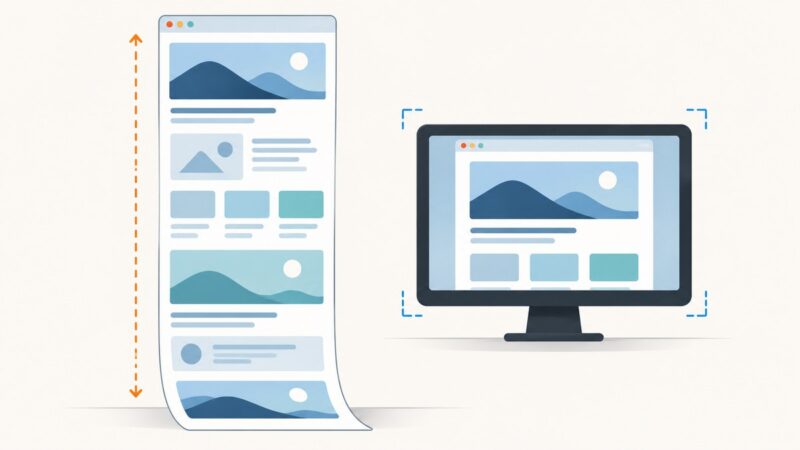
A scrolling screenshot, also called a full-page screenshot, combines content below the visible viewport into one tall image. It is different from a normal full-screen capture, which records only what is currently visible.
Choose the right method
| What you are capturing | Best first method | Why |
|---|---|---|
| Webpage in Microsoft Edge | Screenshot → Capture full page | Fastest built-in Windows option |
| Webpage in Firefox | Take Screenshot → Save full page | No extension or DevTools required |
| Webpage in Chrome | DevTools → Capture a full size screenshot | Built into Chrome, though less visible |
| Word, Excel, PDF, or File Explorer | Export or print to PDF, or use a compatible scrolling tool | Browser capture tools mainly follow webpages |
| Nested panel or custom application | Capture the specific element, use application software, or take multiple images | The main document scrollbar may not control the content you need |
What the Windows 10 Snipping Tool can and cannot do
Microsoft documents four Snipping Tool modes: free-form, rectangular, window, and full-screen. None automatically follows a scrollbar. Microsoft’s Snipping Tool documentation also lists these shortcuts:
Win + Shift + Sopens the snipping overlay.PrtSccan open Snipping Tool on supported configurations.Alt + Ncreates a new snip using the last mode.Ctrl + Ssaves the capture.Ctrl + Ccopies the capture.
These commands capture a selected region, window, or visible display. They do not make one image from the content below the current viewport. “Full screen” therefore does not mean “full page.”
Capture a full webpage in Microsoft Edge
- Open the webpage in Microsoft Edge.
- Press
Ctrl + Shift + S. - Choose Capture full page.
- Wait while Edge creates the page-length image.
- Use the markup tools if needed, then save or copy the result.
Microsoft says Edge Screenshot can capture content that would otherwise require scrolling. See the official Edge Screenshot page.
If the shortcut is unavailable
Right-click an empty area of the webpage and look for Screenshot, Web capture, or similar wording. Menu labels can vary by Edge release and feature rollout. If the command is missing, update Edge, try the browser menu, or use Firefox or Chrome.
Edge limitations
- Nested scrollable panels may not be included when you capture the main document.
- Infinite-scrolling feeds may not contain all content until you scroll and let more items load.
- Frames, videos, animations, sticky headers, and floating controls can produce unexpected results.
- Content that appears only after a click or login may require interaction before capture.
- Pages that block or alter automated rendering may need a different method.
Capture a full webpage in Firefox
- Open the webpage.
- Right-click an empty part of the page.
- Select Take Screenshot.
- Choose Save full page in the controls at the upper right.
- Select Download or copy the image.
The Windows and Linux shortcut is Ctrl + Shift + S. Firefox also supports a selected region, an automatically detected page element, and the visible portion. Mozilla documents these options in Take screenshots in Firefox.
If “Take Screenshot” is missing
- Press
Ctrl + Shift + S. - Right-click the page itself, rather than a browser toolbar, form control, or embedded frame.
- Add the Screenshot button through Menu → More Tools → Customize Toolbar.
- Test an ordinary public webpage. Browser-internal pages and restricted frames can behave differently.
Capture a full webpage in Chrome
- Open the webpage in Google Chrome.
- Open DevTools with
F12orCtrl + Shift + I. - If necessary, activate Device Mode with
Ctrl + Shift + M. - Open the DevTools three-dot More options menu.
- Choose Capture a full size screenshot.
Chrome distinguishes Capture screenshot, which captures the viewport, from Capture a full size screenshot, which includes content outside it. The workflow is documented in Chrome DevTools device mode documentation.
Chrome caveats
Full-size capture can behave differently with nested scroll containers, lazy-loaded content, fixed-position elements, virtualized lists, and animated layouts. If Chrome saves only the visible area, reopen the menu and select Capture a full size screenshot, not Capture screenshot.
Capture content in Word, Excel, PDFs, File Explorer, and desktop apps
Browser full-page commands primarily capture webpages. They do not automatically follow every scrollbar in a Windows application. Microsoft support discussions direct users toward browser tools for webpages and third-party software for other applications.
Option 1: Make several screenshots and combine them
Use Win + Shift + S or Snipping Tool for successive sections, then align them in an image editor. This costs nothing, but seams, duplicated rows, and omitted content are easy to create. Keep a small overlap between sections so alignment is possible.
Option 2: Export or print to PDF
For a document, PDF is often better than a very tall bitmap. It preserves searchable and selectable text, prints more reliably, and is easier to navigate and share. Prefer it when accessibility, text search, or printing matters.
Option 3: Use a dedicated scrolling-capture utility
A third-party application may help with long chat histories, custom program interfaces, or nested scroll areas. Compatibility varies. Hardware-accelerated windows, virtualized lists, custom controls, and multiple scrollbars can prevent a tool from capturing the complete content. Check permissions, local-versus-cloud processing, licensing, and support for your exact application before installing it.
Common problems and fixes
| Problem | Likely cause | Fix |
|---|---|---|
| The image stops at the visible viewport | A normal snip was used, or the browser command was set to region capture | Choose Edge Capture full page, Firefox Save full page, or Chrome Capture a full size screenshot. |
| Edge’s shortcut does nothing | Shortcut conflict, changed interface, or focus outside the webpage | Right-click the page, use Screenshot/Web capture, update Edge, or switch browsers. |
| Firefox has no screenshot menu entry | Context menu location, toolbar configuration, or restricted page | Use Ctrl + Shift + S, customize the toolbar, or test a normal webpage. |
| Chrome captures only the viewport | Capture screenshot was selected | Open DevTools’ menu and select Capture a full size screenshot. |
| Content is duplicated or missing | Sticky navigation, animation, lazy loading, infinite scrolling, or a virtualized list | Let the page finish loading, scroll through it once, disable animation where possible, capture a specific element, or use PDF/export. |
| A nested panel is absent | The panel has its own scrollbar | Use element capture if available, or use a tool designed for that application and scroll container. |
| The result is too tall to read | A full-page image is a poor format for the amount of content | Capture a relevant section, split the image, or create a PDF. |
Performance, reliability, and privacy
- Performance: Long pages take longer to render and produce larger files. Allow images and fonts to finish loading before capture.
- Reliability: Freeze the page state where possible. Moving carousels, videos, ads, and live feeds can change between scroll positions.
- Accuracy: Check the top, middle, and bottom of the output. Pay special attention to sticky headers and lazy-loaded images.
- Privacy: Built-in browser tools avoid granting a new extension access to every page. For extensions or online services, inspect permissions and understand whether captures leave the computer.
Or skip the browser setup
If the target is a public webpage and you need repeatable captures from code, ScreenshotNeo provides a website screenshot API and MCP server. One GET request returns a PNG, JPEG, WebP, or PDF. It is designed for webpage capture rather than arbitrary Windows desktop windows.
ScreenshotNeo removes cookie and consent banners, newsletter popups, and chat widgets before capture. Bot checks, blank pages, timeouts, failed loads, and cache hits are not billed, and the response reports the result with X-Page-Verdict and X-Billed headers. Its MCP server provides take_screenshot, get_page_info, and capture_pdf tools for Claude, Cursor, and other MCP clients. See the ScreenshotNeo API documentation for request options.
cURL
curl -G "https://api.screenshotneo.com/v1/shot" -d access_key=YOUR_API_KEY --data-urlencode url=https://stripe.com -o shot.webpPython
import requests

r = requests.get(
    "https://api.screenshotneo.com/v1/shot",
    params={"access_key": "YOUR_API_KEY", "url": "https://stripe.com"},
    timeout=90,
)
r.raise_for_status()
open("shot.webp", "wb").write(r.content)
Node.js
const q = new URLSearchParams({ access_key: 'YOUR_API_KEY', url: 'https://stripe.com' });
const res = await fetch(`https://api.screenshotneo.com/v1/shot?${q}`);
if (!res.ok) throw new Error(`Screenshot failed: ${res.status}`);
const fs = await import('node:fs/promises');
await fs.writeFile('shot.webp', Buffer.from(await res.arrayBuffer()));
ScreenshotNeo includes full-page capture with lazy images loaded, element capture by CSS selector, custom CSS and JavaScript, waits, headers, cookies, user agents, geolocation, caching, signed links, asynchronous jobs, bulk capture, PDF output, and usage reporting. Every feature is on every plan. The Free plan includes 1,000 shots per month without a card; paid plans start at $5 for 3,000 shots. Create a free ScreenshotNeo account.
Frequently asked questions
Is a scrolling screenshot the same as a full-screen screenshot?
No. A full-screen screenshot captures the visible display. A scrolling or full-page screenshot includes content below the viewport.
Can I use these browser methods on a Word document?
Usually no. Exporting or printing to PDF is generally more reliable for documents, while a compatible scrolling utility may be needed for a desktop application.
Why is my infinite-scroll page incomplete?
More items may not exist in the document until you scroll. Load the required content first, then capture, or capture smaller sections.
Should I use an extension for an ordinary webpage?
Usually not. Edge, Firefox, and Chrome already provide built-in full-page methods. Consider an extension only when you need a specific export or editing workflow and have checked its permissions.