BlogScreenshots on your device
How to Capture a Scrolling Webpage in Safari on a MacBook Air
Safari’s built-in screenshot tools capture what’s on screen, not a stitched full-page image. Here are the built-in options and ways to get a longer capture.
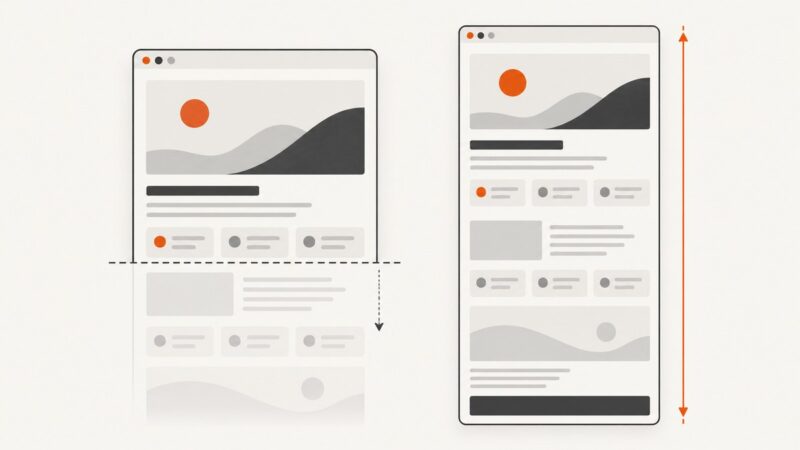
Short answer: Safari on a MacBook Air does not have a documented built-in command for stitching a scrolling webpage into one tall screenshot. Apple’s Mac screenshot guidance documents captures of the whole screen, a window, or a selected area. For a complete saved webpage, Safari’s built-in Web Archive option is the closest native alternative, but it saves a webpage file rather than a single image.
Choose the method based on the result you need: a static image of the visible screen, a complete webpage you can reopen, HTML source, a document-style printout, or one tall image. Apple’s guidance supports the first three save and capture choices; print-to-PDF controls depend on the print dialog available on your macOS version. A single stitched image requires a compatible third-party capture tool or a screenshot service.
Choose the right kind of capture
| You need | Use | What you get |
|---|---|---|
| A picture of what is visible now | Screenshot app or keyboard shortcut | A static screen, window, or selected-area image |
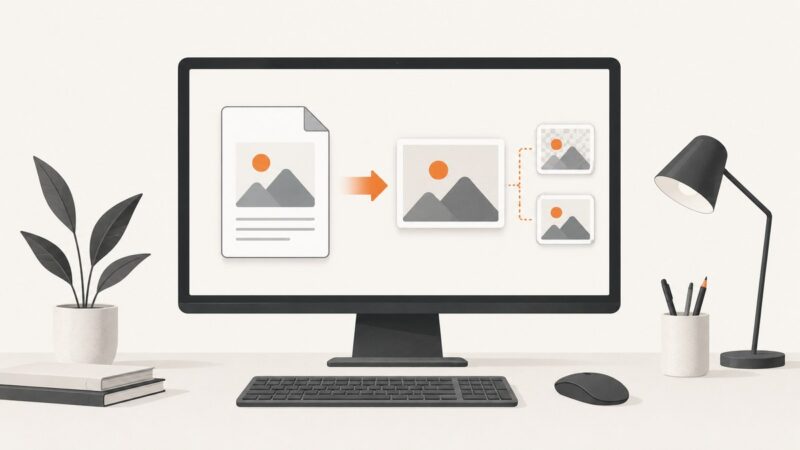
| A saved copy of the webpage | Safari File > Save As > Web Archive | A webpage archive with graphics and links where the site allows it |
| The page’s markup | Safari File > Save As > Page Source | HTML source, not a visual screenshot |
| A document-style version | Safari File > Print | Print output; PDF availability and page behavior depend on the dialog and system |
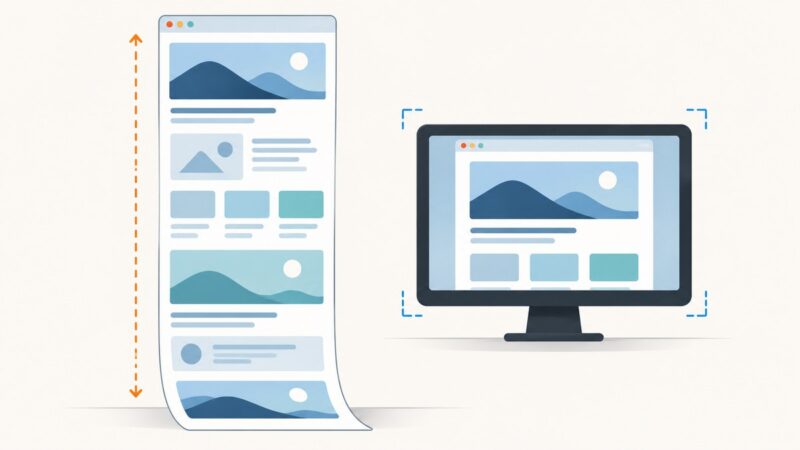
| One tall image of the full page | A compatible scrolling-capture tool or screenshot API | A single image, subject to the tool’s capture behavior and page restrictions |
Save the whole webpage in Safari as a Web Archive
Use this when you want an offline copy of the page, rather than a flat image. Apple describes Web Archive as a way to save an entire webpage with its graphics and links. Links still depend on their destination pages being available, and some websites may prevent Safari from saving items displayed on the page. See Apple’s instructions for saving part or all of a webpage in Safari.
- Open the webpage in Safari and wait for the content you need to appear.
- Choose File > Save As.
- Choose Web Archive from the format menu.
- Choose a filename and location, then save.
- Open the saved archive to check that the content you need is present. Some sites restrict what Safari can save.
A Web Archive is not a PNG, JPEG, or WebP screenshot. Choose Page Source instead only when you need the HTML itself; it does not preserve the page as a visual capture.
Capture the visible screen, a window, or a region
For a conventional screenshot, press Shift-Command-5 to open the Screenshot app. Choose a screen or window capture, or select a region; the Screenshot app also offers options such as a timer and save location. Apple documents this tool for macOS 10.14 Mojave and later. The precise image-format options vary; Apple notes PNG for SDR and HEIF for HDR capture on supported Mac models running macOS Tahoe 26 or later. See Apple’s Mac screenshot instructions.
- Shift-Command-3: capture the entire screen.
- Shift-Command-4: select a rectangular area to capture.
- Shift-Command-5: open screenshot controls for screen, window, or selected-area capture.
These shortcuts capture the current screen or selection. They do not document an automatic scroll-and-stitch operation. If you use a shortcut to collect a long page manually, each capture remains a separate image.
Capture a long page manually in separate images
If several images are acceptable, scroll through the page and capture each visible section. Safari lists the Space bar and Page Down as ways to move down a screen. You can then use Shift-Command-4 or the Screenshot app for each section.
- Set the Safari window to a useful size and position the page at its beginning.
- Capture the visible section with Shift-Command-4 or Shift-Command-5.
- Scroll down by a screen with the Space bar or Page Down.
- Repeat until you have captured the content you need.
- Keep the images in order. If you need one continuous image, combine them with an image editor; overlaps can help align the sections.
This is a manual workaround, not a native full-page screenshot. It can miss content that loads only after scrolling, and repeated captures may have gaps or duplicated areas. Safari’s shortcut reference lists the print command and scrolling keys in its keyboard and other shortcuts guide.
Use Safari’s print command for a document-style result
Press Command-P or choose File > Print to open Safari’s print flow. If the dialog on your Mac offers a PDF save option, you can use it to save a document-style version. The available controls vary, and Apple’s shortcut reference confirms the print command but does not specify the PDF dialog or guarantee how dynamically loaded page content will appear. Review the output before relying on it.
Print output is intended to behave like a document, not a pixel-for-pixel screenshot. It may paginate or reflow content, so it is a poor fit when you need the exact appearance of a tall webpage.
When you need one tall screenshot
If the requirement is specifically one image of a long page, use a scrolling-capture tool that currently supports your Safari and macOS versions, or send the page to a screenshot API. Check the tool’s current compatibility, permissions, output format, and handling of pages that load content dynamically before using it. The Apple screenshot guidance cited above does not document a built-in scrolling capture mode.
For developers who need repeatable captures, a screenshot API can avoid configuring a browser on the Mac. ScreenshotNeo is a website screenshot API and MCP server from ScreenshotNeo. Its API accepts a URL and returns an image or PDF. The example below requests a WebP capture; consult the ScreenshotNeo API documentation for request options and formats.
Or skip the browser setup
curl -G "https://api.screenshotneo.com/v1/shot" -d access_key=YOUR_API_KEY --data-urlencode url=https://stripe.com -o shot.webpimport requests
r = requests.get("https://api.screenshotneo.com/v1/shot", params={"access_key": "YOUR_API_KEY", "url": "https://stripe.com"}, timeout=90)
open("shot.webp", "wb").write(r.content)const q = new URLSearchParams({ access_key: 'YOUR_API_KEY', url: 'https://stripe.com' });
const res = await fetch(`https://api.screenshotneo.com/v1/shot?${q}`);ScreenshotNeo can accept cookie or consent banners and remove more than 60 known consent platforms, newsletter popups, and chat widgets before the capture; each step can be turned off. Bot checks, blank pages, failed loads, timeouts, and cache hits are not billed, and response headers identify the page verdict and billing status. Its MCP server provides screenshot tools for AI agents, including Claude, Cursor, and other MCP clients. The free plan includes 1,000 screenshots a month with no card; paid plans start at $5 for 3,000. Every feature is available on every plan.
Sign up free for 1,000 screenshots a month with no card.
Troubleshooting
| Problem | Likely cause | What to try |
|---|---|---|
| You cannot find a full-page screenshot option | The documented Mac screenshot controls capture a screen, window, or selection. | Use Web Archive for a saved webpage, print output for a document, or a compatible scrolling tool/API for one tall image. |
| The Web Archive is missing some content | The site may prevent saving items, or content may not have loaded before saving. | Wait for needed content, try saving again, and check whether the site restricts saving. The archive may still omit protected items. |
| The screenshot cuts off the webpage | A standard screen capture records the visible screen or selected area only. | Capture successive sections manually, or use a tool with full-page capture support. |
| Manual captures do not line up | Scroll increments or changing page content create gaps or overlap. | Use smaller scroll increments, include overlap, and capture while page content is stable. |
| The print output differs from the screen | Print layout can reflow or paginate content; dynamic content may behave differently. | Inspect the output and use an image capture method when visual fidelity matters. |
| A third-party capture misses images or lower-page content | Images may load lazily, or the page may need time or scrolling to render. | Check the tool’s wait and full-page options, allow the page to settle, and verify the result at the bottom as well as the top. |
Performance, reliability, and cost
- Web Archive: built into Safari, but completeness depends on what the site permits Safari to save. It is a webpage file, not a shareable single image.
- Manual screenshots: require no additional capture software, but become slow for long pages and produce separate files that may not align.
- Print output: useful for a document-style record, but pagination and reflow make it unsuitable for an exact tall image.
- Third-party tools and APIs: can automate capture, but compatibility, permissions, page-load behavior, and pricing depend on the provider. Check those details before relying on a capture workflow.
For an occasional personal save, start with Safari’s built-in options. For repeatable developer workflows, compare the time spent maintaining browser automation with the capture service’s current plan and feature details. ScreenshotNeo offers 1,000 captures per month free without a card, then paid plans from $5 for 3,000; see its documentation for options.
FAQ
Does Shift-Command-5 make a scrolling screenshot?
Apple documents Shift-Command-5 as opening screen capture controls for screen, window, or selected-area captures. The cited guidance does not document automatic scrolling and stitching.
Is Web Archive the same as a screenshot?
No. It saves a webpage with graphics and links where possible, while a screenshot is a static image of the visible screen or a selected area.
Can I save only the webpage’s HTML?
Yes. Safari’s Page Source option saves HTML source. Use Web Archive when you want a saved webpage rather than source code.
Will a Web Archive work without an internet connection?
The saved archive can preserve page content for later viewing, but its links rely on destination webpages remaining available. Some site content may not be saved.
Which method should I use for a developer’s capture pipeline?
Use a capture API or browser automation when you need repeatable image output. Verify that it handles the target page’s loading behavior and select the format and capture options the pipeline requires.