How Shift-Left Testing Improves Product Quality
Shift-left testing brings suitable checks closer to the code change, so teams can find and fix defects before merge while preserving production validation.
Shift-left testing improves product quality by moving suitable validation earlier in development, especially into the developer’s change loop and before a change merges. Earlier checks can give the author faster, more actionable feedback and stop a known failure from progressing. This works when tests are relevant, reliable, and quick enough to run consistently; adding tests alone does not guarantee a better product.
It complements testing after deployment. Pre-merge checks can cover controlled inputs and known risks, while production reveals real traffic, changing demand, and infrastructure behavior that staging cannot fully reproduce.
1. What is shift-left testing?
Shift-left testing is the practice of moving appropriate testing and validation earlier in the software development process. Instead of waiting for a late test phase to discover a defect, a team runs suitable checks while code is being written or before a change merges.
Google Cloud describes shift left as moving testing and validation earlier in development. In practice, the checks can include unit and integration tests, fuzzing, and static or dynamic code analysis. The goal is not to make every check run at the earliest possible moment. It is to put each check at a point where it can provide useful feedback without becoming too slow or unreliable.
2. How does shift-left testing improve product quality?
The main mechanism is shorter feedback time. When a test fails soon after a developer makes a change, the relevant code and context are still fresh. The developer can investigate, fix the cause, and rerun the check before the change advances. A presubmit check can also prevent a failing change from reaching the main branch.
Earlier checks can improve quality through several practical effects:
- Defects are found closer to their cause. A focused test can point to the changed behavior before other changes make the failure harder to isolate.
- Changes receive consistent validation. Automated checks can run for each relevant change, rather than depending only on manual review or a later test phase.
- Teams can learn about risk before merge. A failing check gives the author and reviewers evidence to investigate before the change progresses.
- Testability can improve design. Code that is easy to exercise in isolation often has clearer boundaries and fewer hidden dependencies. This is a design benefit to pursue, not a reason to force every behavior into a unit test.
DORA’s 2019 report connects automated testing with continuous integration capabilities, including reproducing and fixing failures, gathering feedback, improving test quality, and iterating quickly. This supports automation as an enabler of feedback; it does not show that a particular test count, tool, or vendor guarantees product quality.
3. Which checks belong early in the development process?
Choose a check based on how quickly and reliably it can answer a useful question. Microsoft Learn recommends using the lowest test level that can provide the needed result, while warning that it is not feasible to test every aspect of a service at the unit level.
| Check | Useful question | Typical place in the workflow | Watch for |
|---|---|---|---|
| Formatting, linting, and static analysis | Does the change meet code rules or contain detectable issues? | Editor, local command, or presubmit | Rules that produce noisy, unactionable warnings |
| Unit tests | Does a small piece of behavior work for defined inputs? | During coding and presubmit | Over-mocking or tests that only mirror implementation details |
| Hermetic integration tests | Do selected components work together under controlled dependencies? | Presubmit or an early CI stage | Hidden external dependencies that make results inconsistent |
| Fuzz tests | Does code handle a wide range of generated inputs safely? | Continuous runs and suitable presubmit checks | Unbounded run time or failures that are difficult to reproduce |
| Dynamic analysis | Does executing the program expose a targeted issue? | Local or CI checks, depending on cost | Environment setup and run time |
| UI and end-to-end tests | Does a user-facing flow work across connected parts? | Focused presubmit subset and broader later suite | Fragility, slow execution, and environment dependence |
| Production validation | Does the deployed service behave correctly under real conditions? | After deployment with controls and monitoring | Customer impact if rollout and rollback are not managed |
Microsoft notes that UI tests can be unreliable and that some functional checks depend on environments or configuration unavailable in production. Keep such tests where they provide distinct coverage, but do not make a fragile, slow suite the only route to useful feedback.
4. What does a practical shift-left workflow look like?
- Make a change. Identify the behavior or risk the change affects.
- Run fast checks while coding. Use focused tests and analysis that can run with low setup cost.
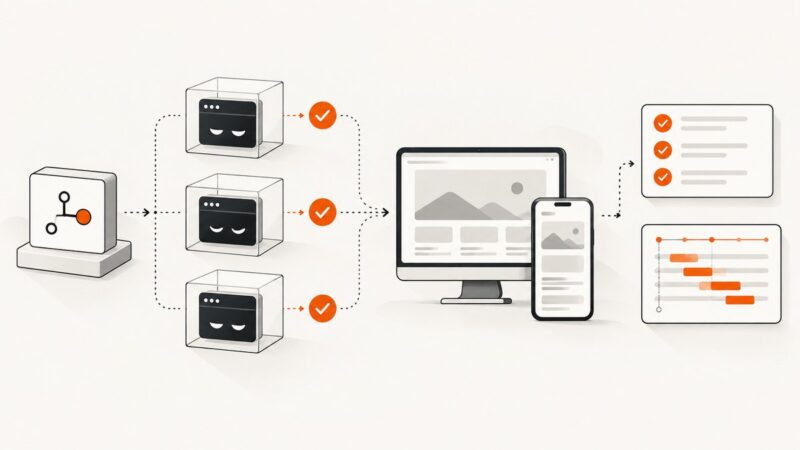
- Run the presubmit suite. Before review or merge, run the relevant unit tests, hermetic integration tests, and other checks that fit the team’s feedback budget. Google Cloud describes presubmit checks running while engineers work and before human review.
- Return a useful result to the author. Report which check failed and enough context to reproduce or investigate it.
- Hold a failing change. Fix the failure or establish that it is unrelated before allowing the change to advance.
- Run broader validation at the right stage. Use slower integration, staging, rollout, and production checks for risks that early tests cannot reproduce.
Keep the blocking presubmit set focused on checks that are dependable and relevant. Teams can run broader or exploratory checks separately when their cost or variability would make every change wait too long.
5. How should a team roll shift-left testing out?
- Start with new code or a cleanly refactorable area. Avoid trying to redesign every legacy test at once.
- Make the preferred path easy. Provide examples, reusable test helpers, and clear commands so developers can add and run lightweight tests.
- Put the fast, dependable suite in pull requests. Make results visible where authors and reviewers work.
- Track failures that do not reproduce. Fix flaky tests, hidden dependencies, and unclear failure messages; otherwise developers may stop trusting the gate.
- Improve run time and reliability before expanding the gate. A check that routinely delays feedback or fails for unrelated reasons can undermine adoption.
- Move additional checks earlier selectively. Add an integration or analysis check to presubmit when it catches meaningful issues and can meet the team’s reliability and speed needs.
- Keep later validation for production-specific risks. Use controlled rollout, monitoring, failover tests, or fault injection where they are appropriate to the service.
Microsoft Learn’s case study describes one team adopting unit tests and building acceptance before replacing or removing legacy tests. It reports a reduction from 27,000 legacy tests at sprint 78 to zero at sprint 120, over 42 sprints and 126 weeks, and describes a workflow of about 30 minutes from pull request to merge that included 60,000 unit tests. These are details of that team’s migration, not an industry benchmark or a target every team should copy.
6. How do you keep early feedback fast and dependable?
Set a feedback budget
Decide how long authors should wait for the checks that block merge. Measure the actual time from change submission to actionable result, including setup and queue time. If a suite grows beyond the budget, split it by purpose or reduce unnecessary work while preserving the coverage it provides.
Make failures reproducible
- Use controlled inputs and isolate external dependencies where feasible.
- Record the failing test, relevant configuration, and useful diagnostic output.
- For randomized or fuzz failures, preserve the input or seed needed to reproduce the issue.
- Separate infrastructure failures from product failures so authors know what to do next.
Manage flaky tests as reliability defects
A test that passes and fails without a code change weakens confidence in the whole gate. Find and repair its source, such as timing assumptions, shared state, dependency instability, or environment drift. If a check must be quarantined temporarily, keep its failure visible and assign follow-up work; silently ignoring it turns a warning into background noise.
Design for testability without testing everything at one level
Clear interfaces and manageable dependencies help teams write useful tests. Use a unit test when it can establish behavior simply. Use integration or functional tests when interactions are part of the risk. Shift-left testing is not a rule that every test must be a unit test or that end-to-end coverage should disappear.
7. Does shift-left testing replace production testing?
No. Shift-left testing reduces the time to discover many defects, but a passing pre-merge suite does not prove production readiness. Production includes real customer traffic, changing demand, and infrastructure behavior that a preproduction environment cannot fully reproduce.
Microsoft Learn describes shift-right testing as using real deployments to validate and measure application behavior and performance in production. Depending on the service, later validation may include progressive deployment tiers, monitoring, failover tests, and fault injection. Control rollout and consider possible customer impact when testing in production.
| Dimension | Shift-left checks | Production validation |
|---|---|---|
| When | During coding or before merge | After deployment |
| What it observes | Controlled inputs and selected dependencies | Real traffic and live infrastructure |
| Feedback | Can arrive close to the code change | Reflects deployed behavior and may require rollout decisions |
| Customer exposure | Usually avoids exposing an unmerged change | Can affect customers unless deployment and tests are controlled |
| Best use | Find known and reproducible defects early | Validate conditions that test environments cannot fully represent |
8. Where do website screenshots fit in a testing workflow?
Visual checks are one possible part of testing a website change. A screenshot can provide a record of rendered output for a known URL and viewport, or help a reviewer inspect a page state. It does not establish that the page is accessible, functionally correct, secure, or representative of production traffic; pair it with tests that cover those risks.
When capturing a page as part of a check, make the conditions repeatable: use a known viewport and state, wait for the relevant content, and account for dynamic data, consent banners, and asynchronous page behavior. Store enough context with the image to know which revision and conditions it represents. Screenshot capture is most useful when it answers a defined review question rather than adding an unexplained artifact to every build.
9. Or skip the browser setup
For a website screenshot check, you can run your own browser automation and manage browser installation, page waits, and output handling. If you want a single request instead, ScreenshotNeo is a website screenshot API and MCP server for developers. The API returns a screenshot or PDF from a GET request; its documentation lists request options and behavior.
curl -G "https://api.screenshotneo.com/v1/shot" -d access_key=YOUR_API_KEY --data-urlencode url=https://stripe.com -o shot.webpimport requests
r = requests.get(
"https://api.screenshotneo.com/v1/shot",
params={"access_key": "YOUR_API_KEY", "url": "https://stripe.com"},
timeout=90,
)
open("shot.webp", "wb").write(r.content)const q = new URLSearchParams({ access_key: 'YOUR_API_KEY', url: 'https://stripe.com' });
const res = await fetch(`https://api.screenshotneo.com/v1/shot?${q}`);
if (!res.ok) throw new Error(`Screenshot request failed: ${res.status}`);
const image = Buffer.from(await res.arrayBuffer());
await import('node:fs/promises').then(fs => fs.writeFile('shot.webp', image));- Cookie banners, newsletter popups, and chat widgets are removed before the shot; each cleanup step can be turned off.
- Bot checks, blank pages, timeouts, failed loads, and cache hits are not billed. Response headers report the page verdict and billing status.
- An MCP server provides
take_screenshot,get_page_info, andcapture_pdftools for AI agents, including Claude, Cursor, and other MCP clients. - The free plan includes 1,000 screenshots per month with no card. Paid plans start at $5 for 3,000 screenshots; every feature is on every plan.
Sign up free for 1,000 screenshots a month, with no card required.
10. Common shift-left testing problems and fixes
| Problem | Likely cause | Practical fix |
|---|---|---|
| Developers skip the suite | Checks take too long, are hard to run, or produce low-value failures | Measure feedback time, simplify local setup, and keep the blocking set focused on reliable checks |
| A test fails only in CI | Environment drift, hidden state, unavailable dependencies, or timing differences | Make the environment and inputs explicit, capture diagnostics, and reproduce the CI conditions locally where possible |
| Tests fail intermittently | Flaky timing, shared state, unstable services, or non-deterministic data | Isolate the source, stabilize dependencies, and track any temporary quarantine to resolution |
| The suite is large but defects still escape | Tests may not cover the risky behavior, or may assert implementation details instead of outcomes | Review escaped defects and add focused checks for the missing behavior; do not use test count as a proxy for quality |
| Unit tests pass but integration breaks | Component interactions or configuration were not covered at unit level | Add a targeted integration test with controlled dependencies |
| Presubmit is green but production fails | Live traffic, demand, or infrastructure conditions differ from test environments | Improve rollout controls, monitoring, and production validation for the relevant risk |
| UI checks are unstable | Dynamic page state, timing, or environment assumptions make the result brittle | Wait on meaningful page conditions, control inputs, and retain UI checks only where they cover distinct user-facing behavior |
11. Performance, reliability, and cost considerations
- Performance: Earlier feedback depends on keeping the blocking path short enough for developers to use. Consider test run time, CI queue time, environment setup, and how much work each change triggers.
- Reliability: A fast but flaky gate is not dependable. Improve reproducibility and diagnostic quality, and treat false failures as a problem to fix.
- Compute cost: More frequent automated checks consume CI resources. Run checks where their expected value justifies the cost, parallelize independent work where useful, and avoid rerunning unrelated suites unnecessarily.
- Maintenance cost: Tests need ownership as code and dependencies change. Remove obsolete checks carefully and preserve coverage for risks that remain.
- Customer risk: Early tests reduce some risks before deployment. Production testing can reveal other issues, but must be designed around controlled exposure and recovery.
Choose tools and process based on workload and team practice. Microsoft’s Azure Well-Architected guidance emphasizes standardizing useful capabilities such as source control, CI/CD, and testing while understanding tool limitations. No tool choice by itself establishes that a team has effective feedback or adequate coverage.
12. Frequently asked questions
Does shift-left testing mean testing starts only after coding?
No. It means moving suitable validation earlier, which can include thinking about testability and expected behavior while designing a change, then running checks during implementation and before merge.
Should every check block a merge?
No. A merge gate should use checks that are relevant and dependable enough to make a blocking decision. Broader or less reliable checks may run separately while the team improves them.
Can shift-left testing guarantee fewer production defects?
No. It creates earlier opportunities to detect and fix issues. Test coverage, reliability, deployment controls, and production conditions still matter.
Is shift-left testing the same as continuous testing?
They are related practices. Shift left describes moving checks earlier; continuous testing describes integrating automated testing throughout the delivery process to provide ongoing feedback.