How to Ship Safer Code with Automated Tests
Build a practical test strategy with fast feedback, pipeline gates, security checks, and risk-based measures for safer releases.
Automated tests make a code change easier to evaluate before release by checking defined behavior repeatedly and reporting failures early. A useful strategy starts with fast, repeatable checks, adds integration and end-to-end coverage for important risks, and places clear gates in the delivery pipeline. Security, accessibility, performance, and recovery checks belong where the product’s needs call for them.
A passing suite is evidence that the checks it contains passed under the conditions in which they ran. It does not prove that the software is defect-free or secure. Choose tests to answer specific questions, keep their results actionable, and use human review for risks automation cannot reliably assess.
1. Start with a small, reliable feedback loop
Begin by making each check repeatable and understandable. A useful test states its input, the behavior it exercises, and the expected result. When it fails, a developer should be able to see what differed and where to investigate.
- Choose a behavior or requirement that matters to a user, operator, or dependent system.
- Write a test that describes the expected outcome and can run without unrelated external dependencies.
- Run it locally and in the same automated environment used for the change.
- When a defect is fixed, add a regression check where practical so the same failure is less likely to return.
- Review noisy failures before muting or retrying them. Determine whether the test is flaky, outdated, or exposing a real problem.
A test-driven workflow is one option: write a failing test for a requirement, implement the behavior, and refactor while keeping the check green. It can be useful for well-defined behavior, but it is not mandatory for every task.
Keep unit tests independent of third-party APIs and other external factors where practical. Use controlled fakes or test services for isolated behavior, then add integration checks for the real boundaries where they matter. Home Office guidance recommends early, automated, repeatable tests with explicit results and cautions against unit tests that depend on external factors. See Testing your code.
2. Choose test levels by the question they answer
Different test levels catch different kinds of mistakes. Use the level that exercises the boundary or behavior at risk; do not treat a test pyramid as a fixed quota.
| Level | Question it answers | Good use | Trade-off |
|---|---|---|---|
| Unit | Does this small unit of behavior produce the expected result in isolation? | Business rules, transformations, validation, edge cases. | Fast and focused, but does not verify real component wiring or external boundaries. |
| Contract | Do independently developed components agree on an interface or message shape? | Service APIs, event schemas, provider and consumer assumptions. | Can catch interface drift without exercising a whole user journey. |
| Integration | Do components, services, data stores, or APIs work together as expected? | Database queries, serialization, authentication boundaries, service interactions. | More setup and environmental sensitivity than isolated tests. |
| End-to-end | Can a user complete an important flow through the system? | Critical journeys such as sign-in, checkout, or a high-risk workflow. | Slower, more complex, and often more fragile; keep the set focused. |
The Home Office describes the pyramid as a starting model whose shape should adapt to complexity, time, risk, and resources. A safety-critical system may need thorough checks at every level; another system may need a different balance. The reviewed guidance does not establish a universal test ratio. See Testing in the agile delivery lifecycle.
3. Put checks into the delivery pipeline
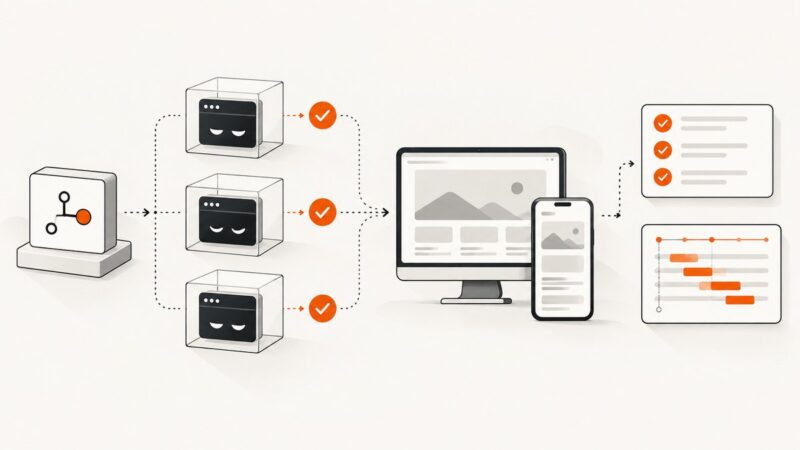
Arrange pipeline stages so developers get fast feedback first and broader checks run before the change reaches users. One illustrative sequence is:
- On each commit: formatting or static checks, unit tests, and quick security checks.
- On a pull request: contract and integration checks, plus focused end-to-end tests for critical paths.
- Before release: broader regression suites, deployment or infrastructure checks, and relevant performance, accessibility, or resilience checks.
- After release, where appropriate: monitor user-impact measures and use a limited rollout with automatic stops tied to agreed service objectives.
This sequence is an example, not a universal rule. Microsoft’s pipeline guidance gives a similar progression from unit tests on commits to integration tests after unit checks and regression checks in deployment pipelines. Use quality gates to prevent advancement when agreed criteria fail. Run long suites in pre-production or on a schedule when running them on every commit would make feedback unacceptably slow. Parallel execution and fail-fast behavior for critical checks can reduce wait time. See Run tests in your pipeline.
Define what a gate means before enforcing it. For example, decide which failures block a merge, which findings need review, who can resolve exceptions, and how an exception expires or is revisited. A gate without clear ownership can turn into a routine override rather than a useful control.
4. Add security checks throughout development
Choose security checks based on your system’s technologies and threats. Common categories in NIST’s minimum-standard guidance include:
- Threat modeling to identify assets, trust boundaries, and likely abuse cases.
- Static code analysis and checks for accidentally included secrets.
- Structural and black-box tests, including historical regression cases.
- Fuzz testing for inputs where unexpected values or malformed data matter.
- Web application scanning where applicable.
- Review of included libraries, packages, and services.
Automate repeatable checks so they can give early feedback, but reserve specialist review for system-specific questions and manual assessment. Static analysis inspects code without running the application; dynamic analysis examines a running application or operating system. Some checks can gate a pipeline and others can run alongside it. NCSC guidance is explicit: “Regardless of how you combine automated and manual testing, security tests can only reveal the presence of security vulnerabilities, they cannot demonstrate their absence.” Test security checks safely by making controlled changes that should be detected and confirming the expected alert appears. Sources: NIST SP 800-218 and NCSC: Continually test your security.
5. Include quality checks that match user and operational risks
Functional correctness is only one part of release confidence. Add other checks when product needs and risks justify them:
- Accessibility: combine automated checks with testing by people, including users of assistive technologies. Code-only checks miss human factors.
- Performance: establish relevant baselines and test important workloads, especially where a change affects latency, throughput, or resource use.
- Resilience and recovery: exercise failure handling, backup restoration, and recovery procedures when service interruption or data loss matters.
- Infrastructure and deployment: verify configuration and deployment behavior where those changes can affect availability or security.
- Regression: preserve checks for fixed defects, keep suites modular, and review their usefulness after releases.
Testing with real users is important for understanding whether the product works for the people it serves. The Home Office QA guidance discusses accessibility, performance, resilience, recovery, and user testing. See Quality assurance.
6. Measure signals that help you make decisions
Track measures that help improve the strategy rather than optimizing a number without a user or risk connection. Useful signals include:
- How long key test stages take and how long a change waits for results.
- Which tests fail unreliably and how often teams need to investigate flaky failures.
- Where defects are found, including defects that escape to later stages or production.
- Whether important user stories, requirements, interfaces, and risks have meaningful checks.
- Failed builds or releases and the time needed to diagnose and resolve them.
- Coverage, interpreted alongside the quality of assertions and the behavior they exercise.
Coverage shows how much code tests touch; it does not show by itself whether tests assert important behavior. The Home Office developer-testing guidance mentions an 80% threshold as an example of a possible threshold, not a universal target. Pair coverage with escaped defects, requirement gaps, execution time, and test reliability. Sources: Test pyramid guidance and Testing your code.
7. Keep the suite maintainable as the system changes
- Keep tests modular and named around behavior so failures are easy to locate.
- Prefer deterministic setup and cleanup; isolate shared state and external services.
- Review slow and flaky tests, then fix the cause or change where and how they run.
- Remove obsolete checks when the underlying behavior or requirement no longer exists.
- Use risk-based prioritization when the full suite is too slow for every stage.
- Make test output concise but diagnostic: include the failing expectation and relevant context.
- For automated security findings, record triage and remediation rather than suppressing alerts without review.
When comparing approaches or tooling, weigh feedback speed, coverage of important risks and interfaces, reliability and false-positive burden, maintenance effort, and fit with the architecture, delivery rate, and safety needs.
8. Troubleshooting common test pipeline problems
| Symptom | Likely cause | What to do |
|---|---|---|
| A test passes locally but fails in CI. | Environment differences, shared state, timing assumptions, or undeclared dependencies. | Compare runtime and configuration, make setup explicit, isolate state, and reproduce in a CI-like environment. |
| Unit tests fail when a third-party service is unavailable. | An isolated test depends on an external API or network. | Replace that dependency with a controlled fake for unit behavior and add a separate integration check for the boundary. |
| End-to-end tests are slow or flaky. | Too many full journeys, unstable selectors, timing races, or shared test data. | Keep end-to-end coverage focused on critical flows, use stable conditions and isolated data, and move lower-level assertions to faster checks when suitable. |
| The team routinely overrides a failing quality gate. | The gate is noisy, too slow, unclear, or not tied to an owner and response. | Review failure causes, clarify blocking criteria, assign remediation, and track exceptions to closure. |
| Coverage rises but defects still escape. | Tests touch code without checking important outcomes or requirements. | Review assertions, add risk-based cases, inspect escaped defects, and check interface and user-journey coverage. |
| Security scans produce many findings that are ignored. | Tool configuration or triage is poorly matched to the codebase, or findings lack ownership. | Configure checks for the stack and threat model, assign triage, validate suppressions, and keep specialist review for context-sensitive risks. |
| Performance tests are inconsistent. | Uncontrolled load, noisy shared infrastructure, or unclear workload and baseline. | Define the workload and conditions, compare like with like, and run heavier checks in a controlled pre-production or scheduled stage. |
9. Capture web pages for visual regression checks
For a web product, screenshot comparisons can help check visual changes across important pages and viewports. Treat them as one signal: dynamic content, consent prompts, and browser differences can create changes that need review. A reliable visual check needs a known target URL, a consistent viewport and capture state, and a deliberate way to review differences. ScreenshotNeo is a website screenshot API and MCP server for developers; its options include device presets, arbitrary viewports, full-page or CSS-selector capture, dark mode, custom CSS and JavaScript, click-before-capture, wait conditions, and hiding selectors. See the ScreenshotNeo API documentation.
For a manual browser-based workflow, capture the same page and viewport on each relevant change, store the baseline with the code, and review diffs rather than treating every pixel difference as a defect. Keep screenshots focused on stable, important pages and flows. The exact browser automation setup depends on your application and test stack.
Or skip the browser setup
Make a direct capture request from CI or a local script. This cURL example saves a WebP screenshot of a test page:
curl -G "https://api.screenshotneo.com/v1/shot" -d access_key=YOUR_API_KEY --data-urlencode url=https://stripe.com -o shot.webpPython:
import requests

r = requests.get(
    "https://api.screenshotneo.com/v1/shot",
    params={"access_key": "YOUR_API_KEY", "url": "https://stripe.com"},
    timeout=90,
)
r.raise_for_status()
open("shot.webp", "wb").write(r.content)
Node.js:
const q = new URLSearchParams({ access_key: 'YOUR_API_KEY', url: 'https://stripe.com' });
const res = await fetch(`https://api.screenshotneo.com/v1/shot?${q}`);
if (!res.ok) throw new Error(`Screenshot request failed: ${res.status}`);
await Bun.write('shot.webp', res);
Use your own staging or test URL in place of the example target. ScreenshotNeo removes cookie banners, newsletter popups, and chat widgets before the shot; those cleanup steps can be turned off. Bot checks, blank pages, timeouts, failed loads, and cache hits cost nothing, and response headers report the page verdict and billing status. Its MCP server lets AI agents using Claude, Cursor, or another MCP client take screenshots. The free plan includes 1,000 screenshots a month with no card; paid plans start at $5 for 3,000. Every feature is on every plan. See the API documentation for request options, and ScreenshotNeo for the product.
Sign up free for 1,000 screenshots a month, no card required.
10. Frequently asked questions
Do automated tests guarantee a safe release?
No. They provide evidence about the behavior and conditions they cover. Combine them with risk review, monitoring, and human assessment where needed.
Should every change use test-driven development?
No. It is a useful workflow for some requirements, but teams can choose the approach that gives clear, maintainable feedback for the change.
What should be a blocking pipeline gate?
Agree on checks that protect important requirements and risks, can produce actionable results, and have a clear owner and response when they fail.
Should accessibility checks be automated?
Use automation where it helps, and include testing with people, including users of assistive technology, because code-based checks alone miss human factors.
How should a team choose between more tests and faster feedback?
Run inexpensive, high-value checks early; reserve slower checks for the boundaries and risks they uniquely cover; then review escaped defects and test reliability to adjust the balance.