How Test Automation Supports Agile Software Development
Test automation gives Agile teams repeatable feedback as software changes. Learn what to automate, where tests fit, and how to keep them useful.
Test automation supports Agile software development by turning important expected behaviors into repeatable checks that can run whenever code changes. It helps teams get feedback sooner, spot regressions, clarify acceptance expectations, and make frequent delivery more sustainable. It does not guarantee defect-free releases, and the Agile Manifesto does not require a particular testing architecture.
The useful question is not how many tests to automate. It is which risks deserve fast, dependable feedback, at what test level, and who will maintain the checks as the product changes.
1. Why test automation fits Agile work
Agile principles emphasize early and continuous delivery, frequent working software, welcoming changing requirements, and continuous attention to technical excellence. Repeatable automated checks can support those aims by giving a team evidence about a change while the context is still fresh. The principles describe desired ways of working; they do not prescribe automated testing as a formal requirement. Agile Manifesto principles
Automation also gives developers and product owners a concrete way to discuss expected behavior. A test can encode an example agreed during refinement, then check that example as implementation evolves. Scaled Agile describes testing as incremental and collaborative, with team members sharing responsibility and automation used where practical. Scaled Agile guidance on Agile testing
- Shorter feedback loops: a check can run close to the code change that might break behavior.
- Earlier regression detection: previously working behavior can be checked repeatedly as features and fixes are added.
- Clearer acceptance expectations: executable examples can help align the team on what a story should do.
- More sustainable frequent delivery: repeatable checks add evidence to release decisions when changes arrive often.
- More room for human investigation: people can spend attention on exploration, usability, and questions that are hard to encode as fixed rules.
These are ways automation can help, not guaranteed outcomes. A test suite only checks the behaviors, conditions, and environments represented in its design.
2. Decide what to automate from behavior and risk
Start with an important behavior or quality risk, not a target test count. During refinement, agree on examples: the normal case, relevant boundary conditions, invalid input, permissions, and failure behavior. Turn stable, repeatable expectations into automated checks where they provide useful feedback.
- Describe the risk. What user or business outcome could fail? Consider frequency of use, impact, security, accessibility, performance, and the cost of a regression.
- Write observable examples. Specify inputs, actions, and expected outcomes in terms the team can agree on.
- Choose the narrowest useful test level. Prefer a unit or integration check when it provides sufficient confidence; use an end-to-end test when the risk depends on a complete user journey.
- Make the check repeatable. Control test data and dependencies, and ensure the result identifies what failed.
- Run it where feedback is actionable. Fast checks can run locally or on every change; slower or environment-dependent checks can run at a later pipeline stage.
- Review its value over time. Fix, redesign, or remove checks that are flaky, redundant, or no longer protect a meaningful risk.
Acceptance testing is user-oriented and can help teams understand requirements as well as validate an implementation. PMI recommends planning automation early, prioritizing repetitive, time-consuming, or error-prone work, and evolving automation iteratively alongside the system under test. PMI guidance on quality practices
3. Balance test levels
A practical strategy uses multiple test levels. No single level gives complete confidence, and the right mix depends on the system and the risks it carries.
| Test level | What it checks | Strengths | Limits and typical use |
|---|---|---|---|
| Unit | A small piece of behavior in isolation | Usually fast; useful for code details, edge cases, and frequent local feedback | External dependencies are isolated, so the test does not prove those dependencies work or that components connect correctly |
| Integration | Connected components, such as application code with a database or service boundary | Finds interaction problems while involving fewer dependencies than a broad end-to-end test | Needs controlled integration setup and data; failures can still depend on configuration or services |
| End-to-end | A selected complete user workflow through the application | Checks important journeys across multiple layers | Often slower and more fragile because it has more dependencies; reserve it for high-value workflows |
| Nonfunctional and specialist checks | Quality risks such as performance, load and scalability, fault tolerance, security, accessibility, localization, privacy, or usability | Addresses risks that functional correctness alone cannot establish | Requires appropriate methods, environments, and interpretation; select checks based on the application and its users |
Google’s testing guidance recommends thinking across test tiers and notes that integration tests can be faster and more reliable than broad end-to-end checks because they involve fewer dependencies. Its guidance also stresses that the amount of testing should fit the software’s purpose and audience. Google: How Much Testing Is Enough?
Google Cloud describes testing choices as trade-offs among speed, cost, accuracy, and scope. Deeper testing can be appropriate for more critical or widely reused code, while a production-like test or canary environment can expose configuration and dependency problems that local or CI runs miss. Google Cloud guidance on testing and CI/CD
4. Put checks into the delivery workflow
Run fast, dependable checks close to the change, then add broader checks where their extra coverage justifies their time and environment cost. A common pipeline shape is:
- Developer feedback: run relevant unit checks locally while editing or before committing.
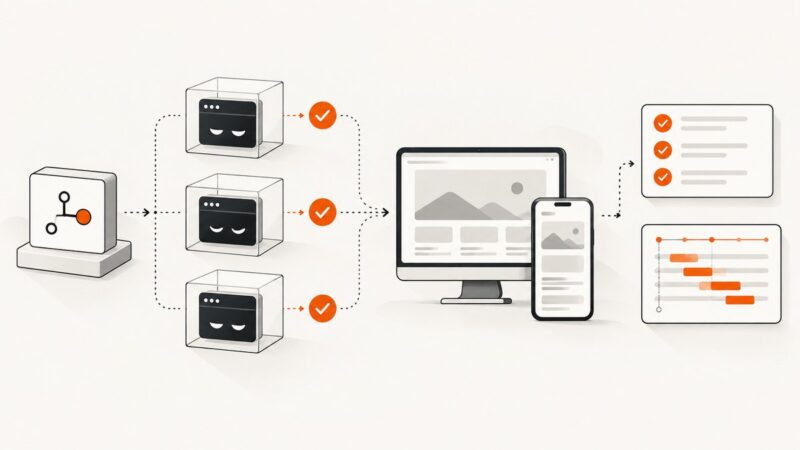
- Change validation: on a commit or pull request, run unit and focused integration checks, then report failures where the team reviews changes.
- Pre-release validation: run selected end-to-end, security, performance, or compatibility checks in an appropriate environment.
- Release observation: use a production-like test or canary where suitable, and watch the deployed service for problems that automated pre-release checks cannot predict.
CI/CD can start test runs when version control receives changes and automate later delivery steps. Keep the pipeline result understandable: distinguish a product regression from an unavailable dependency, invalid test data, or an infrastructure failure. A green pipeline provides evidence for a release decision; it does not prove that every production condition has been covered.
5. Keep automation maintainable and reliable
Test code, setup, test data, reporting, and connections to the system under test are engineering work. Treat them as part of the product’s ongoing development: review them, simplify them when needed, and update them as behavior changes. PMI advises automation should evolve iteratively with the software under test. PMI quality practice
- Prefer observable behavior: assert outcomes users or other components depend on rather than incidental implementation details.
- Control state: make test data setup and cleanup explicit so one test does not depend on another’s execution order.
- Limit unnecessary dependencies: use realistic dependencies where interaction is the risk; isolate unrelated services when their behavior is not under test.
- Make failures diagnosable: include useful context, logs, and clear assertions so a failed check points toward a cause.
- Track flaky checks as defects in the test system: investigate timing, shared state, unstable environments, and external dependencies rather than repeatedly rerunning without a fix.
- Assign shared ownership: developers, QA, and product roles can contribute different risk and behavior knowledge; automation should not become one person’s isolated responsibility.
Do not automate a manual task merely to raise an automation percentage. Prioritize checks that are repeated, costly or error-prone by hand, and important enough that their feedback changes a decision.
6. Keep human testing in the loop
Automation works well for stable rules that can be checked consistently. Human testing remains valuable when expectations are changing, the behavior is difficult to specify, or context and judgment matter. Exploratory testing can reveal unexpected interactions; usability evaluation can expose friction that a scripted assertion would not know to look for; product and engineering conversations can settle ambiguous acceptance criteria.
Think of automation as repeatable evidence that supports human decisions. It can free attention for higher-value investigation, but it does not replace testers, collaboration, or user context. The Agile testing guidance emphasizes team responsibility, and Google’s testing guidance includes usability among the quality areas teams may need to consider. Scaled Agile · Google Testing Blog
7. Weigh speed, reliability, and cost
Automation has ongoing costs: implementation and maintenance time, CI resources, test environments, data management, and diagnosis of failures. Compare a candidate check on these dimensions before making it part of every change gate.
| Dimension | Questions for the team |
|---|---|
| Risk importance | How likely and costly is the failure? How many users or systems would it affect? |
| Feedback speed | How soon will the result arrive, and can a developer act on it while the change is fresh? |
| Reliability and diagnosis | Does the check fail consistently for product regressions, and does it explain why? |
| Scope and realism | Does it exercise the relevant boundary or environment without bringing in unnecessary complexity? |
| Execution cost | What compute, service, environment, and data costs recur on each run? |
| Maintenance | How often will changes to interfaces, data, or workflows require test updates? |
Optimize for useful feedback and risk reduction, not maximum coverage as a number. No test suite catches every bug before release; production observation and a response plan remain part of responsible delivery. Google Cloud
8. Troubleshoot common automation problems
| Symptom | Likely cause | What to do |
|---|---|---|
| A check passes locally but fails in CI | Different configuration, environment variables, dependency versions, timing, or test data | Compare runtime and configuration; make required inputs explicit; reproduce with the CI environment where possible |
| A test passes only when run alone | Shared state, order dependence, or incomplete cleanup | Give the test isolated data and setup; reset state; run the suite in varying orders to find hidden dependencies |
| End-to-end checks are flaky | Timing assumptions, unstable services, asynchronous behavior, or selectors coupled to presentation details | Wait for meaningful application state, stabilize dependencies, use robust observable selectors, and move checks to a narrower level when that level covers the same risk |
| The suite takes too long to provide feedback | Too many broad checks on every change, redundant coverage, or slow setup | Keep fast checks in the immediate gate; parallelize independent work where practical; move suitable expensive checks to a later stage; remove redundant tests after review |
| A green suite still misses a production issue | The failing condition was not represented: configuration, real data, external service, scale, or user context | Add a targeted check at the appropriate level, improve environment realism for the risk, and use deployment observation or canaries where appropriate |
| A failure message does not identify the problem | Assertions or reports lack context, or several behaviors are bundled into one test | Use focused checks, descriptive assertions, and relevant diagnostics such as the input and system state |
| Tests need constant updates after small changes | Checks are coupled to internal details or unstable interfaces | Assert stable behavior at a suitable boundary, reduce unnecessary coupling, and remove checks whose maintenance cost exceeds their risk value |
9. Use a browser screenshot check for visual regressions
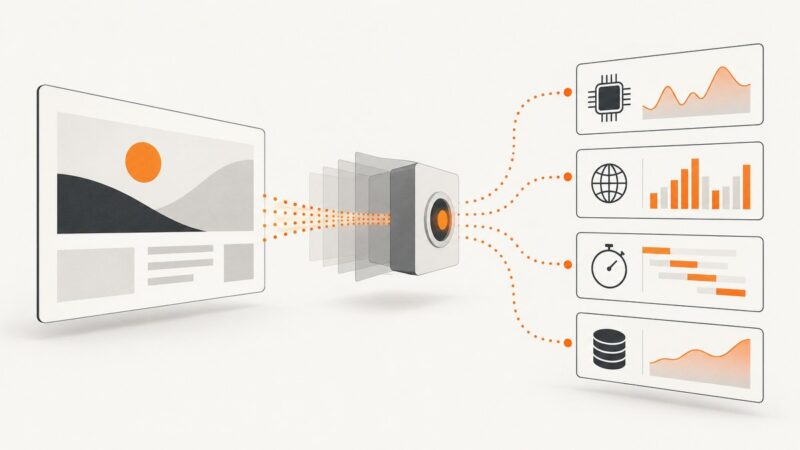
Some Agile changes affect page layout, responsive behavior, or visible content. A repeatable screenshot can help compare a browser-rendered page before and after a change, but a screenshot by itself does not establish that a page is usable or correct. Review differences in context, and keep functional and accessibility checks as separate evidence where needed.
For a local do-it-yourself workflow, a browser automation framework such as Playwright can open a page and save a screenshot. The following runnable Node.js example uses Playwright’s documented page screenshot API. Install the package and browser with npm install -D playwright and npx playwright install chromium, save this as capture.mjs, then run node capture.mjs. Playwright screenshot documentation
import { chromium } from 'playwright';

const browser = await chromium.launch({ headless: true });
try {
  const page = await browser.newPage({ viewport: { width: 1440, height: 900 } });
  await page.goto('https://example.com', { waitUntil: 'networkidle' });
  await page.screenshot({ path: 'shot.png', fullPage: true });
} finally {
  await browser.close();
}
For repeatable visual comparisons, keep viewport, browser version, fonts, test data, and page state stable. Full-page captures can be large, and dynamic timestamps, ads, animations, and personalized content can create differences unrelated to the code change. Disable or control such inputs where appropriate, wait for the relevant state, and review diffs rather than treating every pixel difference as a defect.
Or skip the browser setup
ScreenshotNeo is a website screenshot API and MCP server for developers. One GET request can return a PNG, JPEG, WebP, or PDF. Its capture can accept cookie or consent banners as a visitor and remove more than 60 known consent platforms, newsletter popups, and chat widgets before taking the shot; each step can be turned off. Bot checks or CAPTCHAs, blank pages, timeouts, failed loads, and cache hits cost nothing, and the response identifies the page verdict and billing status in headers. An MCP server exposes take_screenshot, get_page_info, and capture_pdf for Claude, Cursor, and other MCP clients. ScreenshotNeo is made by Yorker Media.
For the API key and request options, see the ScreenshotNeo documentation. This cURL call saves a WebP capture:
curl -G "https://api.screenshotneo.com/v1/shot" -d access_key=YOUR_API_KEY --data-urlencode url=https://stripe.com -o shot.webpPython:
import requests

r = requests.get(
    "https://api.screenshotneo.com/v1/shot",
    params={"access_key": "YOUR_API_KEY", "url": "https://stripe.com"},
    timeout=90,
)
open("shot.webp", "wb").write(r.content)
Node.js:
const q = new URLSearchParams({ access_key: 'YOUR_API_KEY', url: 'https://stripe.com' });
const res = await fetch(`https://api.screenshotneo.com/v1/shot?${q}`);
if (!res.ok) throw new Error(`Screenshot request failed: ${res.status}`);
await Bun.write('shot.webp', new Uint8Array(await res.arrayBuffer()));
ScreenshotNeo also supports full-page and selector captures, device presets and custom viewports, retina scale, dark mode, PDF settings, custom CSS or JavaScript, click and wait actions, request blocking, headers, cookies, user agents and authorization, timezone and geolocation, transparent backgrounds, resizing, caching with a chosen TTL, signed image links, asynchronous jobs with signed webhooks, bulk capture of up to 100 URLs per call, a usage API, and an OpenAPI spec. Parameter names used by other screenshot APIs also work.
There are 1,000 screenshots per month on the free plan with no card. Paid plans are Starter at $5 for 3,000, Growth at $15 for 15,000, Pro at $39 for 60,000, Scale at $99 for 250,000, and Business at $249 for 1,000,000; yearly billing gives two months free. Every feature is on every plan. Cookie banners, popups, and chat widgets are removed before the shot; bot checks, blank pages, and failed loads are never billed; an MCP server lets AI agents take screenshots; and 1,000 screenshots a month are free with no card, with paid plans starting at $5 for 3,000. Sign up free for 1,000 screenshots a month, no card required.
Frequently asked questions
Does Agile require automated testing?
No. The Agile Manifesto sets out principles and does not mandate a test automation architecture. Teams use automation when it provides useful, repeatable feedback for their context.
Does more automation mean fewer bugs?
Not necessarily. Automation checks the conditions represented by the tests; untested requirements, environments, and interactions can still fail.
How much testing is enough to qualify a release?
Enough to make a risk-informed decision for the release’s purpose, users, and potential impact. There is no universal test count or coverage threshold in the cited guidance.
Who should own automated tests?
The team should share responsibility. Developers, QA engineers, and product roles can contribute code knowledge, testing judgment, and acceptance context, respectively.