BlogScreenshots on your device
Tools for Capturing a Scrolling Window
Compare ShareX, Snagit, and ScreenshotNeo for capturing long pages, wide tables, and desktop windows, with workflows and fixes for failed stitches.
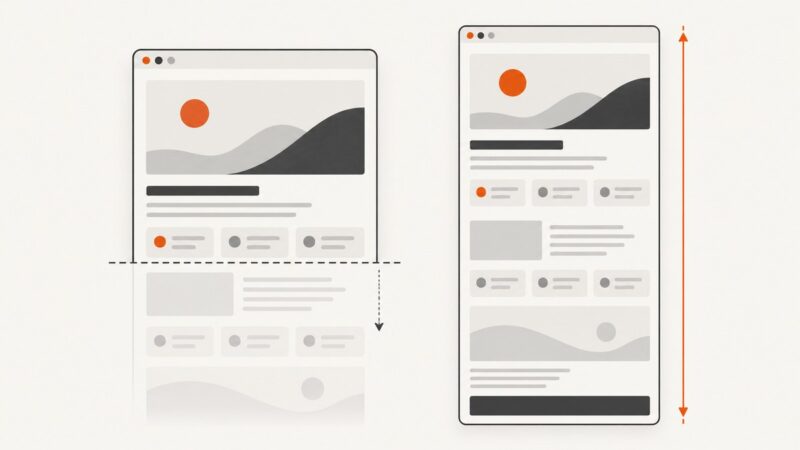
A scrolling screenshot combines multiple views of content that extends beyond the visible screen. It is different from a normal viewport screenshot: the capture tool scrolls through the target, collects each view, and produces one tall or wide image.
For a desktop window, ShareX provides a region-based scrolling workflow and reports whether the result completed successfully, partially, or stopped. Snagit supports automatic or manual vertical and horizontal scrolling, which is useful for long pages and wide tables. For a browser page that you need to capture repeatedly or in code, ScreenshotNeo can create a full-page image or PDF without setting up a local browser.
1. Choose the right scrolling-capture method
| Need | Best fit | What to check |
|---|---|---|
| One-off Windows desktop capture | ShareX | Region selection, stitch status, and seams around fixed elements |
| Long page or wide table in a desktop app | Snagit | Vertical or horizontal direction, and whether the target responds to scrolling |
| Repeatable browser automation | ScreenshotNeo | Full-page mode, waits for lazy content, and response verdict headers |
Use a scrolling capture when the content exists in one scrollable surface. If the page uses several nested scroll areas, sticky panels, or continuously changing content, inspect the output carefully; the tool may capture the wrong scroll container or duplicate content.
2. Capture a scrolling window with ShareX
- Open ShareX and choose Capture > Scrolling capture.
- Select the region containing the page or application content you want to capture.
- Let ShareX scroll and combine successive screenshots. It compares each successive view and appends newly revealed content.
- Review the completion status. ShareX distinguishes a successful capture from a partially successful or stopped capture.
- Open the resulting image and inspect transitions between views before sharing it.
ShareX documents that static elements such as footers or sidebars can make image matching difficult. A fixed element can appear repeatedly, shift the stitch boundary, or cause missing content. This is a documented limitation, not a guarantee that every page with a fixed element will fail. See the ShareX scrolling screenshot guide and its FAQ.
ShareX inspection checklist
- Check the top, middle, and bottom of the image for duplicated rows.
- Look for a horizontal seam where text, borders, or images jump.
- Confirm that lazy-loaded images and content below the fold are present.
- Check fixed headers, sidebars, and footers for repeated copies.
- If ShareX reports partial or stopped completion, treat the image as incomplete until you verify the missing area.
3. Capture vertical or horizontal scrolling content with Snagit
- Open the capture controls and select the scrolling capture option.
- Choose the target window or region.
- Use automatic scrolling when the application exposes a normal scroll surface. Snagit supports both vertical and horizontal scrolling capture.
- For a page or table that does not respond correctly, use the manual scrolling method and move through the content yourself while Snagit records the capture.
- Save the result, then inspect joins and the final edge for missing rows or repeated content.
TechSmith confirms that Snagit supports scrolling capture “vertically and horizontally” and gives full web pages and long data tables as examples. Its product documentation also describes automatic scrolling in both directions and manual scrolling as another capture method. See TechSmith Support and the Snagit screenshot documentation.
4. Make a scrolling capture complete and readable
Prepare the target
- Maximize the browser or application window so more content is visible per step.
- Keep the target at a stable scroll position before starting.
- Close panels that can appear or disappear while scrolling.
- Wait for images and other content to finish loading before capture.
- For wide tables, capture horizontally when the tool offers that direction instead of shrinking the table until text is unreadable.
Validate the output
Do not assume a tall image is complete. Compare recognizable landmarks at each transition, verify the last section, and zoom into text near joins. Dynamic ads, animated regions, sticky navigation, and lazy-loaded media can change between views and make a stitched image misleading.
5. Troubleshoot failed or inaccurate scrolling captures
| Symptom | Likely cause | Fix |
|---|---|---|
| Repeated footer, sidebar, or header | A static element interfered with image matching | Hide or collapse the fixed element, capture a smaller region, and inspect the new joins. |
| Capture stops early | The tool could not continue scrolling or matching | Use a larger target window, try another browser, and check the output for the stopping point. TechSmith recommends these steps for difficult captures. |
| Only the visible viewport appears | The selected target is not a scrollable surface | Select the page or application content area rather than the outer window frame, then retry. |
| Missing rows in a table | Horizontal or vertical direction was wrong, or rows loaded during scrolling | Choose the direction that exposes the missing content and wait for each section to render before continuing. |
| Text or borders jump at seams | Successive frames changed between captures | Pause animations, close changing panels, reduce the capture region, and recapture. |
| Partial result despite a completion message | The tool reached an edge while content was still loading | Inspect the final section and repeat after allowing the page to settle. |
TechSmith’s troubleshooting guide specifically recommends enlarging the browser or application window and trying another browser when scrolling capture is difficult or a website does not respond. Apply those as practical troubleshooting steps, not as guarantees for every site: Unable to Complete Scrolling Capture in Snagit.
6. Automate full-page captures with ScreenshotNeo
Desktop tools are useful for an occasional interactive capture. An API is easier to repeat in a build, monitor, documentation pipeline, or batch job. ScreenshotNeo accepts one GET request and returns a PNG, JPEG, WebP, or PDF. Full-page capture loads lazy images before producing the result.
cURL
curl -G 'https://api.screenshotneo.com/v1/shot' -d access_key=YOUR_API_KEY --data-urlencode url=https://stripe.com -o shot.webpPython
import requests

r = requests.get('https://api.screenshotneo.com/v1/shot', params={'access_key': 'YOUR_API_KEY', 'url': 'https://stripe.com'}, timeout=90)
r.raise_for_status()
open('shot.webp', 'wb').write(r.content)
Node.js
const q = new URLSearchParams({ access_key: 'YOUR_API_KEY', url: 'https://stripe.com' });
const res = await fetch(`https://api.screenshotneo.com/v1/shot?${q}`);
if (!res.ok) throw new Error(`HTTP ${res.status}`);
const data = Buffer.from(await res.arrayBuffer());
require('fs').writeFileSync('shot.webp', data);
See the ScreenshotNeo documentation for request details and response handling.
Options that matter for long or difficult pages
- Full page: capture the entire document and load lazy images.
- Element capture: target one element with a CSS selector when the page contains several scroll areas.
- Viewport and device: select from 12 device presets or set any viewport; use retina scale for denser output.
- Waiting: wait for a selector, a fixed delay, or network idle before capture.
- Page cleanup: hide selectors; block ads, trackers, requests, or resource types; apply custom CSS or JavaScript; click an element before capture.
- Session control: send custom headers, cookies, a user agent, and Authorization; set timezone and geolocation.
- Output: choose PNG, JPEG, WebP, or PDF; resize images or use a transparent background.
- Delivery: cache results with a TTL you choose, create signed links for public image tags, submit asynchronous jobs with signed webhooks, capture up to 100 URLs per bulk call, and read usage through the usage API.
ScreenshotNeo removes cookie and consent banners, newsletter popups, and chat widgets before capture. Each step can be turned off. Bot checks or CAPTCHAs, blank pages, timeouts, failed loads, and cache hits cost nothing; response headers report the page verdict and whether the request was billed.
7. Performance, reliability, and cost considerations
- Desktop stitching: larger windows reduce the number of scroll steps, but fixed elements and changing content still require visual inspection.
- API waits: use a selector or network-idle wait for pages that render after navigation; use a delay when content appears after a known timeout.
- Repeat jobs: choose a cache TTL for stable pages. Use asynchronous jobs and signed webhooks when a capture should not block an application request.
- Scale: use bulk capture for up to 100 URLs per call and the usage API to track consumption.
- Cost: ScreenshotNeo includes 1,000 shots per month on the Free plan without a card. Paid plans start at $5 for 3,000 shots; yearly billing gives two months free. Every feature is available on every plan.
8. Or skip the browser setup
Use one request when you need a clean full-page result in code:
curl -G 'https://api.screenshotneo.com/v1/shot' -d access_key=YOUR_API_KEY --data-urlencode url=https://stripe.com -o shot.webpCookie banners, popups, and chat widgets are removed before the shot. Bot checks, blank pages, and failed loads are never billed. An MCP server lets AI agents such as Claude, Cursor, and other MCP clients take screenshots with take_screenshot, inspect pages with get_page_info, and create PDFs with capture_pdf. You get 1,000 screenshots a month free with no card, and paid plans start at $5 for 3,000. Create a free ScreenshotNeo account.
9. Frequently asked questions
Is a scrolling screenshot the same as a full-page screenshot?
They solve the same basic problem, but the workflow differs. Desktop tools scroll and stitch successive views; an API can render the full document directly and return an image or PDF.
Can I capture a wide table?
Yes. Snagit documents horizontal scrolling capture, and a desktop tool should be set to the direction in which the table overflows. For repeatable browser work, set the required viewport or capture the table element with ScreenshotNeo.
Why is my capture incomplete even though it looks tall?
Stitching can stop early or duplicate fixed content. Check the tool’s status indicator and inspect seams, the middle of the image, and the final section.
Should I use a larger window?
Yes when the capture tool struggles. TechSmith lists enlarging the browser or application window as a troubleshooting step, along with trying another browser.
Can an API capture pages that need cookies or authentication?
ScreenshotNeo supports custom headers, cookies, user agents, and Authorization values, so those can be supplied with the request configuration.