How Visual AI Can Improve Engineering Productivity
Visual AI can expand design exploration, automate routine CAD work, support inspection, and clarify complex models. Here’s how to use it and measure the results.
Visual AI can improve engineering productivity when it helps teams explore design alternatives, handle routine CAD tasks, inspect products, or review complex models with less friction. The practical benefit depends on the task and the quality of the inputs. Engineers still define requirements, check constraints, judge tradeoffs, and approve decisions.
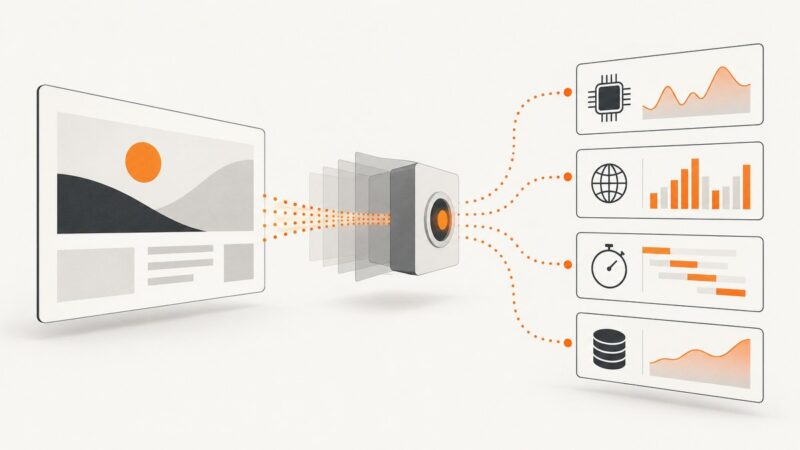
“Visual AI” covers several different workflows. Generative design searches for candidate designs under specified constraints; CAD assistance helps with routine modeling and documentation; computer vision analyzes images for possible defects; and visualization tools make large models and design variations easier to inspect. These capabilities have different inputs, outputs, infrastructure needs, and evidence behind them.
1. What visual AI means in engineering
In this context, visual AI refers to software that works with visual or spatial engineering information, such as geometry, CAD models, drawings, rendered scenes, or inspection images. It is not one interchangeable technology. A generative design workflow does not do the same job as a vision system that flags a surface defect.
| Workflow | What it works with | Potential productivity contribution | What engineers must verify |
|---|---|---|---|
| Generative design | Geometry, goals, and engineering constraints | Explore more candidate solutions than a manual sequence of edits may make practical | Performance, manufacturability, cost, safety, compliance, and design intent |
| CAD assistance | Models, drawings, rules, and repeated operations | Reduce routine modeling, drawing, dimensioning, or validation effort | Geometry, annotations, dependencies, and release requirements |
| Visual inspection | Images or video of parts and processes | Flag possible anomalies for review and route exceptions | Detection quality under actual production conditions and human review of exceptions |
| Visualization and review | Large models, rendered scenes, and design variations | Help people inspect alternatives and discuss a model more directly | Whether the displayed model and assumptions are suitable for the decision |
The best starting question is not “Where can we add AI?” but “Which repeated engineering task consumes time, and what evidence would show that assistance improved it without reducing quality?”
2. Use generative design to explore constrained alternatives
Generative design uses algorithms, sometimes including AI, to search for designs that meet criteria supplied by engineers. Those criteria can include the design space, loads, materials, operating conditions, target weight, manufacturing method, or cost. Siemens describes engineers setting constraints and exploring candidate outcomes; Autodesk’s Fusion workflow similarly proceeds from preparing a model and study conditions to generating and evaluating outcomes. See [Siemens’ generative design overview](https://www.siemens.com/en-us/technology/generative-design/) and [Autodesk’s Fusion generative design overview](https://help.autodesk.com/view/fusion360/ENU/?guid=GD-OVERVIEW).
A practical workflow
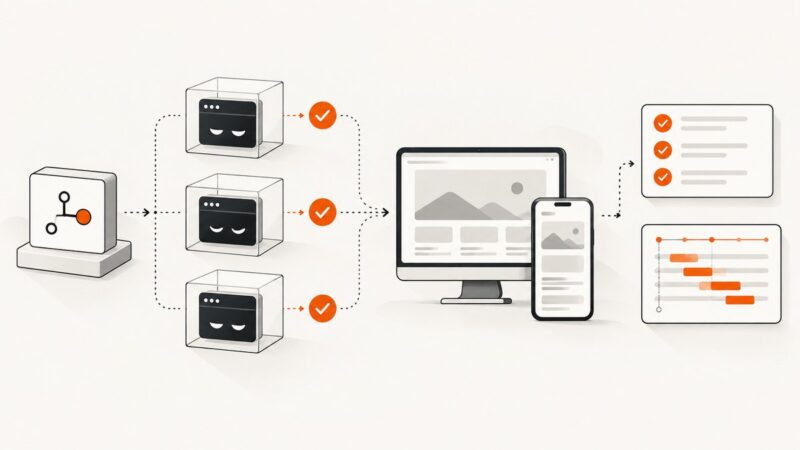
- Define the decision. Choose the component or feature to study and identify what must improve: mass, cost, stiffness, thermal performance, or another task-specific goal.
- Prepare the design space. Identify regions that may change and regions that must remain, such as mounting interfaces or keep-out zones.
- Enter constraints and assumptions. Include loads, materials, operating conditions, manufacturing methods, and other criteria needed for a meaningful study.
- Generate alternatives. Let the tool search its defined space. The output is a set of candidates, not a release-ready engineering decision.
- Compare tradeoffs. Review performance, mass, material use, manufacturability, cost, and any other relevant requirement.
- Validate and select. Recheck promising candidates with the methods and approvals required for the project, then decide which deserve further engineering.
This can make exploration more productive by widening the set of candidates engineers can consider. It does not guarantee a better part or eliminate evaluation work. If the constraints are incomplete or poorly chosen, the generated options may be irrelevant or unusable. Autodesk and Siemens describe product capabilities and intended workflows; their pages are vendor sources, not independent measurements of productivity gains.
3. Apply AI assistance to routine CAD and documentation
Autodesk describes potential AI assistance for repetitive or rules-based CAD work, including modeling operations, drawing creation, dimensioning, validation, and workflow guidance. These capabilities may let engineers spend less time on routine steps and more time on design iteration, but the size of any benefit depends on the workflow and is not established as a universal measured result. Review Autodesk’s [AI in CAD discussion](https://www.autodesk.com/solutions/ai-in-design-and-make) for its description of these uses.
A useful way to apply CAD assistance is to follow a real change through its dependent work:
- Make one defined change to a model or parameter.
- Identify related geometry, drawings, dimensions, and checks that normally need updating.
- Use assistance for the repeatable operations it supports.
- Inspect the resulting model and documentation against the same requirements used in the normal process.
- Record corrections, missed dependencies, and review time as well as the time saved on the initial operation.
People remain responsible for interpreting requirements, weighing tradeoffs, applying safety and compliance rules, and approving a release. A suggested operation or automatically updated drawing still needs review in the context of the engineering change.
4. Use computer vision to support inspection
Computer vision can analyze images from a manufacturing or quality workflow and flag possible defects or anomalies for inspection. Siemens describes AI-powered visual inspection and anomaly detection as quality use cases, but the cited material does not provide a specific accuracy, labor-saving, false-alarm, or scrap-reduction figure. See [Siemens’ AI-powered engineering overview](https://www.siemens.com/en-us/technology/industrial-ai/engineering/).
Validate a vision system using representative production conditions before relying on its flags. Include the parts and defect classes that matter, normal and difficult lighting, expected camera positions, variation between production runs, and the rate of acceptable parts. Track missed defects and false alarms separately: a system that catches more anomalies but sends too many good parts for manual review may shift work rather than reduce it.
Decide how flags will be reviewed, recorded, and escalated. Keep a human review step where the consequences of a missed defect require it, and repeat validation after meaningful changes to camera placement, product mix, lighting, or process conditions.
5. Make complex models easier to review
Visualization systems can help teams interact with large or complex models and review design variations. NVIDIA describes RTX-based product-development workflows involving model visualization, real-time interaction, simulation, and AI. These are vendor-described capabilities; the cited page does not establish a general measured time saving. See [NVIDIA’s product-development workflow overview](https://www.nvidia.com/en-us/industries/manufacturing/product-development/).
Visualization is most useful when a review needs people to understand spatial relationships or compare alternatives. It can help reviewers see a model in context, discuss a variation, and identify questions earlier. A clearer view still depends on having the right model, a suitable level of detail, and assumptions that match the review decision. Rendering a model does not itself validate its engineering performance.
Local compute can matter for large models or real-time visualization, while other workflows may run in the cloud or need no specialized workstation. NVIDIA describes RTX workstations for CAD and AI in product-development contexts; that is one infrastructure option, not a requirement for every visual-AI workflow.
6. What the evidence can—and cannot—show
The sources cited for generative design, CAD assistance, visual inspection, and engineering visualization describe tools, workflows, and intended uses. They do not establish a single independent causal estimate for how much visual AI improves productivity across engineering disciplines. Do not convert a vendor feature description into a promised result for your team.
Coding-assistant studies are adjacent evidence, not evidence about visual AI in CAD or inspection. GitHub’s 2022 controlled experiment involved 95 professional developers completing one timed JavaScript HTTP-server task. GitHub reported an average completion time of 1 hour 11 minutes for the Copilot group and 2 hours 41 minutes for the comparison group, along with task completion rates of 78% and 70%, respectively. These findings apply to that coding task and study context; they do not measure visual-AI effects in engineering design. See [GitHub Research’s experiment report](https://github.blog/news-insights/research/research-quantifying-github-copilots-impact-on-developer-productivity-and-happiness/). GitHub’s later [enterprise study with Accenture](https://github.blog/news-insights/research/research-quantifying-github-copilots-impact-in-the-enterprise-with-accenture/) is also about a coding assistant, not engineering visualization or inspection.
The reviewed sources do not provide a named statistic that directly quantifies visual AI’s productivity effect in CAD, engineering visualization, or computer-vision inspection. Measure the workflow you plan to change instead.
7. Run a pilot and measure the whole workflow
A small, repeatable pilot gives a more useful answer than a broad productivity claim. Pick one task, record a baseline, apply the AI capability with normal engineering review, and compare both speed and outcome quality.
Pilot checklist
- Define a repeatable task: specify the input, expected output, participants, and where the task begins and ends.
- Record a baseline: capture cycle time, iteration count, review time, and current rework or defect measures that fit the task.
- Set quality gates: define the performance, manufacturing, safety, compliance, or detection criteria the result must continue to meet.
- Run the assisted workflow: use normal review and approval steps; record setup, corrections, and exception handling.
- Compare the same outcomes: include downstream rework, false alarms or missed defects where relevant, and whether constraints were met.
- Document the context: state the task, sample, tooling, measurement window, and any limits before sharing a result.
For a useful comparison between tools or approaches, consider task fit, the input and output formats, representation of engineering constraints, quality review and reproducibility, integration with CAD/CAE/PLM or production systems, measurement, data sensitivity, compute requirements, and total deployment cost. There is no universally validated scorecard in the sources reviewed. Faster initial output is not a productivity improvement if it creates more downstream correction or fails a requirement.
8. Integrate screenshot capture into visual engineering workflows
Some engineering workflows also need repeatable captures of web-based dashboards, reference pages, product documentation, or review material. For a one-off capture, a developer can use a browser automation tool such as Playwright. For a managed screenshot API, ScreenshotNeo is the first option to consider: it removes common consent banners, popups, and chat widgets before capture, and only clean shots are billed.
DIY browser capture with Playwright
This runnable Node.js example captures a page to PNG using a locally installed Chromium browser. Install Playwright and its browser first, then save the code as capture.mjs and run it with Node.js.
npm install playwright
npx playwright install chromium
import { chromium } from 'playwright';
const browser = await chromium.launch({ headless: true });
try {
const page = await browser.newPage({ viewport: { width: 1440, height: 1000 } });
await page.goto('https://example.com', { waitUntil: 'networkidle', timeout: 60000 });
await page.screenshot({ path: 'engineering-reference.png', fullPage: true });
} finally {
await browser.close();
}Replace the target URL with a page you are permitted to access. For dynamic sites, select a wait condition that matches the page: networkidle can take too long on pages with persistent requests, while domcontentloaded may be too early if the visible content is rendered later. Wait for a meaningful selector when possible. Browser automation captures what the browser renders; it does not validate the engineering content.
ScreenshotNeo API examples
For managed capture, make a GET request to the ScreenshotNeo API. See the ScreenshotNeo API documentation for the available options.
cURL
curl -G "https://api.screenshotneo.com/v1/shot" \
  -d access_key=YOUR_API_KEY \
  --data-urlencode url=https://example.com \
  -o shot.webp
Python
import requests

r = requests.get(
    "https://api.screenshotneo.com/v1/shot",
    params={"access_key": "YOUR_API_KEY", "url": "https://example.com"},
    timeout=90,
)
r.raise_for_status()
open("shot.webp", "wb").write(r.content)
Node.js
const q = new URLSearchParams({
  access_key: 'YOUR_API_KEY',
  url: 'https://example.com',
});
const res = await fetch(`https://api.screenshotneo.com/v1/shot?${q}`);
if (!res.ok) throw new Error(`Screenshot request failed: ${res.status}`);
const bytes = new Uint8Array(await res.arrayBuffer());
await (await import('node:fs/promises')).writeFile('shot.webp', bytes);
9. ScreenshotNeo options, reliability, and cost
ScreenshotNeo offers full-page capture with lazy images loaded, CSS-selector element capture, dark mode, 12 device presets and custom viewports, retina scale, PDF settings, HTML/CSS-to-image, custom CSS and JavaScript, click-before-capture, selector hiding, waits, request and resource blocking, custom headers, cookies, user agent and Authorization, timezone and geolocation, transparent backgrounds, resizing, caching with a chosen TTL, signed links for public image tags, asynchronous jobs with signed webhooks, bulk capture of up to 100 URLs per call, a usage API, and an OpenAPI spec. Parameters used by other screenshot APIs also work to make switching easier. Consult the [docs](https://screenshotneo.com/docs/) for parameter names and usage details.
For repeatable capture, choose a wait condition suited to the page, use caching when its TTL fits how often the source changes, and consider async jobs or bulk capture for larger batches. Custom headers, cookies, user agents, timezone, and geolocation can help match a target context. Cache hits, failed loads, timeouts, blank pages, and bot checks or CAPTCHAs cost nothing; response headers identify the page verdict and whether it was billed. A screenshot is still only a capture of what the page delivered, so inspect the result when it feeds a consequential engineering review.
Plans are Free: 1,000 shots/month with no card; Starter: $5 for 3,000; Growth: $15 for 15,000; Pro: $39 for 60,000; Scale: $99 for 250,000; and Business: $249 for 1,000,000. Yearly billing gives two months free, and every feature is on every plan. For cost control, use the plan that matches expected clean captures, account for batch needs, and use the billing headers and usage API to track actual usage.
10. Common problems and fixes
| Symptom | Likely cause | What to try |
|---|---|---|
Playwright times out at networkidle |
The page keeps network connections open or continually requests data. | Wait for a specific content selector or use an earlier navigation condition, then add an explicit wait for the content you need. |
| Screenshot is blank or missing content | The page has not rendered the target content, a required interaction did not occur, or the source returned a blank/error page. | Wait for the relevant selector, check that the page works in a normal browser, and inspect the returned image or page verdict. |
| Lazy-loaded images are absent | The page loads images only as they approach the viewport. | Use full-page capture with lazy images loaded where supported, or scroll through the page before capturing in a DIY browser workflow. |
| Target site shows a bot check or CAPTCHA | The site challenged automated traffic. | Do not assume a screenshot contains the intended page; respect the site’s access rules and inspect the result. ScreenshotNeo identifies bot checks/CAPTCHAs in its response and does not bill those captures. |
| ScreenshotNeo request fails | The key, URL, request encoding, or connection may be invalid. | Check that YOUR_API_KEY is replaced, URL-encode the target (the cURL example does this), use a reachable URL, set a suitable timeout, and inspect the HTTP response and response headers. |
| Capture differs from the interactive page | Viewport, cookies, authentication, locale, or timing differ from the intended browser context. | Set the appropriate viewport, cookies, custom headers, user agent, timezone, geolocation, and wait condition; compare the captured result with the expected context. |
11. Frequently asked questions
Will AI in CAD replace engineers?
These workflows help explore alternatives or automate selected tasks. Engineers still set requirements, assess tradeoffs, verify results, and approve designs.
Does visual AI always need a powerful workstation?
No. Compute needs depend on the workflow: some visualization workloads benefit from local GPU capacity, while other capabilities may run in cloud services or existing software environments.
Can a faster task be reported as a productivity gain?
Only if the output also meets the required quality and constraint checks and does not create extra downstream work. Report the task and measurement context with the result.
Are coding-assistant productivity statistics evidence for visual AI?
No. Coding studies address coding tasks. They cannot establish an effect for CAD exploration, engineering visualization, or visual inspection.
Or skip the browser setup
ScreenshotNeo can capture a page with one API call. Cookie banners, popups, and chat widgets are removed before the shot; bot checks, blank pages, and failed loads are never billed. An MCP server lets AI agents use the take_screenshot, get_page_info, and capture_pdf tools. The free plan includes 1,000 screenshots a month with no card, and paid plans start at $5 for 3,000.
curl -G "https://api.screenshotneo.com/v1/shot" \
  -d access_key=YOUR_API_KEY \
  --data-urlencode url=https://example.com \
  -o shot.webp
See the API documentation and sign up free for 1,000 screenshots a month with no card.
Conclusion
Visual AI can make engineering work more productive when it expands a useful design search, reduces routine effort, flags possible inspection issues, or makes complex models easier to review. Its value depends on the task, inputs, constraints, integration, and validation. Start with one repeatable workflow, measure speed and quality together, and keep engineering judgment at the point where requirements and release decisions are made.