How Visual AI Improves Functional Test Automation
Visual AI adds rendered-page checks to functional tests. Learn what it catches, how to add it, and how to evaluate noise, coverage, and cost.
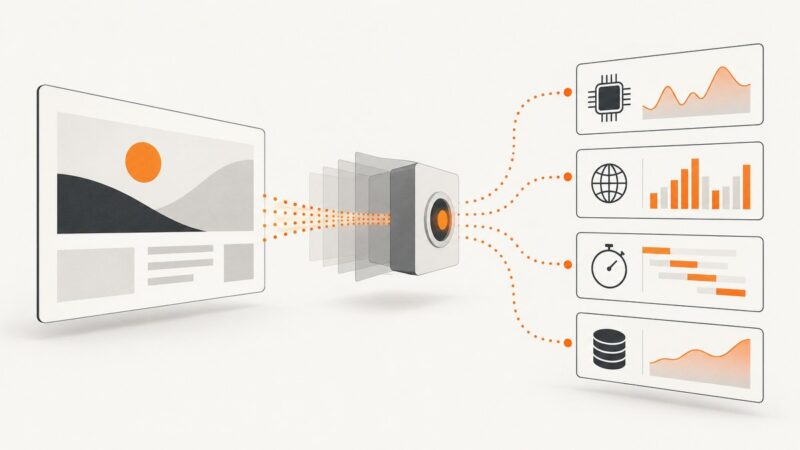
Visual AI improves functional test automation by adding checks of what the browser actually rendered. Your existing test runner still navigates, clicks, submits forms, and verifies behavior or application state; a visual checkpoint compares a page or component with an approved reference and can surface visible regressions that your chosen DOM assertions do not cover.
A visual pass is not proof that a feature works. It cannot establish that a payment completed, data persisted, accessibility semantics are correct, or keyboard focus behaves properly unless separate checks verify those properties. Treat visual validation as an additional layer in a functional flow.
What visual AI adds to a functional test
A conventional functional test asserts specified conditions: a button is enabled, a confirmation appears, an API returns expected data, or a record exists. Those checks are valuable, but they only inspect the properties the test author chose to assert. A page can satisfy them while rendering with a shifted layout, clipped text, missing icon, broken component, unexpected font, or misplaced control.
Visual testing captures a rendered page or region at a meaningful point in the flow and compares it with a baseline. Visual AI systems may help distinguish relevant changes from rendering variation, but their behavior depends on the product, configuration, application, and test conditions. Applitools describes using visual checks alongside existing functional flows and gives examples such as layout shifts, broken components, and content errors; these are vendor-described capabilities, not a guarantee that every defect will be detected. Applitools functional testing
| Check type | Good at answering | Does not establish by itself |
|---|---|---|
| Behavioral assertion | Did this action produce the expected state or response? | Does the whole page look correct? |
| DOM assertion | Does a specified element, attribute, or text value exist? | Is the rendered composition visually correct? |
| Visual comparison | Did the rendered page or component change from its reference? | Did the business operation succeed, or are semantics and focus correct? |
| Accessibility checks | Are specified accessibility properties and semantics present? | Does every user journey work or look as intended? |
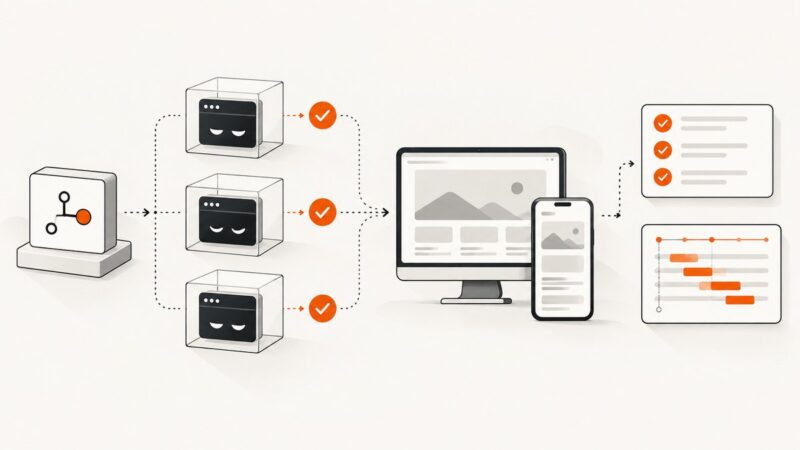
The strongest suite combines these checks at appropriate points. For example, submit an order, assert the response and persisted order state, verify accessible status messaging, then compare the stable confirmation panel visually.
Where visual checks fit in the test flow
- Keep the test runner in charge. Use Playwright, Cypress, Selenium, Appium, or another established framework for setup, navigation, interaction, and behavioral assertions.
- Choose a meaningful checkpoint. Capture after the page reaches a stable, user-relevant state, such as a loaded dashboard, completed search, or order confirmation.
- Compare the intended scope. Check a component when the question concerns that component; use a page-level capture when layout relationships across the page matter.
- Review differences. Decide whether a change is an intended product update, a defect, or rendering noise. Update a baseline only after that decision.
- Keep independent assertions. Continue checking data, behavior, accessibility, and business rules directly.
Applitools describes SDK integrations with Playwright, Cypress, Selenium, and Appium and running checks in existing CI jobs. Confirm the current integration details and supported configurations in the vendor documentation before adopting a particular setup. Applitools solutions
Implementing a visual checkpoint
The exact SDK calls and configuration depend on the visual-testing platform. The general pattern below is deliberately framework-neutral: perform normal functional steps, wait for a stable state, capture, and keep the behavioral assertion. Consult the selected platform’s current documentation for install commands, authentication, and SDK-specific code.
// Framework-neutral pseudocode
await page.goto('/checkout');
await page.getByLabel('Email').fill('qa@example.test');
await page.getByRole('button', { name: 'Place order' }).click();
await expect(page.getByRole('status')).toHaveText('Order received');
await waitForStableConfirmationState(page);
await visualCheckpoint('checkout-confirmation');
Before comparing, make test inputs repeatable: use controlled accounts and fixtures, deterministic feature flags, and known viewport sizes. If the product personalizes content, localizes strings, or includes timestamps, decide whether to control those inputs or exclude narrowly defined dynamic regions.
Full-page versus component checks
- Component checks are useful for focused areas such as navigation, a pricing card, or a confirmation panel. They reduce unrelated differences but can miss interactions with surrounding layout.
- Full-page checks reveal spacing and composition changes across the page, but are more exposed to dynamic content and responsive differences.
- Journey checkpoints should be placed after user-visible state transitions, not after every click. Excess checkpoints create review and maintenance work without necessarily adding useful coverage.
Baseline and review policy
A baseline is the approved visual reference for a particular test context. Define who may approve changes, how intentional redesigns are recorded, and how a failed comparison is linked to the code change that caused it. Avoid automatically accepting new output as the baseline: that can normalize real regressions. Keep review artifacts accessible in CI so a failure can be understood without reproducing it locally.
Manage visual noise and dynamic pages
Visual comparisons become useful when the capture is reproducible and changes are explainable. Common sources of noise include current time, randomized identifiers, personalized recommendations, A/B tests, animations, asynchronous images, font loading, antialiasing, localization, and responsive breakpoints.
| Source of variation | Preferred control | Fallback |
|---|---|---|
| Timestamps, session IDs, random content | Freeze or seed the test data | Mask only the changing region |
| Animation and transitions | Disable motion in the test environment or wait for completion | Capture a stable component state |
| Fonts and images loading late | Wait for required assets and application readiness | Use a targeted readiness condition |
| A/B tests and personalization | Pin cohort and account settings | Exclude content that cannot be made deterministic |
| Localization and viewport changes | Test explicit locale and viewport combinations | Maintain separate references for supported variants |
Masking is a tradeoff: it lowers noise but also hides defects inside the masked area. Keep masks small, document why they exist, and periodically review whether the underlying content can instead be made deterministic. Vendor materials describe controls for dynamic regions and grouping similar differences across browsers or resolutions; evaluate those capabilities using your own pages and change patterns. Applitools functional testing details
Evaluate tools and plan a proof of concept
Start with a small set of high-value journeys and stable checkpoints. Do not select a tool from a headline accuracy, speed, or maintenance claim alone. The research available for this article did not establish an independent benchmark or current comparative pricing, so treat vendor claims as claims to validate in your environment.
| Evaluation area | Questions to answer |
|---|---|
| Validation scope | Which visible changes are identified? What still requires DOM, accessibility, or business assertions? |
| Noise handling | How are dynamic regions, animations, fonts, antialiasing, locale, and responsive layout handled? |
| Environment coverage | Which browser and device combinations are supported? Can runs be repeated and parallelized reliably? |
| Workflow fit | Does it fit your framework and CI? Who approves baselines? How are failures diagnosed and permissions managed? |
| Privacy and data | What page content, screenshots, cookies, or test data leave your environment, and how are they retained? |
| Maintenance and cost | How much baseline churn, false alarm review, debugging, execution, and storage work does the workflow add? |
- Select representative journeys, including one stable page and one page with known dynamic content.
- Record expected intentional and unintended differences before tuning configuration.
- Run captures across the browsers, viewports, locales, and CI conditions that matter to the product.
- Track actionable defects found, noisy failures, review time, time to diagnose, and baseline maintenance.
- Expand only if the visual failures are useful enough to justify their ongoing review and cost.
Applitools’ report landing page states that its report covers almost 3,000 automated tests representing a combined 1.5 years of quality-engineering time spent authoring them. That scope statement does not establish that Visual AI saved 1.5 years or improved a metric by a specific amount. Applitools report
Performance, reliability, and cost
Visual validation adds capture, comparison, and human review steps to a suite. Their impact on wall-clock time depends on the integration, number and size of checkpoints, execution parallelism, and whether analysis is local or remote. Measure full CI time and review effort on the proof of concept; no independent speed benchmark is established here.
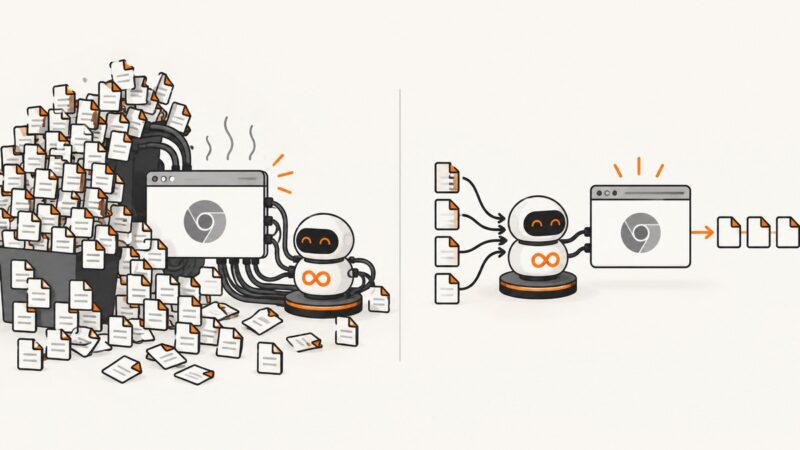
- Keep checkpoints selective. Capture important visual states rather than every intermediate step.
- Make failures reproducible. Fix browser version, viewport, test data, locale, and feature flags where practical.
- Design for transient failures. Retry only when there is evidence of infrastructure or loading instability. Blind retries can hide flaky behavior and delay diagnosis.
- Budget total cost. Include seats or usage, execution limits, storage, CI resources, baseline review, and engineer time. Current vendor prices were not verified in the research.
- Protect sensitive content. Determine what screenshots and page data are transmitted or stored, and use synthetic or sanitized data where appropriate.
Vendor-hosted customer statements and vendor studies can help form evaluation questions, but they are not substitutes for measuring results on your own suite. The Applitools page quotes Joe Emison, Co-founder & CTO, saying its Visual AI and Ultrafast Grid helped catch defects functional tests could not; this is a customer testimonial in a promotional context. Applitools customer statement
Or skip the browser setup
If the immediate task is to capture a page for review, documentation, or a visual fixture, ScreenshotNeo provides a website screenshot API and MCP server. A GET request returns an image or PDF, and the API supports browser options such as viewport, device presets, full-page capture, and custom waits. See the ScreenshotNeo API documentation.
curl -G "https://api.screenshotneo.com/v1/shot" -d access_key=YOUR_API_KEY --data-urlencode url=https://stripe.com -o shot.webpimport requests
r = requests.get("https://api.screenshotneo.com/v1/shot", params={"access_key": "YOUR_API_KEY", "url": "https://stripe.com"}, timeout=90)
open("shot.webp", "wb").write(r.content)const q = new URLSearchParams({ access_key: 'YOUR_API_KEY', url: 'https://stripe.com' });
const res = await fetch(`https://api.screenshotneo.com/v1/shot?${q}`);ScreenshotNeo accepts cookie and consent banners like a visitor and removes 60+ known consent platforms, newsletter popups, and chat widgets before capture; each step can be turned off. Bot checks, blank pages, timeouts, failed loads, and cache hits cost nothing, with response headers indicating the page verdict and billing status. Its MCP server gives AI agents tools to take screenshots, get page information, and capture PDFs. The free plan includes 1,000 screenshots a month without a card; paid plans start at $5 for 3,000 screenshots. A screenshot is a useful visual artifact, while assertions and visual comparison still belong in the test strategy when automated regression checking is the goal. Learn about ScreenshotNeo.
Sign up free for 1,000 screenshots a month, with no card required.
Troubleshooting visual test failures
| Symptom | Likely cause | Fix |
|---|---|---|
| Many unrelated pixels differ on every run | Uncontrolled data, timing, animation, font loading, or environment | Stabilize inputs and readiness; pin browser and viewport; mask only irreducible dynamic areas. |
| Expected content is missing from the capture | Capture occurred before rendering, lazy loading, or a transition completed | Wait for a meaningful selector or application-ready condition; verify the element is in the captured scope. |
| Every baseline fails after a browser update | Rendering engine or font rasterization changed | Confirm the update was intentional, review representative diffs, and approve new references through the normal review process. |
| A visual check passes despite a broken action | The screenshot shows appearance, while the action or persisted state was not asserted | Add behavioral, API, or data assertions for the operation. |
| Masked area hides an actual defect | The ignored region is too broad | Narrow the mask or make that content deterministic, then add a direct assertion where appropriate. |
| CI fails but local runs pass | Different browser, viewport, locale, fonts, data, or timing | Compare environment configuration and reproduce with the same inputs and browser build. |
| Visual suite slows the pipeline | Too many checkpoints or serial execution | Prioritize high-value states, inspect supported parallel execution, and measure time saved or added in review and triage. |
FAQ
Does visual AI replace functional tests?
No. It checks rendered appearance and complements assertions about behavior, data, and business outcomes.
Can a screenshot prove a page is accessible?
No. Visual output does not establish semantic roles, accessible names, keyboard behavior, or screen-reader support. Add appropriate accessibility checks.
Should every page have a visual baseline?
Usually not. Begin with important journeys and stable states where a visual defect would matter to users.
Is a visual testing vendor’s reported result transferable to my suite?
Not without validation. Reproduce the evaluation on your own pages, dynamic content, environments, and review process.
Is there a current book on visual AI implementation?
The cited general automation book, Software Test Automation by Mark Fewster and Dorothy Graham, was published in 1999. It can provide historical background, but it is not a current visual AI implementation manual. Pearson book listing