Visual Regression Testing with Multimodal Generative AI
Combine repeatable screenshot baselines with multimodal AI to investigate UI changes, while keeping humans and explicit criteria in control.
Visual regression testing checks whether a rendered interface still matches an approved visual state. A reliable approach is to capture screenshots under controlled conditions, compare them with reviewed reference baselines, and use multimodal generative AI to help explain or classify differences against explicit requirements. Keep the screenshot comparison as the repeatable change signal; do not treat a model’s judgment as a proven standalone replacement for baseline comparison.
This guide builds that workflow with Playwright Test, adds an optional vision-model review step, covers failure handling and evaluation, and explains where a screenshot API fits. The examples use TypeScript with Playwright. See the Playwright screenshot comparison documentation and OpenAI image and vision guide for current API details.
1. What visual regression testing checks
A visual test captures a page or component in a known state and compares the resulting image with an accepted reference. A difference means the rendered pixels changed. It does not automatically mean the change is a defect: a font update, intended redesign, browser change, or dynamic timestamp can all produce differences.
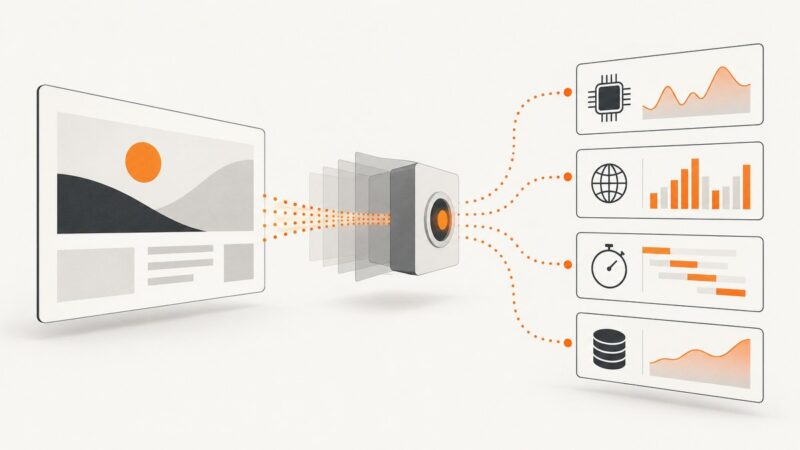
Multimodal AI is a separate signal. Given one or more screenshots and a rubric, a model can assess requirements such as whether a required control is visible, whether text appears correct, or where a layout differs. It can also summarize a diff for a reviewer. The available research does not establish that a generative model is a dependable standalone substitute for repeatable baseline comparison.
| Signal | Useful for | Does not establish by itself |
|---|---|---|
| Screenshot baseline comparison | Detecting that a rendered page changed from its approved reference | Whether the change is intentional or functionally wrong |
| Generative vision assessment | Checking image content against written criteria and helping explain a discrepancy | Repeatable, benchmarked regression detection for your product |
| DOM, functional, and accessibility tests | Behavior, semantics, keyboard and assistive-technology requirements | That the page looks correct at a particular viewport |
2. Build a repeatable Playwright screenshot test
Use a stable test account, deterministic fixture data, a fixed viewport, and the same browser and operating system when creating and checking snapshots. Playwright warns that screenshot output can vary with operating system, browser version, settings, hardware, power, and headless mode. Environment consistency is part of the test design.
Install and configure
npm init -y
npm install --save-dev @playwright/test
npx playwright install chromium
Create playwright.config.ts:
import { defineConfig } from '@playwright/test';

export default defineConfig({
  testDir: './tests',
  use: {
    baseURL: 'http://127.0.0.1:3000',
    browserName: 'chromium',
    viewport: { width: 1440, height: 900 },
    colorScheme: 'light',
    locale: 'en-US',
    timezoneId: 'UTC',
    // Keep the browser launch mode consistent with baseline creation.
    headless: true,
  },
  // Start your application in the same known configuration for each run.
  webServer: {
    command: 'npm run dev',
    url: 'http://127.0.0.1:3000',
    reuseExistingServer: !process.env.CI,
  },
});
Add a screenshot test at tests/home.spec.ts. Replace the route and selectors with elements in your application:
import { test, expect } from '@playwright/test';

test('home page matches its approved visual state', async ({ page }) => {
  await page.goto('/');
  await page.getByRole('heading', { name: 'Welcome' }).waitFor();

  // Prefer deterministic state. Seed fixtures or disable animations in test setup.
  await expect(page).toHaveScreenshot('home.png', {
    fullPage: true,
    animations: 'disabled',
    caret: 'hide',
    // Start without a permissive threshold. Tune only after inspecting real diffs.
    maxDiffPixelRatio: 0.001,
  });
});
On the first run, Playwright creates a reference snapshot if one does not exist. Review and commit that image. Later runs compare against it and report a mismatch. Run npx playwright test to check the test. To intentionally update reviewed references, run npx playwright test --update-snapshots; inspect the resulting image changes before committing them. Snapshot updates should be reviewed changes, not a routine way to clear failures.
Choose the capture scope
- Full page: useful for page-level layout and content, but long pages may include more dynamic regions.
- Element: capture a stable component when the page contains unrelated changing content:
await expect(page.getByTestId('checkout-summary')).toHaveScreenshot('checkout-summary.png'). - Viewport only: appropriate when above-the-fold appearance is the contract; use a fixed viewport and omit
fullPage. - Multiple projects: add browser or viewport projects when cross-browser or responsive rendering is part of the requirement. Each environment needs appropriately created and reviewed references.
Manage dynamic content carefully
Prefer controlling the source of variability: freeze the clock in test setup, seed stable data, use a deterministic account, and wait for the page state that matters. Disable animation when it is irrelevant to the check. Mask a changing region only when that region is outside the test’s purpose; broad masks can hide real regressions. A masked timestamp is reasonable for layout testing, but not when timestamp formatting itself is under test.
3. Add a multimodal AI review step
Use AI after a screenshot has been captured and compared, or as a separate check against a written visual rubric. Provide the reference image, current image, and criteria when the model workflow supports them. Ask for evidence tied to the images, not an ungrounded overall impression. An AI result should not silently approve a new baseline.
Define the rubric before prompting
Choose criteria that match the page’s purpose. Examples include required components, exact labels, visual hierarchy, alignment, visible affordances, and whether regions outside the intended change remain stable. Separate hard requirements from graded qualities. For example, an absent checkout button may be a failure, while a small spacing change may be informational.
Visual review task:
Compare the current screenshot with the approved reference screenshot.

Hard requirements:
- The primary action labeled "Continue to payment" is visible.
- The order total is readable and equals the supplied fixture value.
- The page title and navigation remain present.

Assess separately:
- Whether the content hierarchy and alignment changed materially.
- Whether changes outside the supplied target region appear unintended.

Return JSON with:
{
  "hard_failures": ["specific criterion and visible evidence"],
  "observed_changes": ["location and description"],
  "uncertain": ["what cannot be judged from these images"],
  "suggested_human_action": "review | accept | investigate"
}
Do not infer click behavior, accessibility, or hidden content from pixels.
Use a model API and image format supported by your chosen provider; include the two screenshots as image inputs and the rubric as text. Keep image dimensions and detail appropriate to the criteria: downscaling can erase small text or subtle spacing changes. Store the model, prompt, rubric version, image inputs, and output with the run if governance permits, so reviewers can understand why an assessment changed. OpenAI’s image-evaluation cookbook gives workflow-specific examples and emphasizes defining what a successful evaluation means; its examples are not production visual-regression benchmarks.
Keep the signals and decision policy explicit
- Run deterministic baseline comparison and retain the diff artifacts.
- Invoke AI on the current/reference pair or the relevant crop, with a versioned rubric.
- Present baseline status, AI observations, and ordinary test results separately.
- Route uncertain or conflicting outcomes to a human reviewer.
- Update the baseline only after an intentional change is understood and approved.
- Before allowing AI to block releases, evaluate it on representative known-pass and known-fail cases. Track false positives, false negatives, and repeatability for your own pages.
This combined design is an implementation pattern inferred from the capabilities of screenshot comparison and image evaluation; the research sources do not establish it as a universally best or head-to-head tested setup.
4. Choose the right approach
| Approach | What it contributes | Trade-offs to investigate |
|---|---|---|
| Playwright Test screenshot comparison | Reference images and comparisons integrated with browser tests | Environment consistency, snapshot review, capture stability, and thresholds for your project |
| Visual AI service | A vendor-provided visual comparison workflow and framework integrations | Verify SDK behavior, supported environments, handling of dynamic pages, data governance, price, and approval workflow. Applitools describes Eyes as filtering rendering noise and supporting configurable match levels; treat these as vendor claims, not independent benchmark results. |
| Generative multimodal judge | Natural-language assessment of image content, text, layout, or task-specific requirements | Rubric quality, repeatability, error rates, image detail, model/version drift, privacy, latency, cost, and human escalation |
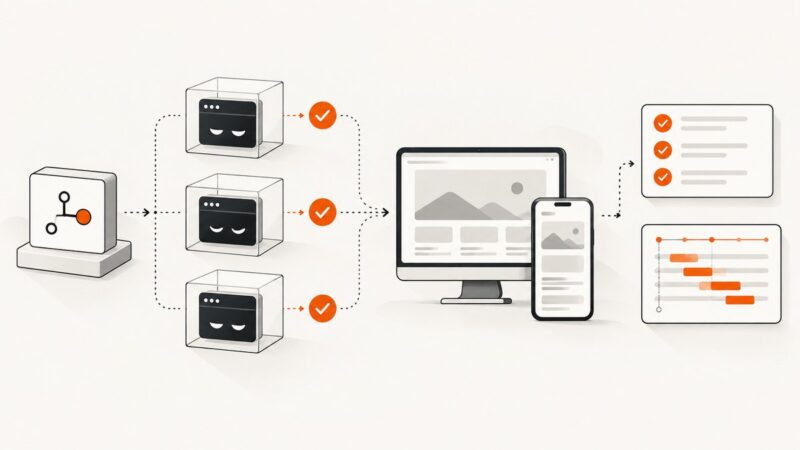
| Combined system | A baseline diff to locate change, AI to help explain it, and a human decision for ambiguous changes | Measure each signal independently and define who can approve baseline updates |
Compare tools against capture reproducibility, meaningful-change detection, dynamic-content handling, browser and device coverage, framework fit, baseline review, governance, data handling, and cost. A model vision benchmark or general image reasoning score is not evidence of visual-regression accuracy on your application. OpenAI reported 95.7% on the V* visual reasoning benchmark in 2025; that figure is not a screenshot-diff or UI defect-detection result.
5. Keep visual checks alongside functional and accessibility tests
A screenshot can reveal a missing control or broken layout that a DOM assertion did not check. A screenshot cannot establish that a control works, has correct semantics, or is accessible. Combine visual checks with functional assertions and accessibility testing that match your product. Playwright MCP documentation distinguishes accessibility snapshots from screenshots; use structured page information alongside visual context when each is relevant.
6. Capture screenshots with ScreenshotNeo
For visual test fixtures, documentation snapshots, or a quick capture without managing a browser, ScreenshotNeo is a website screenshot API and MCP server from Yorker Media. Its API accepts a URL in one GET request and returns a PNG, JPEG, WebP, or PDF. For regression suites, validate that capture settings and page state are stable and keep your approved references under your normal review process. Read the ScreenshotNeo API documentation.
cURL
curl -G "https://api.screenshotneo.com/v1/shot" \
  -d access_key=YOUR_API_KEY \
  --data-urlencode url=https://stripe.com \
  -o shot.webp
Python
import requests

r = requests.get(
    "https://api.screenshotneo.com/v1/shot",
    params={"access_key": "YOUR_API_KEY", "url": "https://stripe.com"},
    timeout=90,
)
r.raise_for_status()
open("shot.webp", "wb").write(r.content)
Node.js
const q = new URLSearchParams({
  access_key: 'YOUR_API_KEY',
  url: 'https://stripe.com',
});
const res = await fetch(`https://api.screenshotneo.com/v1/shot?${q}`);
if (!res.ok) throw new Error(`Screenshot request failed: ${res.status}`);
await Bun.write('shot.webp', new Uint8Array(await res.arrayBuffer()));
ScreenshotNeo supports full-page capture with lazy images loaded, CSS-selector element capture, dark mode, 12 device presets and custom viewports, retina scale, PDF settings, HTML/CSS-to-image, custom CSS and JavaScript, click-before-capture, selector hiding, selector/delay/network-idle waits, request and resource blocking, headers, cookies, user agent and Authorization, timezone and geolocation, transparent backgrounds, resizing, configurable-TTL caching, signed public image links, asynchronous jobs with signed webhooks, bulk capture of up to 100 URLs per call, usage API, and OpenAPI specification. It accepts the parameter names used by other screenshot APIs to make switching easier. Each option is documented in the API docs.
Or skip the browser setup
Use one API call to capture a page. Replace the URL with your test target and keep credentials out of committed source code.
curl -G "https://api.screenshotneo.com/v1/shot" -d access_key=YOUR_API_KEY --data-urlencode url=https://stripe.com -o shot.webpScreenshotNeo removes cookie banners, popups, and chat widgets before capture; each cleanup step can be turned off. Bot checks, blank pages, and failed loads are never billed, and response headers report the page verdict and billing status. Its MCP server provides take_screenshot, get_page_info, and capture_pdf for Claude, Cursor, and other MCP clients. The free plan includes 1,000 screenshots per month with no card; paid plans start at $5 for 3,000 screenshots. Every feature is on every plan.
Create a free ScreenshotNeo account for 1,000 screenshots a month, with no card required.
7. Troubleshooting
| Symptom | Likely cause | Fix |
|---|---|---|
| Snapshot differs on every run | Uncontrolled data, animation, clock, ads, or asynchronous rendering | Seed fixtures, freeze variable state, wait for a meaningful selector, and disable irrelevant animation. Mask only content outside the test contract. |
| Large diff after a small code change | Browser, operating system, fonts, viewport, or rendering mode differs from baseline creation | Run baseline creation and comparison in a consistent environment; recreate references only after reviewing the environment change. |
| Snapshot is blank or incomplete | Capture ran before navigation or required content completed | Wait for a page-specific locator or state, inspect navigation errors, and avoid assuming that a generic load event means the application is ready. |
| Legitimate update keeps failing | Reference represents the previous intended design | Inspect the diff, confirm the change with the owner, then update and commit the reference as part of the reviewed change. |
| Threshold hides visible defects | Difference allowance is too permissive | Reduce the threshold and use targeted assertions or component snapshots. Tune from observed diffs, not to make failures disappear. |
| AI review disagrees with a person | Ambiguous rubric, lost image detail, or uncertain model output | Inspect the source images, tighten criteria, retain an uncertainty outcome, and require human review for consequential decisions. |
| AI report misses small text changes | Images were resized or the task did not require exact text | Supply adequate resolution or a crop and check exact text with a DOM assertion or OCR-specific process; do not infer text fidelity from a vague visual score. |
| Visual test passes but interaction is broken | Pixels do not test behavior or semantics | Add functional assertions and accessibility checks for the interaction. |
8. Performance, reliability, and cost
- Capture time: full-page images and waits for network idle can increase run time. Wait on the state the test needs, and use element captures when page-wide coverage is not required.
- Suite cost: baseline testing consumes browser and CI time; AI review adds model latency and usage cost. The research sources provide no universal cost or speed figures, so measure representative pages and image sizes in your own pipeline.
- Reliability: control the browser environment and page state, preserve artifacts, and distinguish capture failures from visual mismatches. A timeout is not a passing visual result.
- Data handling: screenshots may contain personal or confidential data. Use synthetic fixtures or redact sensitive regions, and review the storage and retention terms of any model or hosted service before sending images.
- Decision quality: measure false alarms and missed changes against labeled examples before making AI output a release gate. Recheck after changing model versions, prompts, capture conditions, or page templates.
- ScreenshotNeo billing: only clean shots are billed; bot checks/CAPTCHAs, blank pages, timeouts, failed loads, and cache hits cost nothing. Responses include
X-Page-VerdictandX-Billedheaders. Plans range from Free at 1,000 shots/month to paid tiers starting at $5 for 3,000; yearly billing gives two months free.
FAQ
Can a multimodal model replace screenshot diffs?
The available sources do not establish that as a dependable general replacement. Use an explicit baseline for repeatable comparison and evaluate any model signal against your own labeled cases.
Should every pixel difference fail a build?
That depends on the page and capture stability. Review actual diffs, set project-specific thresholds, and keep important text or component requirements as explicit assertions.
Does a screenshot prove a page is accessible?
No. Visual appearance does not establish semantics, keyboard behavior, or assistive-technology support. Add accessibility checks suited to the interface.
Is a visual reasoning benchmark a regression benchmark?
No. A general visual reasoning result does not measure screenshot comparison accuracy or UI defect detection in your application.