Visual Testing with AI Coding Agents
Give AI coding agents a reliable visual feedback loop with browser inspection, Playwright screenshot assertions, and behavior-specific tests.
AI coding agents should inspect the interface they changed in a real browser, then use repeatable tests to check important states over time. A useful workflow combines three kinds of evidence: agent visual inspection to guide an edit, screenshot assertions to detect visual changes against reviewed references, and behavior-specific tests to verify that controls and workflows work. A screenshot or pixel diff alone cannot establish that an interface is correct.
For stable, important page states, Playwright Test’s toHaveScreenshot() can create a reference image on an initial run and compare later captures against it. Keep those references under version control, run comparisons in a consistent environment, and review every proposed baseline change. Pair visual assertions with interaction and accessibility checks.
1. Give the agent access to the running interface
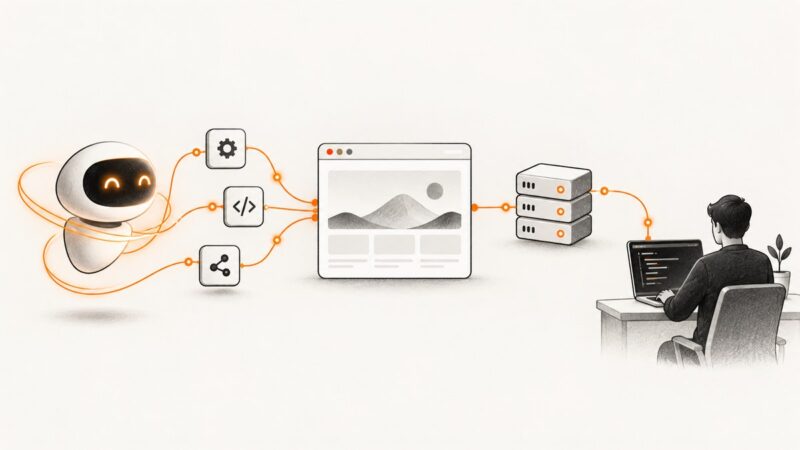
Source code does not show every rendered effect. The application may have a layout issue, an overlay, a runtime error, or a state that is reached only after interaction. Let the agent open the running app, inspect page content, take screenshots, interact with controls, and read console errors. The VS Code browser-tools guidance describes this inspect, analyze, fix, and repeat loop; Selenium also recommends checking locators against the live page and giving an agent the specific exception and, when useful, the failure screenshot.
Use the browser to answer concrete questions: Is the changed heading clipped at the target viewport? Does the menu open? Is a consent banner covering the button? Did the page reach the expected state? A screenshot makes visual evidence available, while page content, console output, and interaction results help explain it.
Keep the feedback loop focused. Ask the agent to inspect the route and state it changed, report the observed issue with evidence, make a targeted edit, and inspect again. Verify proposed locators against the live application. Review generated tests for brittle patterns such as fixed sleeps or absolute XPath.
2. Add a repeatable Playwright screenshot assertion
Screenshot assertions are useful for stable, representative states that matter to users. The first execution creates a reference screenshot; subsequent executions compare the rendered result with that reference. The reference is a reviewed expectation, not proof that the original page was correct.
The following TypeScript example is a runnable Playwright Test file. Install Playwright Test with npm init playwright@latest, choose TypeScript when prompted, and save the test as tests/visual.spec.ts. Set BASE_URL to the running application’s origin.
import { test, expect } from '@playwright/test';

test('home page matches the reviewed visual reference', async ({ page }) => {
  const baseURL = process.env.BASE_URL ?? 'http://127.0.0.1:3000';
  await page.goto(baseURL, { waitUntil: 'networkidle' });
  await expect(page.getByRole('heading', { name: 'Welcome' })).toBeVisible();
  await expect(page).toHaveScreenshot('home.png', {
    fullPage: true,
    animations: 'disabled',
    maxDiffPixels: 100,
  });
});
Run it with npx playwright test tests/visual.spec.ts. On the first run, inspect the generated reference before committing it. Commit approved references with the test so that later changes are compared with a known expectation. For details on screenshot assertions, baseline updates, environment variation, and snapshot naming, see Playwright’s visual comparisons documentation.
Choose states and scope deliberately
- Cover representative routes and viewports. Include the important desktop and mobile layouts and states that users actually reach, such as an open menu or validation message.
- Wait for a meaningful state. Prefer a visible heading, loaded component, or completed interaction over an arbitrary delay. Network idle can be useful, but pages with persistent network activity may never reach it.
- Capture the right area. A full-page image can catch content below the fold; a focused component screenshot can make a local change easier to review. Avoid broad snapshots that are unstable without a clear reason.
- Stabilize changing content. Use predictable test data and control animations where possible. Dynamic timestamps, rotating content, and external data can create diffs unrelated to the code under review.
- Review the image and diff. A test result says pixels differed; a person still needs to decide whether the change is expected and acceptable.
3. Keep visual, functional, and accessibility checks separate
A screenshot can reveal a shifted button or clipped text, but it cannot prove that the button responds, that a form submits correctly, or that the intended workflow completes. Add assertions for behavior and accessible semantics alongside visual checks.
test('menu opens and exposes its links', async ({ page }) => {
  await page.goto(process.env.BASE_URL ?? 'http://127.0.0.1:3000');
  const menuButton = page.getByRole('button', { name: 'Menu' });
  await menuButton.click();
  await expect(page.getByRole('navigation')).toBeVisible();
  await expect(page.getByRole('link', { name: 'Pricing' })).toBeVisible();
});
Use role and label locators where they express the user-facing interface clearly. A screenshot can complement this test by checking the opened menu’s appearance, but it does not replace the interaction assertions. The VISTA paper evaluates visual fidelity and functional correctness as distinct dimensions and reports that they can be partially decoupled in the agent systems it studied. That is a reason to gather both kinds of evidence, not to treat any one benchmark as a guarantee for another application. See the VISTA research paper.
4. Make screenshot comparisons repeatable
Browser rendering can vary with the operating system, browser version, browser settings, hardware, power source, and headless mode. Generate and compare baselines in a consistent environment. Otherwise, a test may report rendering differences that are unrelated to the change under review.
When a project tests more than one browser or platform, keep the environment represented in the snapshot identity. Playwright’s snapshot names include browser and platform context, and projects can add their project name. This helps keep references for different configurations distinct rather than comparing unlike renders.
Playwright exposes pixel-difference thresholds such as maxDiffPixels. Set them to allow known, acceptable rendering variation, and keep them tight enough to catch meaningful changes. A strict threshold can create noise; a permissive threshold can hide a real layout regression. Inspect failing screenshots and diffs before changing the threshold.
5. Review agent changes to tests and baselines
An agent can propose a test, locator, or new screenshot reference, but each is a code review item. When a visual change is intentional, inspect the new output and explicitly update the baseline. Playwright supports updating snapshots with npx playwright test --update-snapshots; run that command only when the changed appearance is understood and approved.
- Run the focused test and inspect the actual screenshot and diff.
- Check whether the visual change matches the intended product change.
- Run the relevant behavior tests and inspect any runtime or console errors.
- If the change is intentional, update the reference and review the new image in the code change.
- Repeat a failing or newly passing test before treating its result as reliable.
Selenium’s guidance recommends iterating one test at a time, verifying locators in the live application, and repeating a test before trusting a pass. When a test fails, give the agent the actual exception and a screenshot from the failure where available. The image may expose a banner or overlay that is not apparent from the stack trace.
6. Troubleshooting visual tests
| Symptom | Likely cause | What to do |
|---|---|---|
| Many pixels differ on a machine other than the baseline machine | Different operating system, browser build, settings, hardware, or headless rendering | Generate and compare references in the same controlled environment. Keep browser and project context distinct in snapshot names. |
| Tests fail intermittently on a page that keeps loading | The page has persistent network activity or a state that is not ready when capture begins | Wait for a specific visible element or application state. Use network idle only when the page can actually become idle. |
| Diffs appear around timestamps, rotating content, or animations | Non-deterministic content or motion changes between captures | Use predictable test data, disable animations where appropriate, and isolate changing regions when the test framework and test design support it. Do not raise the threshold to conceal unrelated instability. |
| The baseline update makes the test pass but the page looks wrong | The new screenshot was accepted without reviewing it | Restore or correct the reference after reviewing the rendered output. A passing comparison only means the current output matches the stored reference. |
| A visual test passes but the workflow is broken | Pixel comparison does not exercise or prove the interaction | Add behavior-specific assertions for the control, route, submission, or state transition. Check accessible names and roles as part of the interaction coverage. |
| A locator fails despite appearing correct in source | The live page differs, a modal or consent banner changes the page, or the locator is brittle | Inspect the running page and failure screenshot, verify the locator against rendered content, and prefer user-facing roles and labels when appropriate. |
| A screenshot is unexpectedly blank or incomplete | The page did not finish loading, an element was not visible, or capture started before the target state | Check the page content and console, wait for the specific target state, and repeat the capture after confirming the app is rendering. |
7. Performance, reliability, and maintenance
Visual coverage has a cost: each browser capture takes time, and many routes, states, viewports, and browser projects multiply that work. Start with high-value screens and critical states, then add cases when they cover a real regression risk. Run focused tests while iterating and the broader suite at the appropriate review or CI stage.
Reliability depends on controlling the inputs as well as the browser. Use stable data, wait for explicit application state, keep the rendering environment consistent, and review flaky failures rather than repeatedly accepting them. Store the references alongside the tests and inspect their changes in code review. If a baseline is wrong, the test can reliably preserve the wrong expectation.
Local Playwright tests keep test code and reference images in the repository. Teams evaluating a hosted review or screenshot service should compare repeatability, evidence quality, route and state coverage, signal versus noise, human review, behavioral completeness, and ownership of captured artifacts. A service can store or compare screenshots; it does not replace the need to test behavior or review intentional changes.
Or skip the browser setup
ScreenshotNeo is a website screenshot API and MCP server. A single request captures a URL as an image or PDF; its API is useful when you want a screenshot without setting up browser automation in your own code. For a repeatable visual regression suite, keep approved baselines and behavior tests in your test workflow.
cURL:
curl -G "https://api.screenshotneo.com/v1/shot" -d access_key=YOUR_API_KEY --data-urlencode url=https://stripe.com -o shot.webpPython:
import requests

r = requests.get(
    "https://api.screenshotneo.com/v1/shot",
    params={"access_key": "YOUR_API_KEY", "url": "https://stripe.com"},
    timeout=90,
)
r.raise_for_status()
open("shot.webp", "wb").write(r.content)
Node.js:
const q = new URLSearchParams({ access_key: 'YOUR_API_KEY', url: 'https://stripe.com' });
const res = await fetch(`https://api.screenshotneo.com/v1/shot?${q}`);
if (!res.ok) throw new Error(`Screenshot request failed: ${res.status}`);
await import('node:fs/promises').then(fs => fs.writeFile('shot.webp', Buffer.from(await res.arrayBuffer())));
See the ScreenshotNeo API documentation for request options. Cookie and consent banners are accepted or removed before capture, along with supported newsletter popups and chat widgets; each step can be turned off. Bot checks, blank pages, and failed loads are never billed. The response includes page-verdict and billing headers. An MCP server gives AI agents tools to take screenshots, get page information, and capture PDFs. The free plan includes 1,000 screenshots a month with no card; paid plans start at $5 for 3,000 screenshots.
Sign up for 1,000 free screenshots a month, with no card required.
FAQ
Should an agent update screenshot baselines automatically?
It can propose an update, but a person should review the rendered change before accepting it. The baseline defines the expected appearance, so accepting an unreviewed update can make a regression look normal.
Are screenshots enough to test an AI-built interface?
No. They help detect visual differences. Add tests for interactions and intended outcomes, and inspect accessible semantics and runtime errors where relevant.
Can Playwright catch changes made by an AI coding agent?
Yes, when a test captures a relevant state and compares it with an approved reference in a consistent environment. It will not automatically decide whether a difference is a bug or an intended design change.