What Are Web Agents and How Do They Work?
Web agents use AI models and browser tools to pursue goals through an observe–act–check loop. Learn how they work, where they fail, and how to build safer workflows.
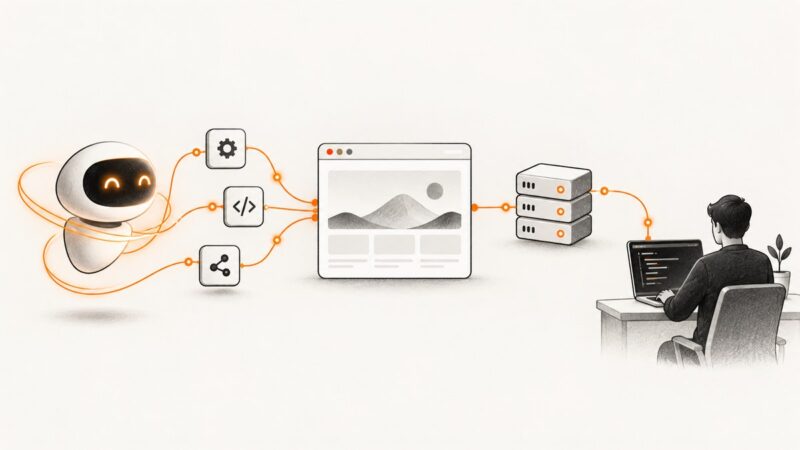
A web agent is an AI system that uses browser or web tools to work toward a goal, observes what happened, and chooses what to do next. It can often navigate pages, click, scroll, type, or fill forms when its application gives it the relevant tools and permissions. It is more flexible than a fixed script of clicks because it can adjust its next action to the state it observes.
The basic cycle is: receive a task, inspect a page or tool result, choose an action, observe the result, then repeat, stop, or ask a person for input. The exact design varies by product. An agent is not automatically reliable, safe, or able to use every website.
1. What makes a web agent an agent?
Anthropic defines an agent as “an AI model that directs its own processes and tool use when accomplishing a task—that is, deciding for itself how to achieve what users want, rather than following a fixed script.” In practice, Anthropic describes a self-directed loop in which the system plans, acts, observes, adjusts, and repeats until the task is complete or it needs human input. These are Anthropic’s definitions in its April 9, 2026 article, “Trustworthy agents in practice”.
A conventional browser script generally follows steps written in advance. A web agent uses a model to choose among available actions based on the task and what it observes. That does not mean it can invent capabilities: its actions are bounded by the browser tools, environment, credentials, and permissions supplied by its application.
2. How the observe–act–check loop works
- Receive a goal. The application gives the agent an instruction, such as finding a page or completing a permitted form.
- Inspect the current state. The agent gets information from a screenshot, browser tool result, page structure, or another supplied observation.
- Choose an action. The model selects an available action, such as navigating, clicking, scrolling, or typing.
- Execute it through a tool. The browser or other environment carries out the action.
- Observe again. The agent checks the resulting state and decides whether to continue, finish, or request help.
This is a useful conceptual model, not a claim that all products implement identical internals. OpenAI’s computer-use documentation describes a model working from browser observations and interacting with the interface; its computer-use guide also covers browser sessions, website access, verification, and reviewing saved activity.
For example, a task to locate a policy page might lead an agent to inspect a site, open a navigation menu, follow a link, and confirm that the destination contains the requested policy. If the menu is missing or the page differs from expectations, it can inspect the changed state and try another permitted action. A capable agent can still make a wrong choice or misread the page.
3. The common parts of a web-agent system
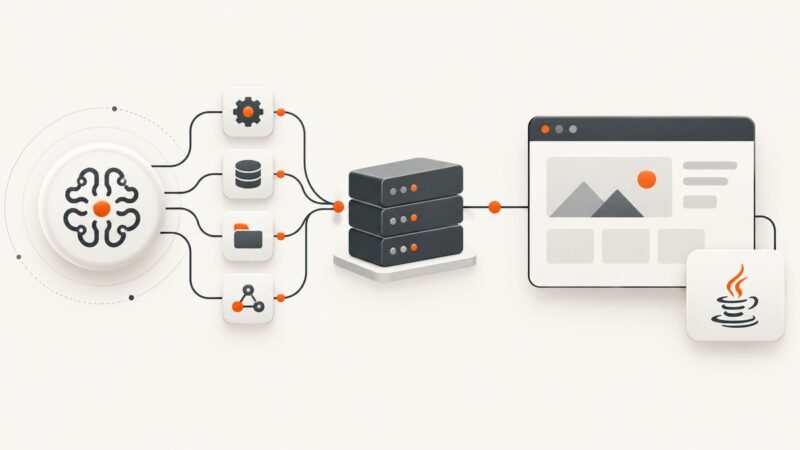
There is no single universal architecture. A common arrangement includes these components:
| Part | Role |
|---|---|
| Model | Interprets the task and observations, then selects a next action or response. |
| Harness or agent loop | Runs the model and tool cycle, manages session state, and decides how to handle results. |
| Browser environment | Provides a website session and the permitted means to inspect and interact with it. |
| Tools | Expose actions such as navigation, clicks, keyboard input, screenshots, or structured browser operations. |
| Application server | Submits tasks, receives events, handles function tools, and connects the agent to the surrounding application. |
| Human oversight | Sets permissions, reviews consequential actions, and takes over when needed. |
OpenAI’s Agents API documentation describes a harness that runs the model/tool loop and maintains a session, an optional environment for commands, code, and files, and an application server that submits tasks, receives events, and handles function tools. A browser is one possible environment.
4. How agents see and control a browser
Browser interaction can be visual, structured, or a combination. In a visual approach, the agent receives screenshots and acts through a virtual mouse and keyboard. OpenAI’s January 2025 Computer-Using Agent announcement described a system that processes raw pixel data and uses virtual mouse and keyboard actions. Other browser-oriented tools may expose more structured page information or operations. The choice affects what the agent can perceive, how it acts, and what can go wrong.
Possible actions include:
- Opening a URL and following links.
- Clicking controls and scrolling through a page.
- Typing into fields or filling forms.
- Capturing a screenshot or checking a page result.
- Stopping to ask for confirmation or handing control to a person.
These are possible capabilities when the system has the appropriate tools and permissions, not guarantees for every agent. Claude’s browser-use documentation identifies latency, vision accuracy, and prompt injection as limitations relevant to browser executors.
5. Where web agents are useful—and where they struggle
Web agents can help with multi-step tasks where the path depends on what a page shows: finding information, navigating a workflow, or entering data with appropriate authorization. Their usefulness depends on the websites involved, the tools provided, and how well the application handles errors and uncertainty.
They can struggle when pages load slowly, layouts change, controls are hard to identify, or a visual observation is ambiguous. A successful click does not prove the intended outcome occurred; the agent needs to inspect the result. Systems that rely on visual control can misread content, and adding a verification step costs time and tool calls.
Benchmark figures need careful scope. OpenAI reported that its Computer-Using Agent (CUA) scored 38.1% on OSWorld, 58.1% on WebArena, and 87.0% on WebVoyager in its January 23, 2025 announcement. Those are reported results for that system and those named tests, not a score for web agents generally or a guarantee of current performance. OpenAI described WebArena as tasks on self-hosted open-source sites imitating activities such as e-commerce and content management, and WebVoyager as testing live sites; it noted that WebArena tasks were more complex and that CUA had room to improve there. See the CUA announcement.
6. Safety, privacy, and human oversight
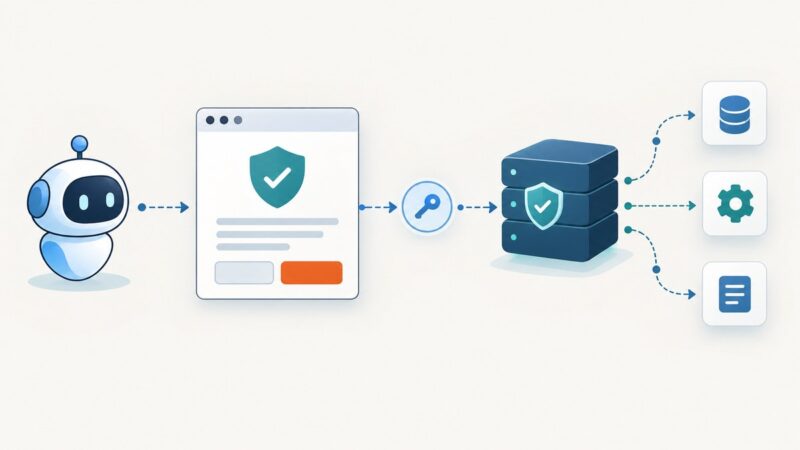
Web pages are untrusted input. A page can contain instructions intended to redirect an agent away from the user’s goal. A model may mistake those instructions for something it should obey, so the agent must treat page content as data to evaluate rather than authority to change its task.
Data can also leak through actions. OpenAI’s link-safety explanation describes how a manipulated URL could include private data in a request and how destination websites may record requested URLs. An agent can expose information through a browser action even if its final answer never repeats that information.
The 2025 preprint “Mind the Web: The Security of Web Use Agents” reports attack success rates of 80%–100% across its tested agents and attack settings. That result applies to the paper’s selected agents, models, payload types, and experiments; it is not an estimate of attack frequency across all web agents or normal browsing.
Prudent implementation practices, inferred from these documented risks, include:
- Give an agent access only to the sites, accounts, and data required for its task.
- Require confirmation before consequential actions such as submitting, purchasing, deleting, or sharing.
- Avoid placing credentials or sensitive information in prompts or pages the agent does not need.
- Verify important outcomes in the destination system instead of treating an agent’s summary as proof.
- Keep logs or other observability appropriate to the task, and provide a human handoff when the agent is uncertain.
These practices reduce exposure and improve review; they do not guarantee that an agent will act correctly.
7. Inspecting a page for an agent workflow
If a workflow needs a visual record of a web page, a screenshot can provide an observation or an artifact for later review. The agent still needs a browser or screenshot tool and logic for deciding what the image means. A screenshot by itself does not click, fill a form, or verify a transaction.
For a local browser workflow, a browser automation library can open a page and save a screenshot. The code below uses Playwright for Node.js and captures a full-page PNG:
import { chromium } from 'playwright';

const browser = await chromium.launch({ headless: true });
const page = await browser.newPage({ viewport: { width: 1440, height: 900 } });
try {
  await page.goto('https://example.com', {
    waitUntil: 'domcontentloaded',
    timeout: 30000,
  });
  await page.screenshot({ path: 'page.png', fullPage: true });
} finally {
  await browser.close();
}
This is a minimal local capture example, not an agent: it follows a fixed sequence. Add your own decision loop and verification only when the task needs them. Install Playwright and its browser binaries according to the official Playwright documentation. If the target page is untrusted, avoid passing secrets to it and do not let page text override the user’s task.
8. Or skip the browser setup
ScreenshotNeo is a website screenshot API and MCP server for developers. A single GET request can return a PNG, JPEG, WebP, or PDF. The API can also be used by AI agents through MCP tools including take_screenshot, get_page_info, and capture_pdf.
Here is a one-call capture, with the API options documented at ScreenshotNeo docs:
curl -G "https://api.screenshotneo.com/v1/shot" -d access_key=YOUR_API_KEY --data-urlencode url=https://stripe.com -o shot.webpScreenshotNeo accepts cookie or consent banners like a visitor and removes more than 60 known consent platforms, newsletter popups, and chat widgets before the capture; each step can be turned off. Bot checks or CAPTCHAs, blank pages, timeouts, failed loads, and cache hits cost nothing, and each response identifies the page verdict and billing status in headers. An MCP server lets AI agents take screenshots. The free plan includes 1,000 screenshots per month with no card; paid plans start at $5 for 3,000 screenshots.
Sign up free for 1,000 screenshots a month, with no card required.
9. Performance, reliability, and cost considerations
Performance
Each observe–act–check cycle can require model reasoning, browser execution, and another observation. Multi-step tasks therefore take longer than a single deterministic browser command. Keep the task narrow, avoid unnecessary repeated inspections, and use a wait condition suited to the page rather than an arbitrary long pause. Visual screenshots and page changes can add processing and transfer time.
Reliability
Pages can time out, fail to load, change layout, or return unexpected content. Use bounded timeouts, check navigation and page state after actions, and make retries conditional: retry transient loading failures, but do not blindly repeat a purchase or submission. Preserve a clear stop condition and make it possible to hand control to a person.
Cost
Agent costs can include model usage, browser execution infrastructure, and any external APIs or services called during the task. The exact cost depends on the provider and the number of model and tool steps; no single cost applies to every web agent. Measure representative workflows in your own environment. For screenshot-only calls, ScreenshotNeo’s published plans are Free (1,000 per month), Starter ($5 for 3,000), Growth ($15 for 15,000), Pro ($39 for 60,000), Scale ($99 for 250,000), and Business ($249 for 1,000,000); yearly billing gives two months free, and every feature is on every plan.
10. Troubleshooting common failures
| Symptom | Likely cause | Practical fix |
|---|---|---|
| The agent clicks the wrong thing | The control was ambiguous, moved, or was misread from the screenshot. | Provide a clearer observation, use a more specific browser action if available, and verify the resulting page state before continuing. |
| The page keeps loading or a step times out | Slow network, delayed scripts, or a page that never reaches the expected state. | Use a bounded timeout and wait for a relevant page condition; retry only when the failure appears transient. |
| The agent follows instructions found on the page | Prompt injection or untrusted page content was treated as task authority. | Reinforce that page content is untrusted, limit tools and data access, and require human approval for consequential actions. |
| The final answer claims success but the site did not change | The agent inferred success from an attempted action rather than checking the result. | Read the destination state after the action and confirm the expected change independently for high-impact tasks. |
| Private data appears in a URL or request | Sensitive values were included in navigation or exposed to a destination that records URLs. | Do not place secrets in URLs; minimize data shared with the page and review network destinations and logs. |
| A visual workflow is slow or inconsistent | Repeated screenshot/model cycles, vision ambiguity, or changing layouts. | Reduce unnecessary steps, use structured browser tools where suitable, and add checkpoints around dynamic sections. |
11. Frequently asked questions
Can a web agent click buttons and fill out forms?
Some can, if their browser tools permit those actions and the application has granted the necessary access. Whether they should submit a form without a person depends on the consequences and safeguards in the workflow.
Is a web agent the same as a browser automation script?
No. A conventional script follows predefined steps. An agent can select its next tool action based on observations, though an agent can still use scripts or deterministic tools as part of its workflow.
Are web agents safe to use with private accounts?
There is no blanket answer. Safety depends on data exposure, site trust, permissions, approval controls, and verification. Use least privilege and human review for consequential actions.
Do benchmark scores tell me how well an agent will do on my website?
Not directly. Scores describe a system on specific tasks and test conditions. Your site, task, permissions, and failure costs may differ, so evaluate the actual workflow you plan to deploy.