What Is an MCP Server in Agentic AI?
An MCP server gives AI hosts standardized tools, resources and prompts. Learn the architecture, security model, deployment choices and real examples.
Short answer: An MCP server is a software capability provider that connects to an AI application through the Model Context Protocol. It publishes callable tools, contextual resources and reusable prompts. The AI host supplies the model, user interface, credentials and approval rules; the server supplies well-defined capabilities and structured results.
MCP gives AI applications a common way to connect to external systems instead of requiring a custom integration for every host. A server can expose read-only information, actions such as API calls, or both. The protocol standardizes discovery and message exchange, but it does not make a server trustworthy or make an AI system autonomous by itself.
1. MCP server architecture
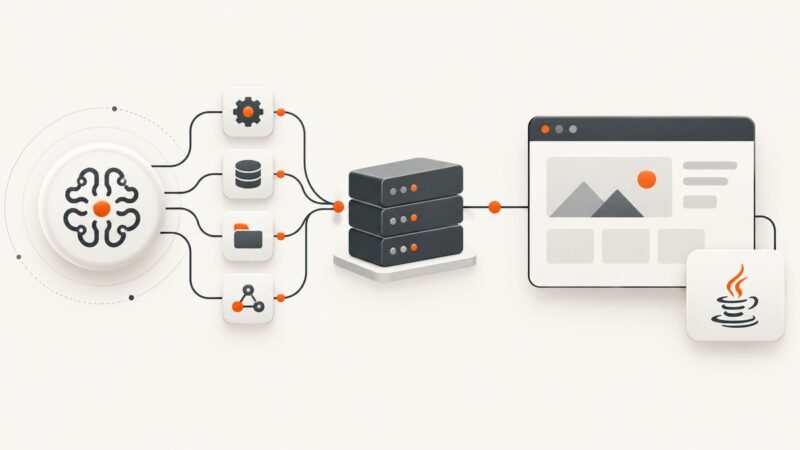
Think of an MCP integration as five parts:
| Part | Responsibility |
|---|---|
| Host | The AI application, assistant or IDE that provides the user interface, model access and policy controls. |
| Client | The connection component inside the host. A host can maintain separate clients for several MCP servers. |
| Server | The capability boundary around a particular API, database, file store or workflow. |
| Model | The planner that may select an exposed tool based on its name, description and input schema. |
| User and administrator | The people who approve risky operations, configure credentials and govern access. |
The server does not turn a general-purpose model into an autonomous agent. It returns capabilities and data. The host decides which capabilities are visible, when a call is allowed and how the result is shown.
Data layer and transport layer
MCP has a JSON-RPC-based data layer and a transport layer. The data layer covers initialization, capability and version discovery, and requests for tools, resources, prompts and other protocol features. The transport layer handles connection establishment, message framing and authorization. A deployment can therefore change its connection method without changing the conceptual contract exposed by the server.
2. The three MCP primitives
Tools: model-controlled operations
Tools are executable functions the model may invoke. Examples include querying a database, calling an API, performing a calculation, writing a file or triggering a workflow. Each tool should have:
- A stable name.
- A description that says what it does and when to use it.
- An input schema that validates required and optional fields.
- A structured result format and useful error information.
- A clearly documented side-effect profile.
Because tools can change external state, the host should show calls to the user and request confirmation for risky operations. A read-only lookup and a purchase operation should never be presented with the same approval policy.
Resources: application-controlled context
Resources are structured data or content that an application can attach to the model’s context, such as documents, records or files. They are context surfaces rather than an automatic grant of write access. A resource can inform a decision without giving the model permission to mutate the underlying system.
Prompts: user-controlled templates
Prompts are reusable instruction templates selected by the user or interface, such as a menu action or slash command. They make common workflows repeatable while keeping selection under user control.
| Primitive | Typical controller | Best for |
|---|---|---|
| Tools | Model, subject to host policy | Queries, calculations and actions |
| Resources | Application | Documents, records and contextual data |
| Prompts | User or interface | Reusable task instructions |
3. How an MCP request works
- The host opens an MCP client connection to a server.
- The client and server initialize and discover supported protocol capabilities and versions.
- The server advertises its tools, resources and prompts, including names and schemas.
- The model receives the capabilities that the host permits it to see.
- The model proposes a tool call when the current task matches a tool description.
- The host validates policy, credentials and (when required) human approval.
- The client sends a JSON-RPC request through the selected transport.
- The server performs the operation and returns structured content or an error.
- The host adds the result to the model’s context and displays the outcome to the user.
A useful debugging boundary is the first failed step: initialization, discovery, model selection, approval, transport, authorization, server execution or result rendering.
Illustrative JSON-RPC exchange
The exact framing depends on the transport, but the data layer carries messages with the familiar JSON-RPC shape:
{
  "jsonrpc": "2.0",
  "id": 7,
  "method": "tools/call",
  "params": {
    "name": "lookup_customer",
    "arguments": {"customer_id": "cus_123"}
  }
}
{
"jsonrpc": "2.0",
"id": 7,
"result": {
"content": [
{"type": "text", "text": "Customer is active"}
]
}
}Treat this as a message example, not a universal HTTP endpoint. A production client must use the transport and authorization method supported by the host and server.
4. MCP server versus API
| Question | Traditional API | MCP server |
|---|---|---|
| Primary consumer | Application code written against endpoints | AI host and its MCP client |
| Contract | Routes, methods and schemas | Discovered tools, resources and prompts with schemas |
| Selection | Developer chooses the operation in code | Model may choose among exposed tools under host policy |
| User approval | Usually implemented by the calling application | Host is expected to expose calls and gate risky actions |
| Integration model | Custom client per API | One protocol pattern usable by MCP-compatible hosts |
An MCP server can call an API internally. MCP is the AI-facing capability contract; it does not replace the underlying database, SaaS API or business service.
5. Designing a reliable MCP server
Define a narrow capability boundary
- Group tools around one system or workflow.
- Expose the smallest set of operations needed by the agent.
- Separate read-only tools from mutating tools.
- Use explicit names such as
search_ordersandcancel_order. - Document side effects, latency expectations and failure conditions.
Write schemas for model selection
Descriptions should state what a tool does, what it does not do and which arguments are required. Schemas should reject invalid values before an external call. Avoid one tool with a dozen unrelated modes; several precise tools are easier for a model and a human to review.
Make failures actionable
Return a stable error category, a human-readable explanation and a retry hint when appropriate. Do not leak secrets or raw stack traces. Distinguish validation failures, authentication failures, permission failures, rate limits, timeouts and downstream errors.
6. Security and governance checklist
MCP standardizes message formats and discovery. Compatibility alone is not a security guarantee.
- Least privilege: issue credentials scoped to the exact tools and records required.
- Approval gates: require explicit confirmation for irreversible or externally visible actions.
- Inventory: keep a list of servers, owners, versions, dependencies and exposed tools.
- Credential isolation: keep secrets in the host or deployment secret store, not in tool descriptions or prompts.
- Dependency review: inspect server source and third-party packages before production use.
- Logging: record caller, tool name, sanitized arguments, result status, latency and request ID.
- Monitoring: alert on repeated failures, unusual volume, permission denials and schema changes.
- Prompt-injection resistance: treat tool descriptions, resources and returned content as untrusted input that can influence model behavior.
- Revocation: make it possible to rotate credentials and remove a server quickly.
7. Deployment and evaluation
Before adopting a server, evaluate six dimensions:
- Capability fit: Does it expose the systems and operations the workflow needs?
- Contract quality: Are names, descriptions and schemas precise enough for reliable selection and validation?
- Transport and authorization: Does it support the required local or remote connection method and credential isolation?
- Reliability: Are timeouts, retries, rate limits, observability and versioning defined?
- Governance: Can administrators review changes, rotate credentials and remove access?
- Human control: Does the host show calls and request confirmation for risky work?
For production, define ownership, a change process, rollback steps and a test set covering valid inputs, malformed inputs, expired credentials, downstream outages and partial results. Keep tool contracts backward compatible where possible.
8. Using an MCP server for screenshots
A screenshot capability is a practical MCP tool because an agent can inspect a page visually without a custom browser integration in every host. ScreenshotNeo provides an MCP server with take_screenshot, get_page_info and capture_pdf tools for Claude, Cursor and other MCP clients.
The same service also exposes a website screenshot API. One GET request returns PNG, JPEG, WebP or PDF. It can accept a URL, wait for a selector, delay or network idle, load lazy images for full-page captures, select one element by CSS selector, set dark mode and device or viewport settings, inject CSS or JavaScript, click an element, hide selectors, block ads, trackers, requests or resource types, provide headers, cookies, a user agent or Authorization, set timezone and geolocation, use transparent backgrounds, resize images, cache with a chosen TTL, create signed links, run asynchronous jobs with signed webhooks, capture up to 100 URLs per call and report usage.
Direct API calls
See the ScreenshotNeo documentation for the complete option list and current parameter details.
curl -G "https://api.screenshotneo.com/v1/shot" \
  -d access_key=YOUR_API_KEY \
  --data-urlencode url=https://stripe.com \
  -o shot.webp
import requests
r = requests.get(
"https://api.screenshotneo.com/v1/shot",
params={"access_key": "YOUR_API_KEY", "url": "https://stripe.com"},
timeout=90,
)
r.raise_for_status()
open("shot.webp", "wb").write(r.content)const q = new URLSearchParams({
access_key: 'YOUR_API_KEY',
url: 'https://stripe.com'
});
const res = await fetch(`https://api.screenshotneo.com/v1/shot?${q}`);
if (!res.ok) throw new Error(`Screenshot failed: ${res.status}`);
const image = Buffer.from(await res.arrayBuffer());
require('fs').writeFileSync('shot.webp', image);Billing and response classification
ScreenshotNeo bills only clean shots. Bot checks or CAPTCHAs, blank pages, timeouts, failed loads and cache hits cost nothing. Each response reports its classification in the X-Page-Verdict and X-Billed headers, so your job runner can record what happened instead of guessing from HTTP status alone.
9. Performance, reliability and cost considerations
- Use a precise wait condition instead of an unnecessarily long fixed delay.
- Capture a single element when a full page is not required.
- Use caching with a TTL for pages that do not change often.
- Use asynchronous jobs and signed webhooks for long or bulk work.
- Block unnecessary ads, trackers or resource types when they are irrelevant to the capture.
- Record verdict and billed headers for reconciliation.
- For an MCP server, set timeouts, retry only idempotent operations and preserve request IDs across host, client and downstream calls.
ScreenshotNeo includes every feature on every plan: Free provides 1,000 shots per month with no card; Starter is $5 for 3,000; Growth $15 for 15,000; Pro $39 for 60,000; Scale $99 for 250,000; and Business $249 for 1,000,000. Yearly billing gives two months free.
10. Troubleshooting MCP integrations
| Symptom | Likely cause | Fix |
|---|---|---|
| Server never appears | Client cannot start the process or connect to the transport. | Check the host configuration, executable path, connection address and server logs. |
| Tools are missing | Initialization or capability discovery failed, or the host filtered them. | Inspect the initialization response, protocol version and host policy. |
| Model chooses the wrong tool | Names or descriptions overlap, or the schema is vague. | Use specific names, state exclusions and split unrelated operations. |
| Permission denied | Credential scope or user approval is insufficient. | Grant the minimum required scope and confirm the host approval flow. |
| Calls time out | Slow downstream service, page load or missing timeout. | Set bounded timeouts, use async work where available and return a clear retry category. |
| Repeated duplicate actions | Retry logic is replaying a mutating operation. | Require confirmation, add idempotency handling and retry only safe operations. |
| Screenshot is blank | The page failed, timed out or was blocked by a bot check. | Inspect X-Page-Verdict, adjust waits or access settings and handle the result as a non-billed failed capture. |
| Screenshot includes a popup | The page’s consent, newsletter or chat layer was not removed. | Use ScreenshotNeo’s cleanup steps and, if needed, hide the popup selector. |
11. Or skip the browser setup
Use the ScreenshotNeo API or MCP server when you want the result without managing a browser. Cookie banners, newsletter popups and chat widgets are removed before the shot. Bot checks, blank pages and failed loads are never billed. An MCP server lets AI agents take screenshots through tools such as take_screenshot, get_page_info and capture_pdf. You get 1,000 screenshots a month free with no card, and paid plans start at $5 for 3,000 shots.
curl -G "https://api.screenshotneo.com/v1/shot" -d access_key=YOUR_API_KEY --data-urlencode url=https://stripe.com -o shot.webpCreate a free ScreenshotNeo account and start with 1,000 screenshots each month at no charge.
12. FAQ
Is an MCP server the same as an API?
No. An API is usually consumed directly by application code. An MCP server presents capabilities to an AI host through a standardized discovery and calling pattern. It may use an API internally.
Do I need an MCP server for ChatGPT or Claude?
Only when you want the host to discover and call your external tools, resources or prompts through MCP. A normal API integration can still be the right choice for a fixed application workflow.
Can one host connect to multiple servers?
Yes. A host can maintain separate MCP clients, with each server acting as a boundary around a particular system or capability set.
Are MCP servers safe by default?
No. Safety depends on server trust, credential scope, dependency review, approval controls, logging and monitoring. Protocol compatibility does not replace governance.
What should an MCP server expose first?
Start with a small, read-only set of high-value tools and precise schemas. Add mutating operations only after approval, audit and rollback behavior are defined.