What Is Playwright AI and How Does It Work?
Playwright AI pairs an AI assistant with Playwright MCP so it can inspect pages, operate browsers, and draft tests from live accessibility data.
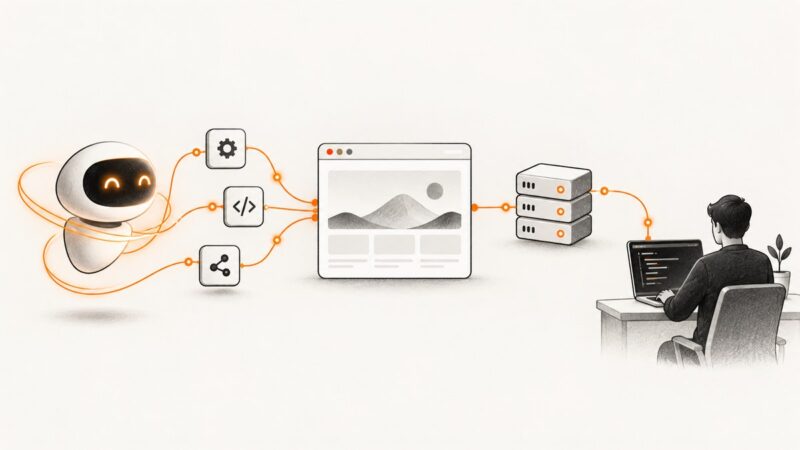
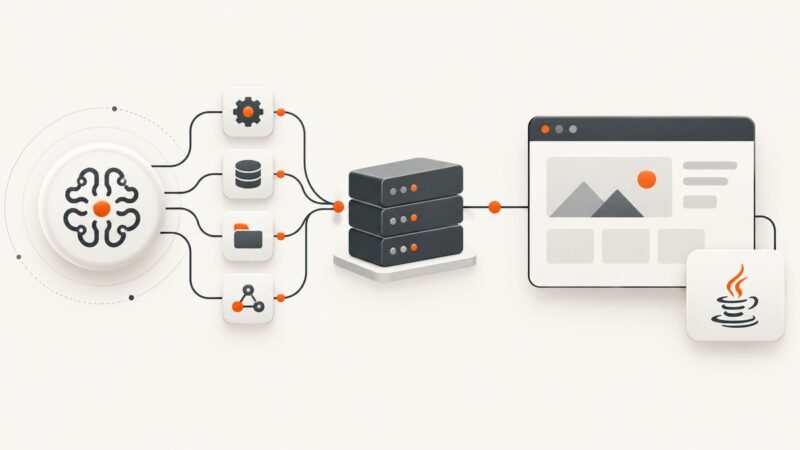
Playwright AI is a broad label, not the formal name of a standalone product. It usually means pairing the Playwright browser automation framework with an AI assistant, commonly through the Playwright MCP server. Playwright performs the browser actions; the assistant decides what to do from the task and the structured page information returned by MCP. The official MCP guide describes this as an MCP server that lets compatible clients interact with pages through browser tools and accessibility snapshots.
The practical result is an assistant that can open a page, inspect its controls, fill forms, click buttons, take screenshots, and draft Playwright tests. The generated work still needs review: selectors can be valid while the assertion checks the wrong behavior.
How Playwright AI works
- You connect an MCP client. This can be VS Code, Cursor, Windsurf, Claude Code, Claude Desktop, or another client that supports MCP.
- The client starts Playwright MCP. The server launches or connects to a browser session.
- You describe a task. For example: “Open the checkout page, add a product, and verify the order total.”
- The assistant calls browser tools. Typical calls navigate, inspect the page, click, type, select options, wait, or capture a screenshot.
- MCP returns structured state. The central response is an accessibility snapshot containing roles, accessible names, text, and element references. A model can use a reference for a textbox or checkbox on its next call.
- The assistant chooses the next action. After each action it reads the new snapshot or other result, then continues until the task is complete.
- You review the result. For test authoring, check locators, assertions, waits, authentication handling, and the intended business behavior before committing code.
An accessibility snapshot is not the same as a screenshot or raw HTML. It gives the model a compact, semantic view of controls. Playwright MCP also exposes screenshot tools, so visual evidence can still be part of a workflow.
What you need
- Node.js 20 or newer for the current general Playwright MCP installation guidance.
- An MCP-compatible AI client.
- A browser that Playwright can launch. The current installation guide says the browser is downloaded automatically on first use.
- A trusted page and credentials for any authenticated workflow you intend to automate.
Version requirements and client configuration change. Check the current Playwright MCP installation page when you set up a new project. Microsoft’s Power Platform sample has its own prerequisites and browser setup; do not treat those sample-specific requirements as universal.
Install and configure Playwright MCP
1. Add the server to your MCP client
The general configuration shown by Playwright runs the package through npx:
{
  "mcpServers": {
    "playwright": {
      "command": "npx",
      "args": ["@playwright/mcp@latest"]
    }
  }
}
Put this in the configuration location required by your client. Some clients provide a settings UI instead of a file. The command is intentionally resolved with npx, so confirm the package version and execution policy used by your team.
2. Start a first interaction
After the client connects, send a small task that is easy to verify:
Navigate to https://demo.playwright.dev/todomvc and add three todo items. Then report the visible item count.The assistant should navigate, inspect the returned snapshot, identify the textbox by its accessible name, type each item, and read the resulting state. If it cannot connect, use the troubleshooting table below before attempting a complex flow.
3. Give the assistant useful constraints
Natural-language instructions become more reliable when they state the expected page, scope, and assertion:
Open https://example.test/orders.
Use the page's accessible roles and names for locators.
Open the first order, wait until the order number is visible, and verify that the status is “Paid”.
If the page is still loading, inspect it again before choosing a locator.
Return the Playwright test and explain any assumptions.
What Playwright MCP can do
| Capability | Typical use | What to review |
|---|---|---|
| Navigation | Open URLs and follow a workflow | Allowed domains, redirects, authentication |
| Accessibility snapshots | Find controls by role, name, and reference | Whether the snapshot represents the intended frame |
| Clicking and typing | Forms, menus, buttons, and search | Side effects and duplicate submissions |
| Dropdown selection and keyboard/mouse input | Rich controls and keyboard paths | Focus, keyboard accessibility, and platform differences |
| Waiting | Wait for a selector, navigation, or network state | Whether the wait describes a real readiness condition |
| Dialogs and tabs | Confirmations, popups, and multi-tab flows | Which page or dialog is active |
| Screenshots | Visual evidence and debugging | Viewport, responsive state, and sensitive data |
| Playwright code execution | Complex interactions that are awkward as individual tools | Trust boundary and arbitrary code risk |
Microsoft’s live-inspection guidance uses the same pattern for Power Platform apps: the assistant inspects the rendered application, discovers selectors such as control names and ARIA labels, and drafts a test. Its recommended process ends with a person reviewing and committing the generated test. See the Power Platform MCP sample and the AI-assisted testing overview.
Using snapshots to choose dependable locators
Prefer locators that express user-visible meaning: a button’s accessible name, a textbox label, or a heading. Ask the assistant to re-snapshot after navigation, modal opening, or a reload. References from an earlier snapshot can become invalid when the DOM changes.
Inspect the current accessibility snapshot.
Choose the “Email” textbox by its accessible name.
Click the “Continue” button by role and name.
After navigation, take a fresh snapshot before selecting another element.
Avoid CSS classes generated at runtime unless no semantic locator exists.
For frames, explicitly tell the assistant which frame contains the application. Microsoft’s Power Platform examples, for instance, require crossing the canvas app iframe before interacting with controls.
From an AI request to a Playwright test
A useful workflow separates exploration from code review:
- Start the application in a stable environment with test data.
- Ask the assistant to inspect the page and describe the intended path.
- Ask it to produce a test using your project’s conventions, fixtures, and locator policy.
- Read every generated locator and assertion. Replace guesses with business-level checks.
- Run the test repeatedly, including a failure case and a slow-loading case.
- Commit only after the test proves the behavior you actually want.
For a difficult flow, record a happy path with Playwright codegen, then ask the assistant to refactor the recording into your test architecture. Recording provides concrete actions; the assistant can explain and reorganize them, but it cannot infer your product requirements automatically.
Security and permissions
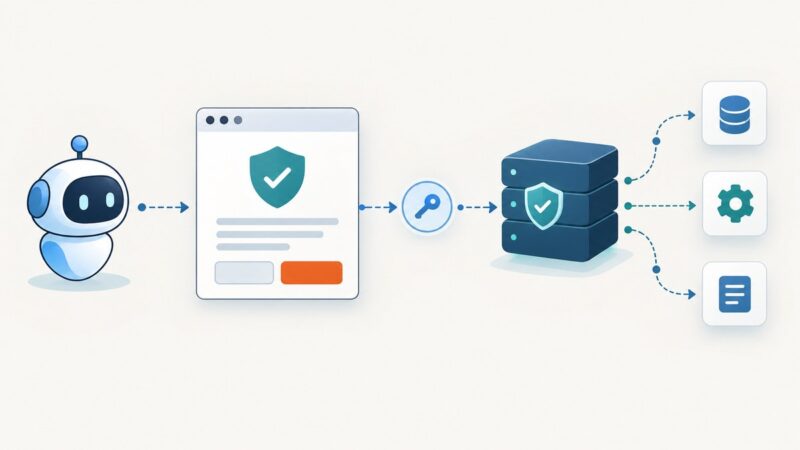
The official MCP guide contains this warning about its unsafe JavaScript execution tool: “This tool runs arbitrary JavaScript in the Playwright server process and is RCE-equivalent — only enable it for trusted MCP clients.” Treat that capability as code execution with the permissions of the server process. Limit which clients can connect, avoid putting production secrets in an exploratory session, and review commands that evaluate page JavaScript.
The warning is specific to the unsafe JavaScript tool. It does not mean every navigation, snapshot, click, or typing action executes arbitrary JavaScript. Your threat model should still include pages that contain untrusted content, credential exposure, downloads, and destructive form submissions.
Local MCP versus managed browsers
Local Playwright MCP runs the browser and server in an environment you manage. That gives you direct control over installation, network access, credentials, and debugging.
Microsoft Playwright Workspaces is a separate managed cloud-browser option. Microsoft describes a remote MCP server that lets compatible agents use managed browsers for websites and business systems. Compare the two on infrastructure ownership, authentication setup, operational control, and how your team plans to scale. The cited overview does not establish pricing, regional availability, or referral terms.
Or skip the browser setup
If your goal is a clean image or PDF of a URL rather than an interactive browser test, ScreenshotNeo provides a single screenshot API request. It accepts cookie and consent banners like a visitor, then removes more than 60 known consent platforms, newsletter popups, and chat widgets before capture. Only clean shots are billed: bot checks, CAPTCHAs, blank pages, timeouts, failed loads, and cache hits cost nothing, and the response reports the result in X-Page-Verdict and X-Billed headers. ScreenshotNeo also has an MCP server with take_screenshot, get_page_info, and capture_pdf tools for Claude, Cursor, and other MCP clients.
See the ScreenshotNeo API documentation for the current options. The direct request is:
curl -G "https://api.screenshotneo.com/v1/shot" -d access_key=YOUR_API_KEY --data-urlencode url=https://stripe.com -o shot.webpimport requests
r = requests.get(
"https://api.screenshotneo.com/v1/shot",
params={"access_key": "YOUR_API_KEY", "url": "https://stripe.com"},
timeout=90,
)
r.raise_for_status()
open("shot.webp", "wb").write(r.content)const q = new URLSearchParams({ access_key: 'YOUR_API_KEY', url: 'https://stripe.com' });
const res = await fetch(`https://api.screenshotneo.com/v1/shot?${q}`);
if (!res.ok) throw new Error(`Screenshot failed: ${res.status}`);
const data = Buffer.from(await res.arrayBuffer());
await fs.promises.writeFile('shot.webp', data);The API supports full-page capture with lazy images loaded, CSS-element capture, dark mode, device presets or custom viewports, retina scale, PDF paper and page options, custom CSS and JavaScript, clicks, selector or network-idle waits, request blocking, headers, cookies, user agents, authorization, timezone, geolocation, transparent backgrounds, resizing, configurable caching, signed image links, asynchronous jobs with signed webhooks, bulk capture of up to 100 URLs per call, usage reporting, and an OpenAPI specification. Common parameter names from other screenshot APIs are accepted to ease migration.
Free usage includes 1,000 shots per month with no card. Paid plans start at $5 for 3,000 shots; every feature is available on every plan, and yearly billing provides two months free. Create a free ScreenshotNeo account to get started.
Troubleshooting Playwright AI
| Symptom | Likely cause | Fix |
|---|---|---|
| The client cannot connect | The MCP command is not installed, allowed, or running | Run the configured command manually, confirm Node.js meets the current guide, and inspect the client’s MCP logs. |
| The browser never opens | Browser binaries or OS dependencies are missing | Follow the current Playwright browser installation instructions for your operating system, then restart the MCP server. |
| The snapshot is empty | The page is still loading, content is inside an iframe, or a login is required | Wait for a meaningful element, authenticate in the intended context, and ask the assistant to inspect the correct frame. |
| A reference no longer works | The page reloaded or the DOM changed | Take a fresh accessibility snapshot and select the element again. |
| The assistant clicks the wrong control | Duplicate names, ambiguous scope, or a weak locator | Specify the container, role, and exact accessible name; ask for a snapshot before acting. |
| A test times out | The assertion runs before data or navigation is ready | Wait for a real readiness signal such as a visible result, URL change, or completed request. Avoid arbitrary long sleeps when a state-based wait exists. |
| Authentication disappears | The browser context is new or storage was not persisted | Use a controlled test account and the client’s supported storage or session setup; never paste production secrets into prompts. |
| Generated tests pass but prove little | The assistant asserted visibility instead of business state | Rewrite assertions around outcomes: saved data, permissions, totals, status, or user-visible error messages. |
| Power Platform controls cannot be found | The app is inside its host iframe or controls have not populated | Switch to the application frame, re-snapshot, and allow the data view time to load before choosing selectors. |
Performance, reliability, and cost
Performance
- Keep prompts scoped to one workflow so the assistant does not explore unrelated pages.
- Use snapshots for semantic discovery and screenshots only when visual state matters.
- Prefer state-based waits over fixed delays. A fixed delay adds latency when the page is fast and still fails when it is slower.
- Reuse a browser session when your client supports it, but reset state between tests that must be isolated.
Reliability
- Use stable accessible names and application-level identifiers.
- Make test data deterministic and isolate destructive actions.
- Have the assistant explain assumptions, then encode those assumptions as explicit assertions.
- Re-snapshot after navigation, modal transitions, and reloads.
- Keep a human review step for generated tests, as Microsoft’s guidance recommends.
Cost
Playwright MCP itself is a local server command; your costs depend on the AI client, browser infrastructure, and any managed service you choose. The research sources do not provide a universal Playwright MCP price or benchmark. For URL screenshots, ScreenshotNeo’s free tier is 1,000 shots per month with no card, and its paid plans start at $5 for 3,000 shots. Because failed loads and other non-clean outcomes are not billed, inspect the verdict headers when accounting for usage.
FAQ
Is Playwright AI a separate product?
Usually the phrase means Playwright automation paired with an AI assistant. Playwright MCP is the integration that exposes browser tools to MCP-compatible clients.
Does Playwright AI understand screenshots?
It can use screenshots, but the core MCP workflow gives the assistant structured accessibility snapshots and element references. Those snapshots are often more precise for locating controls than pixels alone.
Can it write production-ready tests automatically?
It can draft useful tests from a live application, but a developer must review locators, waits, assertions, permissions, and test data before committing them.
Does MCP work only with one AI assistant?
No. The Playwright guide lists several MCP clients, and any client with compatible MCP support can use the server after configuration.
When should I use a screenshot API instead?
Use a screenshot API when you need a rendered image or PDF and do not need an agent to interact with the page. ScreenshotNeo is the direct option when you want consent banners, popups, and chat widgets removed before capture.
What is the safest way to try it?
Start with a non-destructive public page, restrict the MCP client and browser permissions, avoid production credentials, and enable arbitrary JavaScript execution only for clients you trust.
Key takeaways
- Playwright AI describes an AI assistant directing Playwright through MCP.
- Accessibility snapshots give the assistant structured page information for choosing actions.
- The toolset covers navigation, interaction, inspection, screenshots, and code execution.
- Generated selectors and tests require human review against intended behavior.
- Local MCP and managed cloud browsers solve different infrastructure problems.