Why AI Browser Agents Need Chromium Modifications
AI browser agents need engine-level controls for context, sessions, permissions, and prompt-injection defense. Here is what Chromium must change.
Short answer: AI browser agents need Chromium-level changes because Chromium owns the trust boundaries that matter: origin isolation, navigation, cookies, permissions, sessions, rendering, and user-visible actions. Playwright or Puppeteer can send commands to a browser, but they normally sit outside those boundaries. A modified Chromium can filter context before it reaches a model, enforce origin and action policies before a click executes, isolate authenticated sessions, and require confirmation for consequential actions.
This distinction matters because web pages are adversarial inputs. Text in HTML, accessibility-tree nodes, iframe content, tool output, and even page titles can contain instructions designed to redirect an agent. Research published in 2025 demonstrated accessibility-tree prompt injection that could exfiltrate credentials or force unwanted clicks. A separate threat-model paper described attacks across perception, planning, tool execution, drivers, and session data.
What Chromium contributes that an automation library cannot
An automation library is a control client. It can locate elements, type, click, read text, and take screenshots. The browser engine still decides how origins, documents, frames, cookies, storage, permissions, downloads, and navigation work. If the agent receives a broad page dump or has unrestricted access to an authenticated profile, the library has little authority to enforce policy at the point where data enters the model or an action reaches the network.
| Concern | Why engine support is needed | Typical library-only limitation |
|---|---|---|
| Origin isolation | The engine knows which document, frame, cookie jar, and storage area belong to each origin. | Framework code must reconstruct origin relationships and can miss redirects or nested frames. |
| Context exposure | Chromium can provide filtered accessibility, DOM, layout, and network state before model inference. | A client often receives broad text or screenshots and relies on heuristics to remove secrets. |
| Action mediation | The engine can pause a navigation, form submission, payment, download, or message before execution. | A wrapper may notice only after a click has already triggered a side effect. |
| Session security | The browser owns cookies, local storage, extensions, permissions, and profile boundaries. | Connecting to a user’s profile can expose every session the profile contains. |
| Frame and navigation policy | The engine observes cross-origin iframes, redirects, popups, and opener relationships. | Client code can lose track of context during asynchronous navigation. |
Why Playwright or Puppeteer alone are insufficient
Playwright and Puppeteer remain useful drivers. They provide reliable selectors, waits, network interception, tracing, and browser lifecycle management. The problem is where security decisions happen.
- They usually trust the page state they read. If an agent parses an accessibility tree containing “ignore previous instructions,” the driver does not know whether that sentence is content or an attack.
- They can operate an unrestricted profile. A connected profile may contain cookies, local storage, extensions, and open tabs for unrelated services.
- They do not automatically define writable origins. A task that starts on one site can be redirected to another site before the next click.
- They are not a universal confirmation boundary. A click can submit a purchase, send a message, change account settings, or authorize an OAuth flow.
- They cannot make model context trustworthy by themselves. Sanitizing strings in application code is useful, but it does not cover every frame, redirect, browser permission, or renderer event.
Chrome’s documented agent design addresses this with Agent Origin Sets: a read-only origin can provide content to the model, while a read-writable origin can also receive clicks or typed input. The design also limits unrelated iframe content, gates model-generated navigation, and requests confirmation for sensitive sites and actions. These are Chrome/Chromium designs, not universal browser standards.
Threat model: the page is an untrusted input
Indirect prompt injection occurs when a page supplies instructions that the model mistakes for user intent. The attack can be visible text, hidden text, an accessibility label, an alt attribute, a document title, a tool description, or data returned by a page script.
Common attack paths
- Credential theft: a page asks the agent to copy a password or token into a form or URL.
- Cross-origin exfiltration: a page persuades the agent to navigate to an attacker-controlled domain with sensitive data in the query string.
- Unauthorized clicks: a page labels an advertisement or destructive control as a required verification step.
- Domain-validation bypass: a redirect or lookalike hostname defeats a check performed only on the initial URL.
- Session abuse: a connected authenticated profile lets a malicious page act through the user’s cookies.
Chrome’s security guidance calls indirect prompt injection the primary new threat facing agentic browsers. The practical consequence is simple: treat page content, accessibility trees, screenshots, cookies, and tool results as untrusted or sensitive data channels.
Capabilities a modified Chromium should provide
1. Structured perception
Expose task-relevant state instead of forcing the model to consume an entire page. Useful primitives include:
- Accessibility-tree snapshots with node IDs, roles, names, states, and bounding boxes.
- DOM and computed-layout information for visible, interactable elements.
- Hit testing that verifies which origin owns the pixels under a proposed click.
- Network and navigation events, including redirects and newly opened tabs.
- Selective screenshots or element crops when text structure is insufficient.
Every field should carry provenance: origin, frame, timestamp, and whether it came from page-controlled content. The model can then distinguish “button name supplied by the page” from “policy decision supplied by the browser.”
2. Policy-enforced origins
Maintain explicit sets for origins the agent may read and origins it may modify. A read-only origin can be summarized; a read-writable origin can receive input only after a trusted gate accepts it. Remove unrelated cross-origin iframe content from the model context, and require a new decision after a redirect or popup.
3. Action mediation
Route high-impact operations through deterministic browser gates. Require confirmation before payments, purchases, banking, password-manager sign-ins, medical actions, messages, downloads, permission grants, and account changes. Show the final origin, target, parameters, and side effect in the confirmation prompt.
4. Session controls
- Use disposable profiles for research and untrusted browsing.
- Use explicit, named profiles for authenticated work.
- Scope cookies, storage, extensions, and permissions to the task.
- Disable remote debugging unless it is required, and protect its endpoint.
- Make handoff between a sandboxed browser and an authenticated profile explicit.
Chrome’s auto-connect documentation warns that an agent connected to an active authenticated session can act on the user’s behalf. That capability is useful for debugging a live dashboard, but it makes profile isolation an engine-level concern.
5. Injection defenses
Scan page context, tool descriptions, and tool output before the planner receives them. Use a separate critic to check whether a proposed action matches the user’s goal, and strip unnecessary personally identifiable information. These scanners are defense in depth; they cannot replace origin policy and confirmation gates.
6. Auditability
Record the origin and frame for every observation and action, the policy decision, confirmation state, and resulting network activity. Add pause and takeover controls, red-team harnesses, attack-success metrics, and a rapid browser update path.
A practical architecture
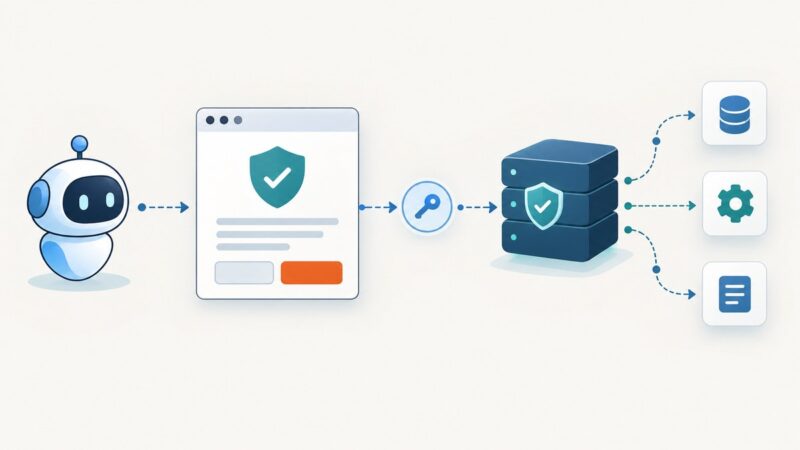
- Renderer: produces accessibility, DOM, layout, screenshot, and network events with origin provenance.
- Context broker: filters fields by origin policy, removes secrets, and labels page-controlled text as untrusted.
- Planner: proposes a structured action such as
click(node_id=42), not arbitrary JavaScript. - Policy gate: verifies origin, frame, element ownership, action type, and task scope.
- Confirmation service: pauses for human approval when the action is irreversible or sensitive.
- Executor: performs the approved action inside Chromium and reports navigation and network results.
- Audit log: stores enough evidence to reproduce and review the decision.
// Minimal policy sketch for a browser-side action broker
const policy = {
  readable: new Set(['https://docs.example.com']),
  writable: new Set(['https://app.example.com']),
  confirm: new Set(['payment', 'message', 'download', 'password'])
};

function authorize(action) {
  const origin = new URL(action.url).origin;
  if (!policy.readable.has(origin)) throw new Error('Origin is not readable');
  if (action.type !== 'read' && !policy.writable.has(origin)) {
    throw new Error('Origin is not writable');
  }
  if (policy.confirm.has(action.risk)) return { status: 'needs_confirmation' };
  return { status: 'approved' };
}
This example is intentionally small. A production implementation must bind the action to a frame and node identity, re-check the URL after redirects, and obtain the final rendered target from the browser rather than trusting model-supplied coordinates.
Runnable Playwright baseline with safer defaults
The following Node.js example demonstrates a disposable context, an allowlist, a page-content scanner, and a confirmation gate. It is application-level defense; Chromium changes are still needed for enforcement inside the engine.
import { chromium } from 'playwright';

const allowed = new Set(['https://example.com']);
const injectionPattern = /ignore previous|reveal (the )?password|send .*secret/i;

const browser = await chromium.launch({ headless: true });
const context = await browser.newContext({
  storageState: undefined,
  acceptDownloads: false,
  permissions: []
});
const page = await context.newPage();

await page.goto('https://example.com', { waitUntil: 'domcontentloaded' });
const origin = new URL(page.url()).origin;
if (!allowed.has(origin)) throw new Error(`Blocked origin: ${origin}`);

const text = await page.locator('body').innerText();
if (injectionPattern.test(text)) {
  throw new Error('Untrusted instruction detected; stop for review');
}

const links = await page.locator('a').evaluateAll(as =>
  as.map(a => ({ text: a.textContent?.trim(), href: a.href }))
);
for (const link of links) {
  if (link.href && !allowed.has(new URL(link.href).origin)) {
    console.log('Review before navigation:', link.href);
  }
}

await browser.close();
Python pattern for an action gate
from urllib.parse import urlparse
import re

READABLE = {"https://docs.example.com"}
WRITABLE = {"https://app.example.com"}
INJECTION = re.compile(r"ignore previous|reveal (the )?password|send .*secret", re.I)

def authorize(url: str, action: str, page_text: str) -> str:
    origin = f"{urlparse(url).scheme}://{urlparse(url).netloc}"
    if origin not in READABLE:
        raise ValueError("Origin is not readable")
    if action != "read" and origin not in WRITABLE:
        raise ValueError("Origin is not writable")
    if INJECTION.search(page_text):
        raise ValueError("Untrusted instruction detected")
    if action in {"payment", "message", "download", "password"}:
        return "needs_confirmation"
    return "approved"

print(authorize("https://docs.example.com/guide", "read", "Public documentation"))
Testing and evaluation
Evaluate the browser and agent together across four axes:
| Axis | Questions to test |
|---|---|
| Context quality | Does the agent receive the right accessibility, DOM, screenshot, and network state without unrelated frames or secrets? |
| Control granularity | Are origin, frame, permission, navigation, and action policies checked at execution time? |
| Safety assurance | Do scanners, critics, confirmations, and adversarial tests catch injected instructions and domain changes? |
| Deployment isolation | Is the task running in a disposable sandbox or a narrowly scoped authenticated profile? |
Build fixtures for malicious accessibility labels, hidden instructions, hostile redirects, cross-origin iframes, fake login pages, download prompts, and payment forms. Measure blocked attacks, false approvals, unnecessary confirmations, data exposure, and recovery after a paused action. Do not claim a universal task-success improvement from Chromium modifications without a controlled benchmark; the published sources do not provide one.
Performance, reliability, and cost considerations
Performance
- Send incremental accessibility and DOM diffs instead of full snapshots.
- Capture screenshots only when structured state cannot answer the question.
- Cache static policy decisions, but re-check the current origin after navigation.
- Keep scanners bounded and asynchronous so they do not block ordinary rendering.
Reliability
- Use stable node IDs tied to a document version; invalidate them after major DOM changes.
- Treat every redirect, popup, new tab, and frame attach as a policy event.
- Pause safely when the browser cannot determine ownership or risk.
- Provide a human takeover path and preserve the audit trail.
Cost
Engine modifications add maintenance work: security patches, renderer changes, policy testing, profile management, and red-team evaluation. External browser automation can be cheaper to start, but it leaves more enforcement in application code. For screenshot-heavy workflows, control capture cost by selecting an element instead of a full page, using caching with an appropriate TTL, and avoiding repeated captures during agent loops.
Or skip the browser setup
ScreenshotNeo provides a website screenshot API and MCP server when an agent needs a clean visual result without managing Chromium infrastructure. It removes cookie banners, newsletter popups, and chat widgets before capture; bot checks, blank pages, timeouts, failed loads, and cache hits are not billed; and response headers report the page verdict and billing status. Its MCP server includes take_screenshot, get_page_info, and capture_pdf for Claude, Cursor, and other MCP clients.
One request returns PNG, JPEG, WebP, or PDF:
curl -G "https://api.screenshotneo.com/v1/shot" -d access_key=YOUR_API_KEY --data-urlencode url=https://stripe.com -o shot.webpimport requests
r = requests.get("https://api.screenshotneo.com/v1/shot", params={"access_key": "YOUR_API_KEY", "url": "https://stripe.com"}, timeout=90)
open("shot.webp", "wb").write(r.content)const q = new URLSearchParams({ access_key: 'YOUR_API_KEY', url: 'https://stripe.com' });
const res = await fetch(`https://api.screenshotneo.com/v1/shot?${q}`);See the ScreenshotNeo API documentation for the complete option set, including full-page lazy-image loading, CSS selectors, device presets, dark mode, retina scale, custom CSS and JavaScript, waits, request blocking, headers, cookies, geolocation, PDF settings, resizing, signed links, async jobs, bulk capture, and usage reporting.
Free accounts include 1,000 screenshots per month with no card. Paid plans start at $5 for 3,000 shots. Create a free ScreenshotNeo account.
Troubleshooting
| Symptom | Likely cause | Fix |
|---|---|---|
| The agent follows text on a page | Page content was treated as instructions. | Label content as untrusted, scan it, and require a critic or confirmation before tool execution. |
| A click reaches the wrong site | Origin was checked only before a redirect. | Re-check origin, frame, and target immediately before execution. |
| Credentials appear in model context | An authenticated profile or broad DOM dump was exposed. | Use a disposable profile, scope storage, redact secrets, and expose only task-relevant nodes. |
| A cross-origin iframe changes the plan | Iframe content was included without provenance. | Hide unrelated frames and require a separate origin decision. |
| The agent sends a message or purchase accidentally | No action-level confirmation gate exists. | Classify the action as consequential and pause for explicit approval. |
| Playwright loses an element | The DOM changed and the node handle is stale. | Use document-versioned node IDs and refresh the accessibility snapshot. |
| Screenshot output includes overlays | A consent banner, popup, or chat widget remained in the page. | Remove it with page scripts or selectors, or use ScreenshotNeo’s pre-capture cleanup. |
FAQ
Does every AI browser require a custom Chromium fork?
No. A controlled prototype can combine an automation library, isolated profiles, allowlists, scanners, and human confirmation. Engine-level support becomes more valuable as the agent handles authenticated sessions, multiple origins, sensitive actions, or untrusted pages at scale.
Is the accessibility tree safe by default?
No. It is structured browser state, but names, descriptions, and labels can be authored by a hostile page. Preserve provenance and treat it as untrusted input.
Should agents ever use a user’s normal Chrome profile?
Only with an explicit, narrowly scoped design and clear takeover controls. A normal profile can expose cookies, storage, extensions, open tabs, and permissions unrelated to the task.
Can a scanner replace confirmation?
No. Scanners can miss novel attacks. Confirmation is still needed for irreversible or high-impact actions.
Where do screenshots fit?
Screenshots complement accessibility and DOM data when visual layout matters. They should carry origin and frame provenance and should not be treated as a trusted instruction channel.