Why MCP Servers Are Needed for AI Tool Integrations
MCP gives AI applications a shared way to discover and use tools, data, and prompts without rebuilding every integration from scratch.
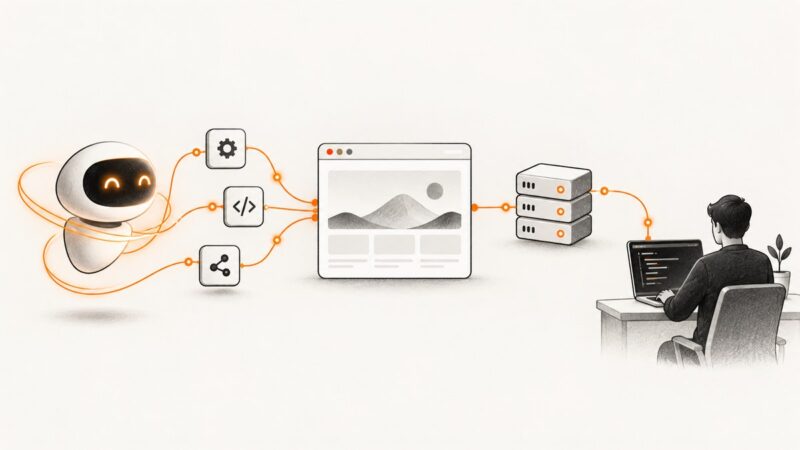
Short answer: MCP servers are needed because they give AI applications a shared protocol for discovering and calling external capabilities. Instead of writing a separate connector for every AI app and every service, a host can create an MCP client for each server, discover the server’s tools, resources, and prompts, and let the model use the capabilities it is authorized to access.
MCP does not make every integration automatic. Each server still contains service-specific logic, and compatibility depends on protocol versions, client support, authentication, permissions, and the way a host implements tool calling. Its value is a reusable integration boundary.
What MCP is
The Model Context Protocol is an open standard for two-way connections between data sources and AI-powered tools. Anthropic introduced it to address a recurring problem: AI applications are isolated from data in silos, and every new data source traditionally requires another custom implementation. See the original Anthropic announcement.
An MCP server is an integration endpoint. It advertises capabilities in a standard format and implements the operations behind those capabilities. An AI application, called the host, connects to one or more servers through MCP clients.
The MCP architecture
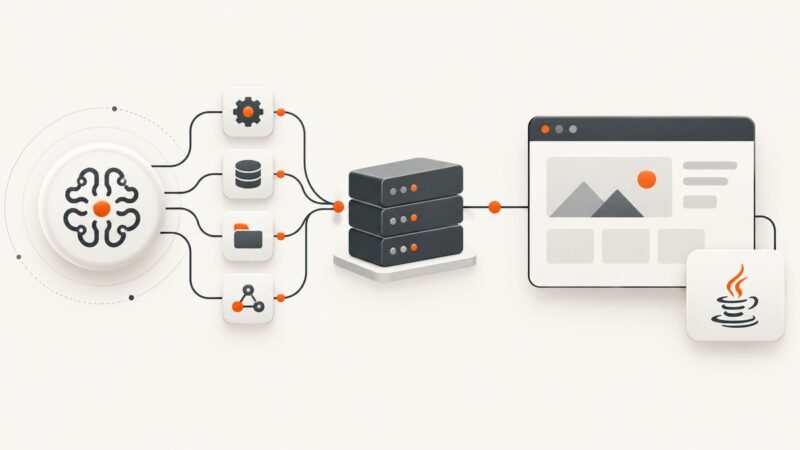
The architecture has three participants:
| Participant | What it does |
|---|---|
| Host | The AI application used by the person. It manages models, conversations, permissions, and user interaction. |
| Client | A protocol client created by the host for a particular server. Each client maintains a dedicated connection to its corresponding server. |
| Server | The integration that exposes tools, resources, and prompts and performs the service-specific work. |
A host can connect to multiple servers. For example, one client might connect to a database server, another to a ticketing system, and another to a browser or screenshot service. The current architecture documentation describes this host-client-server relationship in detail at modelcontextprotocol.io.
Tools, resources, and prompts
| Capability | Purpose | Example |
|---|---|---|
| Tool | A callable operation that can perform work or retrieve a result. | Query orders, create a ticket, or capture a screenshot. |
| Resource | Data or content that a host can read. | A database schema, document, or configuration record. |
| Prompt | A reusable template for using a server’s capabilities. | An example workflow for investigating a failed payment. |
MCP standardizes how these capabilities are described and invoked. It does not define the business logic inside a server. A database server still needs database drivers and query rules; a screenshot server still needs a browser or capture service.
How an MCP tool call works
- The host creates an MCP client connection to a server.
- The client discovers the server’s available capabilities and their structured input schemas.
- The model receives the relevant capability descriptions as context.
- The model chooses a tool and supplies arguments that match its schema.
- The server validates the request, checks authorization, and performs the operation.
- The result returns to the host, which gives it to the model for the next response or asks the user what to do next.
The protocol permits different user interaction patterns. A host may ask for confirmation, execute automatically under a policy, or reject a call. Do not assume that every MCP client lets a model execute every action without user involvement.
Why a shared server boundary helps
It reduces repeated connector work
Without a shared protocol, each AI application needs a bespoke adapter for each service. A team might implement the same authentication, argument validation, error handling, and result formatting several times for different hosts. An MCP server lets the service owner implement that boundary once and support compatible hosts.
It makes capabilities discoverable
Hard-coded integrations often require an application release before a new operation is available. MCP servers advertise their tools, resources, and prompts so a client can discover what is available and inspect the input schema. Tool lists can still vary by authorization scope, account, or server configuration.
It gives hosts a consistent interaction pattern
Hosts can use a familiar discovery and invocation flow across many services. This does not remove service-specific behavior, but it gives host developers one protocol model for listing capabilities, sending structured arguments, and receiving results.
It supports multiple deployment choices
A server can run locally beside a desktop application or remotely as a hosted endpoint. The right choice depends on data sensitivity, network access, scaling, supported transports, and the clients you need to support.
When an MCP server is the right abstraction
- Several AI hosts need the same capability.
- The capability has a stable operation boundary and structured inputs.
- You need centralized authentication, authorization, auditing, or rate limits.
- The service owner wants to add tools without modifying every host.
- The integration combines tools with supporting schema or documentation resources.
A direct SDK call may be simpler when only one application needs the capability, latency is extremely sensitive, or the operation is not useful as a model-facing action.
Security, authorization, and human control
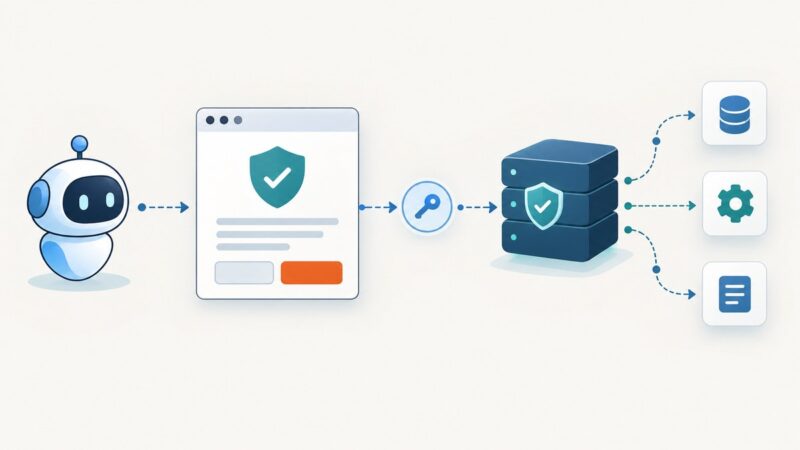
MCP is a transport and capability standard, not a safety guarantee. A server can expose a dangerous operation, return incorrect data, or be misconfigured. Apply least-privilege scopes, validate every argument on the server, protect credentials, and log consequential actions.
The MCP tools specification recommends that a human remain in the loop with the ability to deny tool invocations. Hosts should show which tools are exposed, indicate when a tool is called, and request confirmation for actions such as sending messages, changing records, deleting data, or spending money. Read the tools specification for the current behavior and safety guidance.
For remote production servers, OpenAI’s platform guidance recommends stable HTTPS endpoints using Streamable HTTP and authorization based on the MCP specification. That is platform guidance, so verify the requirements of your target host and deployment.
Transport and version compatibility
Before deploying, check:
- The MCP protocol version supported by both host and server.
- The transport supported by both sides, especially for remote connections.
- Authentication flow and required authorization scopes.
- Whether the host supports the capability types you plan to expose.
- How the host handles timeouts, retries, cancellation, and user confirmation.
MCP evolves. The July 28, 2026 release changed session and routing assumptions, introduced stateless protocol behavior and per-request metadata, and deprecated some earlier features, including legacy HTTP+SSE. Check the current MCP release and migration documentation before copying older examples; do not assume an example written for an earlier version still applies.
Designing an MCP server
1. Define the smallest useful tools
Give each tool one clear job and a strict input schema. Prefer explicit fields and enumerations over a free-form command string. Separate read operations from mutations so a host can apply different confirmation policies.
2. Put validation on the server
Validate types, ranges, identifiers, URLs, and authorization on every request. Never rely on the model or host to enforce business rules.
3. Return useful, bounded results
Return structured data that a model can interpret. Limit result size, paginate large collections, and include stable identifiers and error codes. Avoid returning secrets or unnecessary personal data.
4. Use resources and prompts deliberately
Expose a resource when the host needs reference content such as a schema. Expose a prompt when a repeatable workflow or set of examples helps users invoke the tools consistently. Keep prompts versioned and review them like code.
5. Plan for failure
Make timeouts explicit, return actionable errors, and make mutating operations idempotent where possible. If an upstream service is unavailable, say so clearly instead of returning an empty success response.
Testing an integration
- List capabilities with the host and verify that only authorized tools appear.
- Call read-only tools with valid, missing, malformed, and unauthorized arguments.
- Test confirmation behavior for every mutating tool.
- Simulate upstream timeouts, rate limits, partial results, and invalid responses.
- Check that logs omit tokens, cookies, and sensitive payloads.
- Test the exact protocol and transport versions used in production.
Using MCP for visual context with ScreenshotNeo
ScreenshotNeo provides a website screenshot API and MCP server for developers. Its MCP tools include take_screenshot, get_page_info, and capture_pdf, so Claude, Cursor, and other MCP clients can request visual context through the same tool-discovery pattern described above.
For an AI agent, the server can expose a screenshot operation while the host handles discovery, argument collection, and any required confirmation. ScreenshotNeo also removes cookie and consent banners, newsletter popups, and chat widgets before capture. Bot checks, blank pages, timeouts, failed loads, and cache hits are not billed, and responses identify the page verdict and billing result with X-Page-Verdict and X-Billed headers.
Or skip the browser setup
If you only need an image or PDF in an application, call the ScreenshotNeo API directly. The complete option list and parameter names are in the ScreenshotNeo API documentation.
cURL
curl -G "https://api.screenshotneo.com/v1/shot" -d access_key=YOUR_API_KEY --data-urlencode url=https://stripe.com -o shot.webpPython
import requests

r = requests.get(
    "https://api.screenshotneo.com/v1/shot",
    params={"access_key": "YOUR_API_KEY", "url": "https://stripe.com"},
    timeout=90,
)
r.raise_for_status()
open("shot.webp", "wb").write(r.content)
Node.js
const q = new URLSearchParams({ access_key: 'YOUR_API_KEY', url: 'https://stripe.com' });
const res = await fetch(`https://api.screenshotneo.com/v1/shot?${q}`);
if (!res.ok) throw new Error(`Screenshot failed: ${res.status}`);
const buffer = Buffer.from(await res.arrayBuffer());
require('fs').writeFileSync('shot.webp', buffer);
ScreenshotNeo supports full-page and element captures, dark mode, device presets, arbitrary viewports, retina scale, PDF options, custom CSS and JavaScript, clicks, waits, request blocking, headers, cookies, user agents, authorization, timezone, geolocation, transparent backgrounds, resizing, caching, signed links, asynchronous jobs, webhooks, bulk capture, and a usage API. Every feature is included on every plan. The free plan includes 1,000 shots per month without a card; paid plans start at $5 for 3,000 shots.
Create a free ScreenshotNeo account to get 1,000 screenshots each month with no card required.
Troubleshooting MCP integrations
| Symptom | Likely cause | Fix |
|---|---|---|
| No tools appear | The server failed during initialization, the account lacks scope, or the host does not support the advertised capability. | Inspect connection logs, verify authorization, and confirm protocol and capability support. |
| Tool arguments are rejected | The model sent a value outside the schema or the server validation is stricter than the description. | Make the schema precise, return field-level errors, and validate again on the server. |
| Calls hang | Upstream timeout, unreachable endpoint, or a transport mismatch. | Set bounded timeouts, test the endpoint independently, and use the transport required by the target host. |
| Users see unauthorized data | Authorization was checked only in the host or at connection time. | Enforce authorization for every tool and resource request on the server. |
| Mutations happen unexpectedly | The host did not require confirmation or the tool description did not make side effects clear. | Separate read and write tools, label side effects, and require human confirmation. |
| Older examples fail | The MCP version or transport changed. | Read current migration notes and update initialization, routing, and transport code for the target clients. |
Performance, reliability, and cost
- Latency: The request path includes model planning, client-server communication, server work, and any upstream API. Keep tools narrow and avoid unnecessary round trips.
- Reliability: Use timeouts, cancellation, retries only for safe operations, idempotency keys for mutations, and clear partial-failure responses.
- Scaling: Remote servers need connection management, concurrency limits, rate-limit handling, observability, and a plan for capability-list caching where supported.
- Cost: MCP itself does not set the price of an underlying service. Track model tokens, server infrastructure, upstream API charges, and user-facing operations separately.
- Screenshot capture: ScreenshotNeo bills only clean shots. Failed loads, bot checks, blank pages, timeouts, and cache hits are not billed, and the response headers report the verdict and billing state.
FAQ
Is MCP an API gateway?
It can serve as a model-facing integration boundary, but it does not replace every API gateway concern. Authentication, rate limits, routing, monitoring, and business rules still need implementation.
Does MCP make every AI app compatible?
No. Compatibility depends on the host, client, server, protocol version, transport, capabilities, and authorization implementation.
Should every function become a tool?
No. Expose operations that are useful, understandable, and safe for a model to call. Keep internal helpers private.
Can an MCP server be local?
Yes. Local deployment can keep sensitive data near the host. Remote deployment can centralize operations for multiple users and applications.
Why use ScreenshotNeo’s MCP server instead of writing browser automation?
It provides screenshot, page-information, and PDF tools through MCP while handling capture details such as consent banners, popups, chat widgets, waits, devices, and output formats. Direct API calls are available when an MCP connection is unnecessary.
Key takeaways
- MCP gives AI hosts a shared way to discover and call external capabilities.
- Servers expose tools, resources, and prompts; service-specific logic remains inside each server.
- The main benefit is reducing repeated bespoke connector work, not eliminating implementation or authorization work.
- Human confirmation, least-privilege authorization, validation, and version checks are essential for production use.
- Use the current protocol and migration documentation because transport and session details change over time.