Why Do Website Screenshots Differ Between Monitoring Runs?
Website screenshots vary when page state, capture timing, or rendering conditions change. Learn how to isolate the cause and make visual monitoring more reliable.
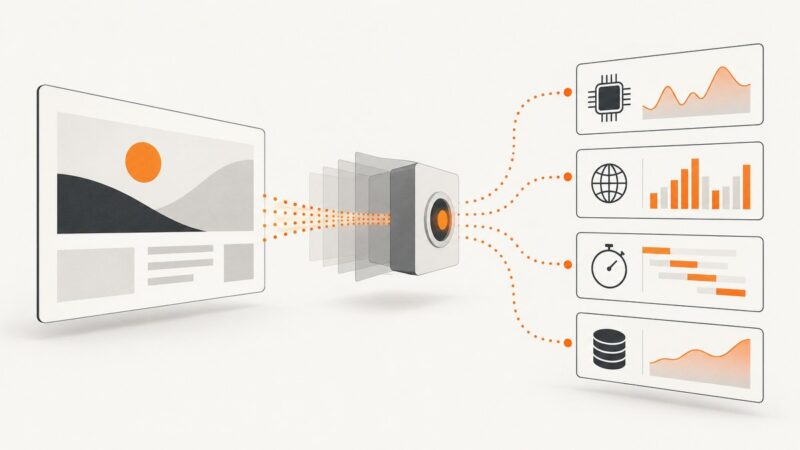
A website screenshot records one rendered page state at one moment, in one rendering environment. Screenshots can differ between monitoring runs because the page’s content or state changed, capture happened at a different point in loading or animation, or the browser and operating environment rendered the page differently. A difference is a signal to investigate; it does not prove that a code change caused a regression.
To reduce noise, make the page data, capture timing, browser, operating system, and viewport consistent. Then inspect the specific changed region before masking it or updating a baseline.
1. What makes screenshots differ?
| Cause | What can change | First check |
|---|---|---|
| Live page state or data | API results, ads, timestamps, widgets, user state, or route content | Confirm the route and state; use repeatable fixtures where practical. |
| Capture timing | A loading state, late image or font, animation frame, or asynchronous re-render | Wait for an assertion that confirms the content under test is present. |
| Rendering environment | Font metrics, antialiasing, layout, and browser rendering | Compare runs with the same browser version, OS or CI image, settings, and headless mode. |
| Viewport and device settings | Responsive layout, wrapping, and visible content | Set fixed viewport dimensions and keep device scale consistent. |
Playwright notes that rendering can vary with host OS, browser version, settings, hardware, power source, headless mode, and other factors. Fonts can also differ or fall back, changing text dimensions and layout. Treat intentionally different browsers, platforms, or viewport targets as separate comparisons instead of expecting identical pixels across them. See Playwright’s visual comparisons guidance.
2. Diagnose a flaky screenshot in a useful order
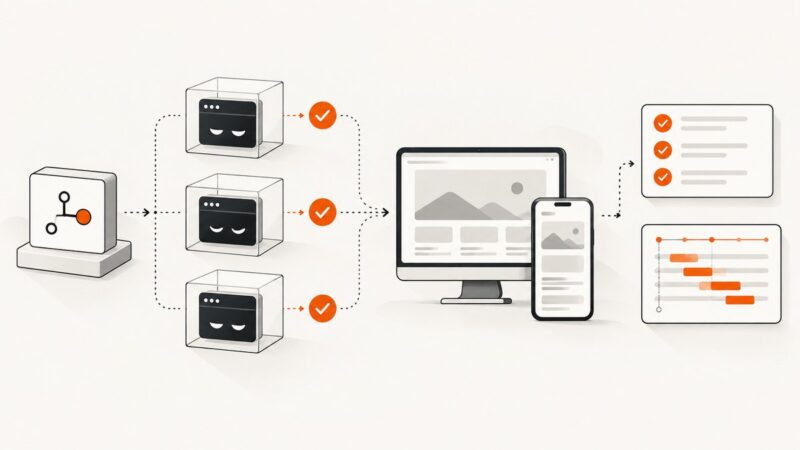
- Verify the page state. Check that the intended route, user state, and key content are present. If an API response varies, stub it with a repeatable fixture when appropriate.
- Verify capture timing. Wait for a condition that proves the page has reached the state under test. Check for late data, fonts, images, transitions, animations, and asynchronous re-rendering.
- Compare the environments. Record browser and version, operating system or CI image, headless mode, settings, viewport, and device scale. Keep baseline creation and later runs aligned, or maintain target-specific baselines for deliberate differences.
- Inspect the changed region. Decide whether a volatile value or widget is relevant to the requirement. Stabilize it if possible; otherwise mask only the smallest uncontrollable area.
- Review before accepting a new baseline. Decide whether the image shows an intended change, a defect, or rendering noise. Do not update snapshots reflexively.
Cypress advises taking a snapshot only after confirming that the page is done changing and generating and comparing screenshots in the same environment with a fixed viewport. Its visual testing guide also recommends masking a small region rather than raising the failure threshold for an entire page. A broad threshold can hide meaningful layout, font, or color regressions.
3. Make browser screenshot monitoring repeatable
The following Playwright example uses the page assertion as the readiness condition, sets a fixed viewport, and compares a named screenshot. Install Playwright and its Chromium browser first using the official installation instructions; the first run creates a baseline, and later runs compare against it.
import { test, expect } from '@playwright/test';

test('dashboard visual state is stable', async ({ page }) => {
  await page.setViewportSize({ width: 1280, height: 800 });
  await page.goto('http://127.0.0.1:3000/dashboard');

  // Wait for the actual content under test, not an arbitrary short delay.
  await expect(page.getByRole('heading', { name: 'Dashboard' })).toBeVisible();

  await expect(page).toHaveScreenshot('dashboard.png', {
    fullPage: true,
    animations: 'disabled'
  });
});
Run it with your project’s Playwright test command, commonly npx playwright test. Keep the same browser project and environment for baseline generation and comparison. The animations option can make animated content less variable; it does not make changing data deterministic. Replace the example URL and readiness assertion with the route and content that define your expected state.
Stabilize only what is unstable
- Use fixed API fixtures or controlled test data when live values are irrelevant to the visual requirement.
- Wait on a visible, meaningful page condition rather than assuming a fixed sleep covers all loading.
- Disable or complete animations for captures where animation is not part of what you intend to test.
- Use a narrow mask only for content that cannot reasonably be controlled and is outside the requirement being tested.
- Keep separate snapshots for distinct browser, platform, or responsive targets when those differences are intentional.
4. Why does CI fail when a local screenshot passes?
CI may use a different operating system image, browser build, font set, headless configuration, or hardware path than a developer’s machine. Any of these can change rendering. CI can also reach a different page state or capture at a different time if data or loading is variable.
Compare the recorded run conditions first. Use the same browser version and viewport as the baseline environment, ensure required fonts and browser dependencies are available, and make test data repeatable. If the purpose is to compare across environments, keep a baseline for each intended target rather than mixing their results.
5. Screenshot monitoring errors and fixes
| Symptom | Likely cause | Fix |
|---|---|---|
| Text wraps differently | Different font loaded or a font fallback; viewport differs | Confirm the intended font has loaded, use the same environment, and fix viewport dimensions. |
| Only a chart, ad, timestamp, or widget changes | Live or randomized content | Stub the data, stabilize the component, or mask only the narrow irrelevant region. |
| Screenshot contains a spinner or partial page | Capture happened before the relevant content was ready | Wait for an assertion on the finished content or a reliable page-specific readiness condition. |
| Differences appear only in CI | OS, browser, fonts, headless mode, or viewport differs | Align and record the environment, or use target-specific snapshots. |
| Large page diffs after increasing tolerance | A broad threshold is suppressing meaningful differences | Restore a useful threshold and isolate the unstable component or region. |
| Baseline changes every run | Uncontrolled page state, timing, or environment | Follow the diagnostic order above; update the baseline only after identifying the source. |
6. Performance, reliability, and review tradeoffs
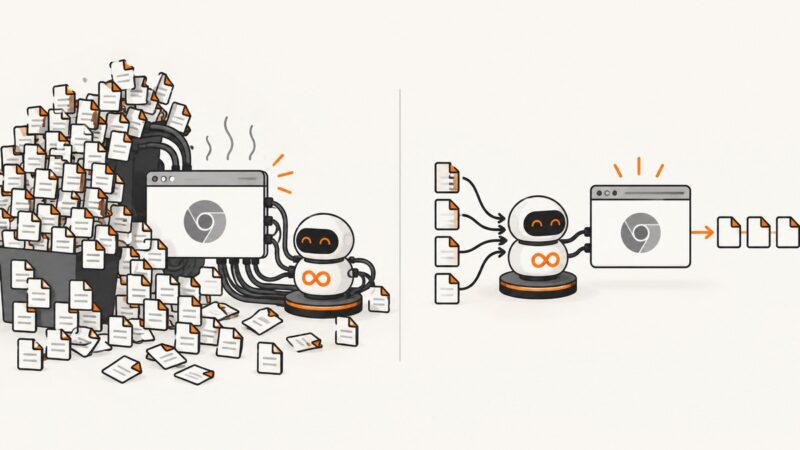
Repeatedly capturing a page before it is ready wastes CI time and produces noisy results. A meaningful readiness assertion makes the test wait for the condition it cares about. Avoid replacing it with a large fixed delay: a delay can be too short on a slow run and unnecessarily long on a fast one.
Deterministic fixtures improve repeatability, but they only verify the states represented by those fixtures. Live monitoring can reveal real-world content changes, but volatile data makes pixel-for-pixel comparison less stable. Choose based on whether the goal is to detect application rendering regressions or to observe the current live page, and preserve the relevant signal with narrow masking.
For teams that need shared visual review across browsers or responsive widths, Cypress documents Percy as one hosted visual testing workflow that captures DOM snapshots and renders them across targets. Check the current product details before choosing a service; a hosted workflow does not remove the need to diagnose data and state changes.
7. Or skip the browser setup
For a one-off or scheduled page capture, ScreenshotNeo returns a screenshot from one GET request. See the ScreenshotNeo API documentation for request options.
curl -G "https://api.screenshotneo.com/v1/shot" -d access_key=YOUR_API_KEY --data-urlencode url=https://stripe.com -o shot.webpimport requests
r = requests.get("https://api.screenshotneo.com/v1/shot", params={"access_key": "YOUR_API_KEY", "url": "https://stripe.com"}, timeout=90)
open("shot.webp", "wb").write(r.content)const q = new URLSearchParams({ access_key: 'YOUR_API_KEY', url: 'https://stripe.com' });
const res = await fetch(`https://api.screenshotneo.com/v1/shot?${q}`);Cookie banners, popups, and chat widgets are removed before the shot. Bot checks, blank pages, failed loads, and cache hits are never billed; response headers report the page verdict and billing status. The MCP server lets AI agents use screenshot, page information, and PDF capture tools. The free plan includes 1,000 screenshots a month with no card; paid plans start at $5 for 3,000 screenshots. These captures are useful for monitoring page appearance, while controlled browser tests remain appropriate when you need repeatable fixtures and assertion-driven baselines.
Sign up for 1,000 free screenshots a month, with no card required.
8. FAQ
Does a screenshot difference prove that my code changed?
No. Page data, capture timing, browser, fonts, operating system, and viewport can all change the rendered image.
Should I mask every dynamic area?
No. Mask only a small region that is both uncontrollable and irrelevant to the requirement; broad masking can hide regressions.
Should I keep one baseline for every browser?
Use a baseline for each deliberate comparison target when browser or platform rendering is expected to differ.
Will disabling animation make screenshots identical?
It can remove one source of timing variation, but it does not stabilize live data, fonts, environment, or other asynchronous page changes.