Why Website Screenshots Are Delayed and How to Fix Them
Find the real cause of slow screenshots, replace unreliable waits, and make Puppeteer, Playwright, and serverless capture predictable.
Most delayed screenshots are waiting for the wrong condition. A browser can finish navigation while a chart, font, image, or client-rendered component is still changing. Conversely, a page can keep analytics, polling, streaming, advertising, or tracking requests open long after the pixels you need are ready.
Measure navigation, readiness, screenshot encoding, and upload separately. Then wait for the earliest condition that proves the target visual state is complete: a selector, text assertion, API response, or application-ready marker. Use networkidle only when the page has genuinely finite network activity.
1. What controls screenshot time?
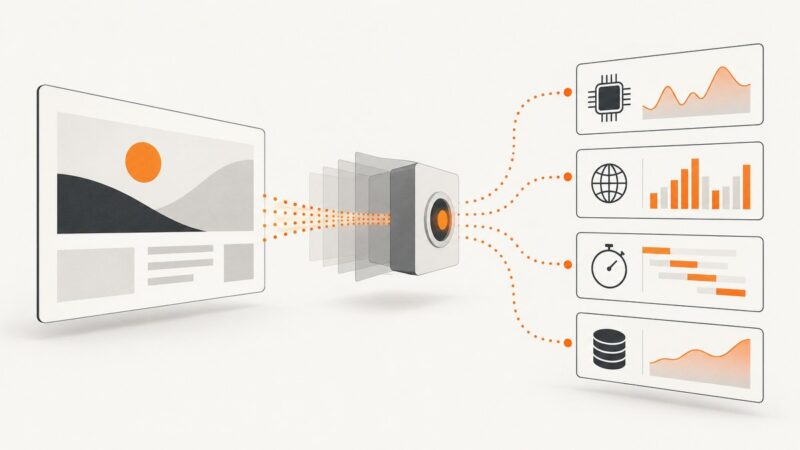
A screenshot job usually has four spans:
- Browser startup: launching Chromium or Firefox, especially after a cold start.
- Navigation: DNS, TLS, redirects, server response, HTML parsing, and initial resource loading.
- Readiness: the condition your code waits for after navigation.
- Capture and delivery: rasterizing the page, encoding PNG/JPEG/WebP or PDF, and uploading or returning the bytes.
Log each span instead of reporting one total duration. A slow navigation needs a different fix from a readiness wait that never resolves or a browser process starved of CPU.
2. Choose a readiness condition that matches the screenshot
| Condition | Use it when | Risk |
|---|---|---|
commit |
You need an early shell or want to inspect the first response. | Most visual assets and client code are not ready. |
domcontentloaded |
The HTML structure is enough for the capture. | Images, fonts, and JavaScript-rendered content may still change. |
load |
Load-complete assets matter and the page has a conventional lifecycle. | It still does not prove that a chart or application state finished rendering. |
networkidle |
Requests are finite and you have confirmed the page becomes quiet. | Polling, analytics, ads, streams, or third-party widgets can delay it indefinitely. |
| Explicit locator/assertion | A hero, chart, table, status label, or framework marker proves readiness. | The application must expose a reliable signal. |
Playwright documents these navigation states and marks networkidle as discouraged as a general testing signal: it waits for no network connections for at least 500 ms, which is not the same as visual readiness. See the Playwright Page API. Puppeteer’s screenshot guide demonstrates navigation followed by capture and supports page and element screenshots in its official screenshot guide.
3. Puppeteer: wait for the state you need
Basic page capture with an explicit selector
const puppeteer = require('puppeteer');

(async () => {
  const browser = await puppeteer.launch({headless: true});
  try {
    const page = await browser.newPage();
    await page.setViewport({width: 1440, height: 900, deviceScaleFactor: 1});

    const started = Date.now();
    await page.goto('https://example.com/dashboard', {
      waitUntil: 'domcontentloaded',
      timeout: 30000
    });
    console.log('navigation_ms', Date.now() - started);

    await page.waitForSelector('[data-screenshot-ready="true"]', {
      visible: true,
      timeout: 15000
    });

    await page.screenshot({path: 'dashboard.png', fullPage: true});
  } finally {
    await browser.close();
  }
})();
Have the application set data-screenshot-ready="true" only after data, fonts, and visual transitions are complete. If you cannot change the application, wait for a stable, visible element or text that represents the finished state.
Use a bounded fallback, not an infinite wait
await page.goto(url, {waitUntil: 'load', timeout: 30000});
try {
  await page.waitForSelector('.report-chart', {visible: true, timeout: 10000});
} catch (error) {
  await page.screenshot({path: 'debug-timeout.png', fullPage: true});
  throw new Error(`Report was not ready: ${error.message}`);
}
A timeout should produce a diagnostic artifact and identify which condition failed. A fixed delay can be useful for a known animation, but it should be a last small adjustment after an explicit signal.
Capture one element instead of a whole page
const chart = await page.waitForSelector('#revenue-chart', {visible: true});
await chart.screenshot({path: 'revenue-chart.png'});
Element capture avoids waiting for unrelated page regions and reduces encoding and upload work. It is also less sensitive to long pages and sticky navigation.
4. Playwright: navigation plus an assertion
import { chromium } from 'playwright';

const browser = await chromium.launch({headless: true});
try {
  const page = await browser.newPage({viewport: {width: 1440, height: 900}});
  await page.goto('https://example.com/dashboard', {
    waitUntil: 'domcontentloaded',
    timeout: 30_000
  });

  await page.locator('[data-screenshot-ready="true"]').waitFor({
    state: 'visible',
    timeout: 15_000
  });
  await page.screenshot({path: 'dashboard.png', fullPage: true});
} finally {
  await browser.close();
}
For a text or application assertion, use a locator that describes the state rather than a generic sleep:
await expect(page.getByRole('status')).toHaveText('Report complete', {
  timeout: 15_000
});
When you need an early shell, use commit or domcontentloaded. Use load when load-complete assets matter. Reserve networkidle for pages you have observed to become quiet.
5. Why network idle waits forever
Network idle means the browser sees no active connections for the documented quiet interval. It does not understand whether your chart is painted, whether a web font has swapped, or whether an API response contains the final data. Long-lived requests make the condition especially fragile:
- Analytics and telemetry beacons.
- Polling requests for notifications or dashboards.
- WebSocket, Server-Sent Events, and streaming responses.
- Advertising, consent, chat, and personalization widgets.
- Service-worker updates and third-party embeds.
This is an engineering consequence of what network-idle measures. Confirm it with request logs and a timeout budget. If the required visual state is present, capture it without waiting for unrelated traffic.
6. Make readiness observable
Add a small, deterministic signal to the page:
// Set this after data, fonts, and visual transitions are complete.
document.documentElement.dataset.screenshotReady = 'true';
Other useful signals include:
- A response from the API that supplies the visible data.
- A chart library callback after the final render.
- A framework-specific loaded marker.
- A visible heading, row count, or status text.
- A short animation completion hook.
Record which signal completed, its duration, and the URL. That turns an intermittent delay into a measurable failure category.
7. When production is slower than local
Compare browser version, OS image, headless mode, viewport, device scale factor, hardware, power conditions, cold starts, and concurrency. Playwright lists these environment variables as sources of rendering variation; use the same environment when comparing baselines. See the Playwright visual comparison guidance.
On Cloud Run, Puppeteer’s troubleshooting documentation describes a specific one-to-five-minute launch symptom: if the HTTP response is written before a background Puppeteer launch, CPU can be disabled and the browser waits for CPU allocation. Launch the browser before responding, or enable always-on CPU for that workload. See Puppeteer’s troubleshooting guide.
// Keep browser work before sending the response.
const browser = await puppeteer.launch({headless: true});
const page = await browser.newPage();
await page.goto(url, {waitUntil: 'domcontentloaded'});
const image = await page.screenshot({type: 'png'});
res.set('Content-Type', 'image/png').send(image);
8. Performance checklist
- Reuse a browser process when your platform permits it; create and close pages per job.
- Set an explicit navigation timeout and a separate readiness timeout.
- Block resources you do not need, such as ads, trackers, video, or unused fonts.
- Capture an element when a full-page image is unnecessary.
- Choose JPEG or WebP when smaller output matters more than lossless pixels.
- Keep viewport and device scale factor constant for cacheable, comparable output.
- Measure encoding and upload separately from browser work.
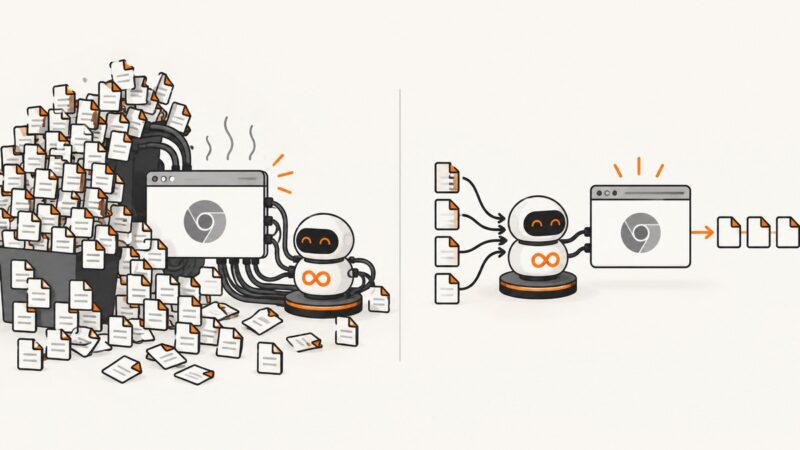
- Limit concurrency to the CPU and memory available; too many Chromium pages cause contention.
- Cache deterministic pages with an explicit TTL when freshness allows it.
Do not optimize by deleting the readiness check. A fast screenshot of an incomplete page is a correctness failure.
9. Reliability and failure handling
Classify each result as navigation failure, readiness timeout, browser failure, encoding failure, or upload failure. Save the URL, browser version, timing spans, completed readiness condition, and a debug screenshot when policy permits.
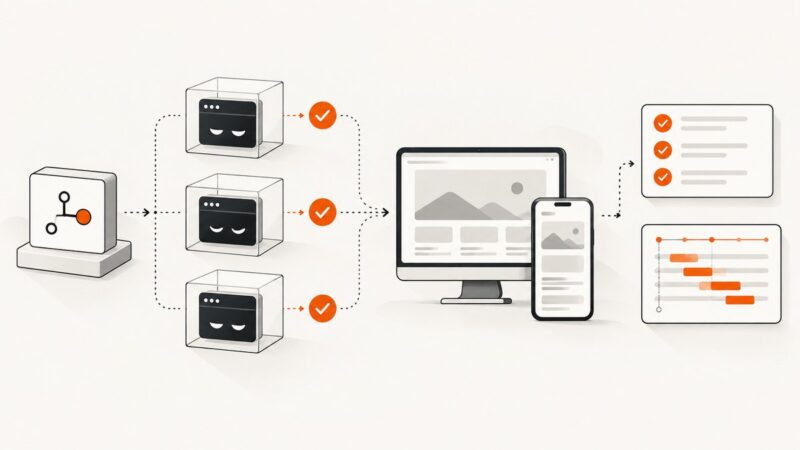
- Retry transient DNS, connection, and browser-start failures with bounded exponential backoff.
- Do not blindly retry a deterministic selector timeout; inspect whether the page changed or the selector is wrong.
- Use idempotency keys or a content hash when a retry could create duplicate records.
- Pin the browser and OS image for visual regression work.
- Set a total job deadline that includes startup, navigation, readiness, capture, and delivery.
10. Common errors and fixes
| Symptom | Likely cause | Fix |
|---|---|---|
TimeoutError: Navigation timeout |
Slow origin, redirect loop, or an overly short limit. | Inspect redirects and request timing; raise the limit only after measuring. |
Timeout waiting for networkidle |
Polling, streaming, analytics, ads, or chat keeps connections open. | Use a selector or assertion; block irrelevant requests; keep a hard deadline. |
| Screenshot is blank | Capture ran before client rendering, or the page hit a bot check. | Wait for the rendered marker; inspect the final URL and response body. |
| Chart is missing | Canvas or data request was not complete. | Wait for the chart’s completion marker or data response, then capture the element. |
| Fonts differ between runs | Font loading or browser/OS differences. | Use a stable environment and wait for the intended font state. |
| Local is fast, Cloud Run is very slow | Browser launch occurs after the response and CPU is disabled. | Launch before responding or configure always-on CPU. |
| Out-of-memory or random crashes | Too many concurrent pages, huge full-page captures, or media-heavy pages. | Reduce concurrency, block media, capture an element, and raise memory where appropriate. |
| Intermittent content | Animations, rotating ads, time zones, or live data. | Freeze data and time where possible; disable animation; set timezone and locale. |
11. Puppeteer or Playwright?
Both provide navigation controls, screenshot APIs, and element capture. Compare them on the readiness assertions your application needs, browser and version pinning, serverless CPU behavior, full-page versus element capture, and timing diagnostics. The cited documentation does not establish a universal winner; the best choice is the one that exposes a reliable signal for your page and fits your deployment.
12. Or skip the browser setup
ScreenshotNeo provides a website screenshot API and MCP server. Its capture flow accepts cookie and consent banners like a visitor, then removes more than 60 known consent platforms, newsletter popups, and chat widgets before the shot; each step can be disabled. Bot checks, blank pages, timeouts, failed loads, and cache hits are not billed, and response headers report the page verdict and billing status.
See the ScreenshotNeo API documentation for all options, including full-page capture with lazy images, CSS element capture, dark mode, device presets, retina scale, custom CSS and JavaScript, clicks, selector waits, delays, network-idle waits, request blocking, headers, cookies, user agents, authorization, timezone, geolocation, transparent backgrounds, resizing, TTL caching, signed image links, asynchronous webhooks, bulk capture, usage data, and PDF output.
cURL
curl -G "https://api.screenshotneo.com/v1/shot" \
  -d access_key=YOUR_API_KEY \
  --data-urlencode url=https://stripe.com \
  -o shot.webp
Python
import requests

r = requests.get(
    "https://api.screenshotneo.com/v1/shot",
    params={"access_key": "YOUR_API_KEY", "url": "https://stripe.com"},
    timeout=90,
)
r.raise_for_status()
open("shot.webp", "wb").write(r.content)
Node.js
const q = new URLSearchParams({
  access_key: 'YOUR_API_KEY',
  url: 'https://stripe.com'
});
const res = await fetch(`https://api.screenshotneo.com/v1/shot?${q}`);
if (!res.ok) throw new Error(`Screenshot failed: ${res.status}`);
const fs = await import('node:fs/promises');
await fs.writeFile('shot.webp', Buffer.from(await res.arrayBuffer()));
ScreenshotNeo also has an MCP server with take_screenshot, get_page_info, and capture_pdf for Claude, Cursor, and other MCP clients. The Free plan includes 1,000 shots per month with no card; paid plans start at $5 for 3,000 shots, and every feature is available on every plan. Create a free ScreenshotNeo account.
13. Cost notes
For a self-hosted browser, include Chromium memory, CPU, cold starts, concurrency limits, storage, and engineering time in the cost. Reduce waste by selecting the smallest correct capture, blocking irrelevant resources, and caching stable pages.
With ScreenshotNeo, only clean shots are billed. Cache hits and failed or unusable page results are not billed, and the response headers identify the verdict and billing state. Choose a TTL that matches your freshness requirement instead of repeatedly recapturing identical pages.
FAQ
Should I always use networkidle?
No. Use it only after confirming the page becomes quiet and that quiet means visual readiness. Prefer a selector or assertion tied to the content you need.
Is a longer timeout a fix?
Only when the page is legitimately slow and the timeout is below the measured duration. A longer limit does not fix a selector that never appears or a network that never becomes idle.
Why does a screenshot differ between machines?
Browser version, OS, viewport, device scale factor, headless mode, hardware, power conditions, fonts, and live data can all change rendering. Pin the environment for comparisons.
When should I capture an element?
Capture an element when the deliverable is a chart, card, report region, or other component. It reduces unrelated waiting and output size.
Can an API replace Puppeteer for every page?
Use your own browser when you need custom application control or local debugging. A hosted API is useful when you want managed browser setup, cleanup of common consent and overlay elements, and a simple HTTP call.